5. Anupubbena medhàvã
thokathokam khaue khaue
Kammàro rajatass' eva
niddhame malam attano. 239.
PURIFY YOURSELF GRADUALLY
5. By degrees, little by little, from time to time, a wise person should remove his own impurities, as a smith removes (the dross) of silver. 239.
Story
A devout person, realizing the inconveniences caused to monks while wearing robes in a grassy plot of land, started erecting a hall for the purpose. Having completed his good work little by little, invited the Buddha and the Sangha to an alms-giving and related the history of the gradual development of the hall. The Buddha praised him and preached on the gradual removal of one's impurities.
===
Vajrayana Tantrayana Buddhism channel:
https://xn--r1a.website/tantrayanabuddhism
Tibetan Buddhism - Vajrayana, Tantrayana and esoteric Buddhism channel:
https://xn--r1a.website/tibetanbuddha
===
Telegram
Vajrayana Tantrayana Buddhism
Buddha teachings from the Vajrayana, esoteric, secret or Tantrayana vehicle
👏1💯1
Every kind of delighting or longing,
So often attaching to all kinds of stuff,
Yearned for because of deep-rooted confusion
— All these, with their roots, have been vanquished by me (Buddha)
I'm devoid of attachment, longing, or thirst,
And see clearly amidst all phenomena.
Having gained the sublime, highest awakening,
I meditate in ripened seclusion (a desolate forest)
Katthaharaka Sutta: Buddha in the Forest
Samyutta Nikaya 7.18
🙏1🕊1🎄1
Forwarded from Words of the Buddha
Ajahn Mun Bhuridatto, a Thai Bhikkhu founded the Kammatthana Thai Forest Theravada Buddhism tradition.
🥰1🤗1
Forwarded from Words of the Buddha
Strategies for Clear Insight
A teaching on impermanence from a founder of the Thai forest tradition
By Ajahn Mun
Part 2 of 2
This step is not the end point. It is the beginning of the next stage we have to practice, which we as earnest meditators are to work at and develop repeatedly in order for heightened awareness to be mastered and complete. Then we will see that the mental fashionings that suppose, “This is mine. . . . That is me,” are inconstancy; and that because of attachment they are suffering—for all elements have been the way they are all along: arising, aging, growing ill, and dying, arising and deteriorating since before we were born. From time immemorial, this is the way they have been. But because the conditions of the mind and the five khandhas have fashioned and labeled throughout every existence up to the present, through lives too numerous to number, the mind has been deluded into following its supposings. It’s not the case that our supposings have attached themselves to us. When you come right down to it, there’s no doubt that all phenomena in the world, whether endowed with consciousness or not, have been the way they are—arising and deteriorating on their own—in just this way.
Thus the earnest meditator comes to analyze things down in line with their inherent nature, seeing that sabbe sankhara anicca, sabbe sankhara dukkha: Acts of mental fashioning—the conditions of the mind—are what is inconstant. The world of living beings is constant: It is simply the way it is. Analyze these things in terms of the four noble truths as a way of rectifying the conditions of the mind, so that you can see for certain, in your own right, that these conditions of the mind are inconstant and stressful. And the fact that you haven’t seen in your own right that they are inconstant and stressful is why you have fallen for mental fashionings. When you truly see this, it will rectify the conditions of the mind. The realization will come to you: sankhara sassata natthi. “There are no mental fashionings that are constant and lasting.”
Mental fashionings are simply conditions of the mind, like mirages. As for living beings, they have been a constant feature of the world all along. When you know both sides—i.e., that living beings are simply the way they are, and that mental fashionings are simply a condition of the mind that supposes them—then thitibhutam, the primal mind that has no conditions, can gain release. As for the teaching that all phenomena or regularities of behavior are not-self: How could they be the self? Their business is simply to arise the way they do. Thus the Buddha taught: sabbe dhamma anatta. “All phenomena are not-self.”
We as earnest meditators should investigate things to see them clearly in this way, until the mind is made to converge, enabling us to see truly and vividly along these lines in our own right, at the same time giving rise to the knowledge that accompanies this vision. This is what is meant by vutthana-gamini vipassana (clear insight leading to emergence). We should work at this stage until it is mastered, until we see truly and clearly, along with the full convergence of the mind and its concurrent knowledge, converging against the current, curing the latent tendencies, turning supposing into release; or until we converge on the primal mind that is simply the way it is, to the point where it is absolutely clear, with the concurrent knowledge: khina jati nanam hoti. “There is the knowledge of no more birth.”
This stage is not an assumption or a supposition. It isn’t anything fashioned or conjectured into being, nor is it anything that can be obtained by wanting. It is something that arises, is, and knows entirely of its own accord. Intense, relentless practice in which we analyze things shrewdly on our own is what will cause it to arise of its own accord.
Don’t investigate once and then let it go for half a month or a month. Investigate in and out, back and forth, again and again.
Telegram
Words of the Buddha
Daily teachings of Buddha Dharma
🏆1😇1
Forwarded from Words of the Buddha
This has been compared to rice plants. Once we have properly nourished and cared for the rice plant, the results—the grains of rice—are not something that can be obtained by wanting. They will appear of their own accord. If a person who wants to get rice is lazy and doesn’t care for the rice plant, he can keep wanting until the day he dies, but no rice grains will appear for him. The same holds true with the reality of release: It isn’t something that can be obtained by wanting. A person who wants release but who practices wrongly or doesn’t practice—and wastes his time being lazy until the day he dies—won’t meet with release at all.
From A Heart Released: The Teachings of Phra Ajaan Mun Bhuridatta Thera by Phra Ajaan Suwat Suvaco, translated from the Thai by Thānissaro Bhikkhu.
===
Ajahn Mun (1870–1949) was a Thai monk who, along with Ajahn Sao Kantasīlo, established the Thai forest tradition of Theravada Buddhism. Very little was recorded of his teachings. A Heart Released is one of the only written sources of his teachings available in English.
===
Part 1 of 2:
https://xn--r1a.website/dhammapadas/3938
Part 2 of 2:
https://xn--r1a.website/wordsofbuddha/5510
===
Words of the Buddha channel:
https://xn--r1a.website/wordsofbuddha
===
Telegram
Words of the Buddha
Daily teachings of Buddha Dharma
🔥1🙏1🏆1
Forwarded from Words of the Buddha
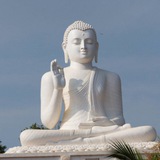
Wewurukannala Buduraja Maha Viharaya, Dikwella, Sri Lanka.
❤1😍1🍾1
Forwarded from Buddha Dharma books
Free Buddha Dharma ebook
Buddhist Ceremonies and Rituals in Sri Lanka
By A.G.S. Kariyawasam
Free download here:
https://www.lotuslibrary.com/wp-content/uploads/2024/08/1923-Buddhist-Ceremonies-of-Sri-Lanka_Kariyawasam.pdf
===
🥰1👏1💯1
Forwarded from Buddha Dharma books
Free Buddha Dharma ebook
Buddhist Ceremonies and Rituals in Sri Lanka
By A.G.S. Kariyawasam
In all the countries into which Buddhism has spread, the 'great tradition' of classical Buddhism is accompanied by a 'small tradition' of local ceremonies and rituals that help to integrate the lofty teachings of the Buddha into the everyday concerns of the people. This booklet provides a concise survey of the local ceremonies and rituals that have been integrated over time into the popular Buddhism of Sri Lanka. The author discusses such Buddhist rites as the Refuges and Precepts, devotional worship, the Bodhi-puja, and the pirit ceremony. The author also explains the holy days and their significance in Sri Lanka.
Free download here:
https://www.lotuslibrary.com/wp-content/uploads/2024/08/1923-Buddhist-Ceremonies-of-Sri-Lanka_Kariyawasam.pdf
===
🔥1🤝1🆒1
6. Ayasà' va malam samuññhitam
taduññhàya tam'eva khàdati
Evam atidhonacàrinam
sakakammàni nayanti duggatim. 240.
ONE'S EVIL RUINS ONESELF
6. As rust sprung from iron eats itself away when arisen, even so his own deeds lead the transgressor 2 to states of woe. 240.
Story
A young monk stricken with indigestion died with a strong feeling of attachment to his new robe. Revealing his destiny, the Buddha discoursed on the baneful consequences of craving.
===
Buddha dharma teachings channel:
https://invite.viber.com/?g2=AQAKw1y3rv%2F6sk61PI2W4izuIiaEZj8YZujhY1tSzL%2B07s7rFnVFDAd0bAYFaMLw
===
Viber
Buddha
Buddha dharma teachings from the suttas and commentaries from Theravada tradition
👏1👌1
Forwarded from Words of the Buddha
So pay heed, all you celestial beings, have love for humankind, who day and night bring offerings; please protect them diligently.
Tasmā hi bhūtā nisāmetha sabbe
Mettam karotha mānusiyā pajāya
Divā ca ratto ca haranti ye balim
Tasmā hi ne rakkhatha appamattā
Ratana Sutta verse 2
Balinese offerings for the divine, Lake Tamblingan, North Bali, Indonesia.
🔥1🤝1🤗1
“Monks, for one whose awareness-release through goodwill is cultivated, developed, pursued, given a means of transport, given a grounding, steadied, consolidated, and well-undertaken, eleven benefits can be expected. Which eleven?
“One sleeps easily,
wakes easily,
dreams no evil dreams.
One is dear to human beings,
dear to non-human beings.
The devas protect one.
Neither fire, poison, nor weapons can touch one.
One’s mind gains concentration quickly.
One’s complexion is bright.
One dies unconfused
and—if penetrating no higher—is headed for a Brahmā world.
“These are the eleven benefits that can be expected for one whose awareness-release through goodwill is cultivated, developed, pursued, handed the reins, taken as a basis, steadied, consolidated, and well-undertaken.”
AN 11.15 Metta Sutta: Goodwill
🙏1😇1🎄1
Forwarded from Words of the Buddha
“Bhikkhus, all is burning. And what, bhikkhus, is the all that is burning? The eye is burning, forms are burning, eye-consciousness is burning, eye-contact is burning, and whatever feeling arises with eye-contact as condition—whether pleasant or painful or neither-painful-nor-pleasant—that too is burning. Burning with what? Burning with the fire of lust, with the fire of hatred, with the fire of delusion; burning with birth, aging, and death; with sorrow, lamentation, pain, displeasure, and despair, I say.....Experiencing revulsion, he becomes dispassionate. Through dispassion his mind is liberated. When it is liberated there comes the knowledge: ‘It’s liberated.’ He understands: ‘Destroyed is birth, the holy life has been lived, what had to be done has been done, there is no more for this state of being.’”
Partial excerpts from SN 35.28 : Ādittasutta
🔥1👏1🙏1👀1
7. Asajjhàyamalà mantà
anuññhànamalà gharà
Malam vauuassa kosajjam
pamàdo rakkhato malam. 241.
CAUSES OF STAIN
7. Non-recitation is the rust of incantations; 3 non-exertion is the rust of homes; 4 sloth is the taint of beauty; carelessness is the flaw of a watcher. 241.
Story
A monk was jealous of the praise accorded to the two chief disciples for their exposition of the Dhamma. He claimed equal proficiency in preaching but when called upon to show his capability he failed to do so. Thereupon the Buddha uttered this verse.
===
Words of the Buddha channel:
https://invite.viber.com/?g2=AQAFqzqlj7FmI061PX17rxWMAtZ%2BRuso%2FH2KmHKZSgnv7v9DD8X0bDkKnZDr9JDq
===
Viber
Words Of The Buddha
Daily teachings from Buddha Dharma
❤1🙏1🏆1
Free Buddha Dharma ebook
Not-self Q & A
By Thanissaro Bhikkhu
Answers to sixteen basic questions on the topic of not-self, plus readings from the Pali Canon on which the answers are based.
Free download available:
https://www.dhammatalks.org/Archive/Writings/Ebooks/Not-self_QA_251113.pdf
===
👏2👌1🫡1
Free Buddha Dharma ebook
Not-self Q & A
By Thanissaro Bhikkhu
Answers to sixteen basic questions on the topic of not-self, plus readings from the Pali Canon on which the answers are based.
Free download available:
https://www.dhammatalks.org/Archive/Writings/Ebooks/Not-self_QA_251113.pdf
===
👍1🔥1👌1🤝1
Forwarded from Words of the Buddha
Just as the radiance of all stars is not worth a sixteenth part of the moon’s radiance; just as in the last month of the rainy season in the autumn, when the sky is clear and free from clouds, the sun rises into the sky and flashes, radiates and dispels all darkness; just as in the pre-dawn light the healing star shines, flashes and radiates; so too, whatever good deeds one might do for the purpose of a good rebirth, none of them are worth a sixteenth part of that love which frees the mind. It is the love that frees the mind which shines, flashes and radiates forth out-surpassing all those good deeds
Whoever makes love grow boundless,
And sets their mind for seeing the end of birth,
Their fetters are worn thin.
If with a pure mind one feels love
Towards even a single being,
That alone makes one a good person.
Having a mind filled with compassion,
The Noble One does great good.
Itivuttaka 20
⚡1🔥1🙏1👻1
"Monks, one should pay homage to a stupa (thūpa) or shrine (cetiyagara) with a composed mind. A monk should not disrespect or disregard a stupa, whether it contains relics of the Tathagata, relics of disciples, or is merely symbolic (representing the Buddha). Doing so leads to a fault."
Cullavagga VI.10: Respect for Stupas (Thupas)
🙏3🔥1👏1🫡1