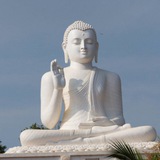
Forwarded from Words of the Buddha
Theravadin monks on Thudong on foot from Indonesia at the border of India and Nepal.
🕊2🔥1🤗1🎄1
Anyone who wants to develop the fire kasina should apprehend the sign in fire. Herein, when someone with merit, having had previous practice, is apprehending the sign, it arises in him in any sort of fire, not made up, as he looks at the fiery combustion in a lamp’s flame or in a furnace or in a place for baking bowls or in a forest conflagration, as in the Elder Cittagutta’s case. The sign arose in that elder as he was looking at a lamp’s flame while he was in the Uposatha house on the day of preaching the Dhamma.
The counterpart sign appears motionless like a piece of red cloth set in space, like a gold fan, like a gold column. With its appearance he reaches access jhana and the jhana tetrad and pentad in the way already described.
Partial excerpts from the Visuddhimagga : chapter 5: the Fire Kasina
🔥1😇1
Forwarded from Words of the Buddha
Water blessings at Borobudur temple, Java island, Indonesia.
👍1🕊1😇1
Forwarded from Words of the Buddha
Free Buddha dharma ebook
Seeing with the Eye of Dhamma
BUDDHADASA BHIKKHU
Free download available:
https://www.opensanghafoundation.org/newsite/wp-content/uploads/2023/08/Seeing-with-the-Eye-of-Dhamma-The-Comprehensive-Teaching-of-Buddhadasa-Bhikkhu-translated-by-Santikaro-and-Dhammavidu-Bhikkhu.pdf
===
🔥1👌1😇1🤝1
Forwarded from Words of the Buddha
Free Buddha dharma ebook
Seeing with the Eye of Dhamma
BUDDHADASA BHIKKHU
Ajahn Buddhadāsa spent more than sixty years in the forest in southern Thailand engaged in meditations, reflections, study of the words of the Buddha, living close to the elements, and teaching. He revealed an exceptional range of realizations throughout his life.
Seeing with the Eye of Dhamma embraces the expanse of his teachings, rich with insights, suitable for daily life. Readers will find reflections on cultivation of the mind, inquiry into the self/ego, superstitious beliefs, and the importance of the observation of life, as well as explanations of the Buddha’s core teachings on mental suffering, conditionality, dependent arising, the elements, mental concoctions, voidness, the goal, and nibbāna. A profound book provides a mind-opening reading experience: Seeing with the Eye of Dhamma falls into this category.
Free download available:
https://www.opensanghafoundation.org/newsite/wp-content/uploads/2023/08/Seeing-with-the-Eye-of-Dhamma-The-Comprehensive-Teaching-of-Buddhadasa-Bhikkhu-translated-by-Santikaro-and-Dhammavidu-Bhikkhu.pdf
===
👍1👏1🙏1
11. Kàyappakopam rakkheyya
kàyena samvuto siyà
Kàyaduccaritam hitvà
kàyena sucaritam care. 231.
12. Vacãpakopam rakkheyya
vàcàya samvuto siyà
Vacãduccaritam hitvà
vàcàya sucaritam care. 232.
13. Manopakopam rakkheyya
manasà samvuto siyà
Manoduccaritam hitvà
manasà sucaritam care. 233.
14. Kàyena samvutà dhãrà
atho vàcàya samvutà
Manasà samvutà dhãrà
te ve suparisamvutà. 234.
BE PURE IN DEED, WORD AND THOUGHT
11. One should guard against misdeeds (caused by) the body, and one should be restrained in body. Giving up evil conduct in body, one should be of good bodily conduct. 231.
12. One should guard against misdeeds (caused by) speech, and one should be restrained in speech. Giving up evil conduct in speech, one should be of good conduct in speech. 232.
13. One should guard against misdeeds (caused by) the mind, and one should be restrained in mind. Giving up evil conduct in mind, one should be of good conduct in mind. 233.
14. The wise are restrained in deed; in speech, too, they are restrained. The wise, restrained in mind, are indeed those who are perfectly restrained. 234.
Story
Some monks moved about wearing wooden sandals, thus creating a great noise. Advising them to be controlled in thought, word and, deed, the Buddha uttered these verses.
===
Words of the Buddha channel:
https://xn--r1a.website/wordsofbuddha
===
Telegram
Words of the Buddha
Daily teachings of Buddha Dharma
✍1🙏1
Forwarded from Words of the Buddha
“Having ventured out from my day’s abiding
at Vulture’s Peak Mountain,
I saw an elephant going in and out
the river by the shore.
A man took a pole with a hook,
and said to him: ‘give me your foot.’
The elephant held out his foot,
and the man mounted him.
Once I saw the untamed tamed,
brought under human control,
from there I sought one-pointedness of mind—
This is why I went to the forest."
Thig 3.4 Dantikātherīgāthā: Verses of the Elder Dantikā
❤1🕊1🎄1
“When your harp’s strings were tuned too tight, was it resonant and playable?”
“No, sir.”
“When your harp’s strings were tuned too slack, was it resonant and playable?”
“No, sir.”
“But when your harp’s strings were tuned neither too tight nor too slack, but fixed at an even tension, was it resonant and playable?”
“Yes, sir.”
“In the same way, Soṇa, when energy is too forceful it leads to restlessness. When energy is too slack it leads to laziness. So, Soṇa, you should focus on energy and serenity, find a balance of the faculties, and learn the pattern of this situation.”
[...] Then Soṇa, living alone, withdrawn, diligent, keen, and resolute, soon realized the supreme culmination of the spiritual path in this very life.[...]
He understood: “Rebirth is ended; the spiritual journey has been completed; what had to be done has been done; there is nothing further for this place.” And Venerable Soṇa became one of the perfected.
Partial excerpts from AN 6.55 : Sonasutta
🙏2👌1😇1
Chapter 18
Mala Vagga
Impurities Or Taints
(Text and Translation by Ven. Nàrada)
1. Paudupalàso' va' dàni' si
yamapurisà'pi ca tam upaññhità
Uyyogamukhe ca tiññhasi
pàtheyyam pi ca te na vijjati. 235.
2. So karohi dãpam attano
khippam vàyama paudito bhava
Niddhantamalo anaïgauo
dibbam ariyabhumim ehisi. 236.
3. Upanãtavayo va'dàni'si
sampayàto'si yamassa santike
Vàso'pi ca te natthi antarà
pàtheyyam pi ca te na vijjati. 237.
4. So karohi dãpam attano
khippam vàyama paudito bhava
Niddhantamalo anaïgauo
na puna jàtijaram upehisi. 238.
DEATH IS NEAR TO YOU
1. Like a withered leaf are you now. The messengers of death wait on you. On the threshold of decay you stand. Provision too there is none for you. 235.
STRIVE HARD
2. Make an island unto yourself. Strive quickly; become wise. Purged of stain and passionless, you shall enter the heavenly stage of the Ariyas. 1 236.
LIFE COMES TO AN END
3. Your life has come to an end now. To the presence of death you are setting out. No halting place is there for you by the way. Provision too there is none for you. 237.
BE PASSIONLESS
4. Make an island unto yourself. Strive without delay; become wise. Purged of stain and passionless, you will not come again to birth and old age. 238.
Story
A father-in-law grew old without doing any good. His son-in-law invited the Buddha and the Sangha to the house and gave alms in his name. Thereupon the Buddha addressed these verses to the old man in admonition.
===
Dhammapada, beloved and favorite teachings of the Buddha channel:
https://xn--r1a.website/dhammapadas
===
Telegram
Dhammapada - Buddha Dharma Teachings
Daily teachings of the Dhammapada, beloved and favorite teachings of the Buddha
❤1👍1💯1
Forwarded from Words of the Buddha
Big Buddha Taiwan, Fu Guang Shan monastery, Kaohsiung, Taiwan.
🔥2❤1👏1🙏1👌1
Forwarded from Words of the Buddha
If no-one else is found
in front or behind,
it’s extremely pleasant
to be dwelling alone in a forest grove.
Come now, I’ll go alone
to the wilderness praised by the Buddha.
It’s pleasant for a mendicant
to be dwelling alone and resolute.
When will I dwell alone,
without a companion,
in the great wood, so delightful,
my task complete, free of defilements?
This is what I want to do:
may my wish succeed!
I’ll make it happen myself,
for no-one can do another’s duty.
Fastening my armor,
I’ll enter the forest.
I won’t leave
without attaining the end of defilements.
As the cool breeze blows
with fragrant scent,
I’ll split ignorance apart,
sitting on the mountain-peak.
In a forest grove covered with blossoms,
in a cave so very cool,
I take pleasure in the Mountainfold,
happy with the happiness of freedom.
I’ve got all I wished for
like the moon on the fifteenth day.
With the utter ending of all defilements,
now there’ll be no more future lives.
Partially excerpted from Thag 10.2 Ekavihāriyattheragāthā
❤1🔥1🙏1🕊1🎄1
Strategies for Clear Insight
A teaching on impermanence from a founder of the Thai forest tradition
By Ajahn Mun
Part 1 of 2
The nature of all good things is that they come from things that aren’t good, just as lotuses that are fair and lovely are born from mud that is filthy and repulsive; yet once they rise clear of the mud, they are clean and pure, becoming a fitting headdress for a king, a viceroy, or a courtier, never again returning to the mud. In this they are like the earnest meditator, one engaged in a persistent effort. Such a person must investigate a thing that is filthy and repulsive if the mind is to gain release from all filthy and repulsive things. The “thing that is filthy and repulsive” here is the body. The body is an assemblage of filth, urine, and excrement. The things that are exuded from the hair of the head, the hair of the body, nails, teeth, skin, and so on are all forms of excrement. When they fall into food, people take offense at it. The food has to be thrown out, for no one can stomach it. Moreover, the body has to be constantly washed and scrubbed if it is to look presentable. If we don’t clean it, it will smell rank and no one will let us come near. Clothing and other accessories, when they are apart from the body, are clean and attractive, but as soon as they come into contact with the body they become dirty. If we let them go without washing for a long time, no one will let us come near, because of the smell.
From this we can see that the body is a house of urine and excrement, asubha—unattractive; patikkula—repulsive. When still alive, it’s bad enough; when there is no more life to it, it’s even more disgusting, to the point where nothing else can compare. So from the very beginning, all earnest meditators investigate the body methodically until they have it mastered. Before the body becomes clear, they investigate whichever part or aspect of the body is agreeable to their temperament until a particular aspect of the body appears as an uggaha nimitta. Then they focus on that aspect, working at it and developing it repeatedly.
“Working at it and developing it repeatedly” should be understood as follows: When rice farmers grow rice, they work in the soil, plowing the soil and planting rice in the soil. The following year they grow rice in the soil again. They don’t grow their rice in the air or in the middle of the sky. They grow it only in the soil, and the rice then fills their granaries of its own accord. When they work repeatedly in the soil, they don’t have to plead, “Rice, O rice, please come and fill our granaries.” The rice pours in of its own accord. And even if they forbid it, saying, “Rice, O rice, don’t come and fill our granaries,” if they have completed their work in the soil, there’s no doubt but that the rice will still come and keep their granaries full.
In the same way, we as earnest meditators should keep investigating the body at the point that is agreeable to our temperaments or first appears for us to see. No matter what, we should not neglect or abandon that point. Working at it repeatedly doesn’t refer only to the practice of walking meditation. We should be mindful, continuing our investigation in all places and at all times. Sitting, standing, walking, and lying down; eating, drinking, working, speaking, and thinking, we should always have all-round mindfulness of the present: This is what is meant by “working at it repeatedly.”
Once you have investigated the body until it is clear, you should then consider dividing it up into its various parts, using your own way of being methodical. Separate the body into the elements of earth, water, fire, and wind, examining it until you really see it in those terms. At this stage, you may use any strategies of your own devising that are agreeable to your temperament, but you must not in any event abandon the original reference point that first appeared to you. Don’t investigate once and then let it go for half a month or a month. Investigate in and out, back and forth, again and again.
Telegram
Dhammapada - Buddha Dharma Teachings
Daily teachings of the Dhammapada, beloved and favorite teachings of the Buddha
❤1👏1👌1🏆1
In other words, withdraw inward to quiet the mind and then come out again to investigate the body. Don’t exclusively investigate the body or exclusively quiet the mind.
A person who wants release but who practices wrongly or doesn’t practice—and wastes his time being lazy until the day he dies—won’t meet with release at all.
When you have investigated in this way until you have it thoroughly mastered, what happens next is what comes of its own accord. The [six senses of the] mind are bound to converge in a big way; and the instant it converges, everything will appear to converge, being one and the same. The entire world will be nothing but elements. At the same time, an image will appear of the world as being level as a drum head, because the entire world is of one and the same inherent nature. Forests, mountains, people, animals—even you yourself—will all ultimately have to be leveled down in one and the same way. Together with this vision, knowledge arises, cutting off all doubts in the heart. This is called yatha-bhuta-nana-dassana vipassana: the clear insight that both knows and sees things for what they actually are.
===
Part 1 of 2:
https://xn--r1a.website/dhammapadas/3938
Part 2 of 2:
https://xn--r1a.website/wordsofbuddha/5510
===
Dhammapada, beloved and favorite teachings of the Buddha channel:
https://xn--r1a.website/dhammapadas
===
Telegram
Dhammapada - Buddha Dharma Teachings
Daily teachings of the Dhammapada, beloved and favorite teachings of the Buddha
❤1👍1🥰1🙏1💯1
Forwarded from Buddha
Free Buddha Dharma ebook
Skills in Questions: How the Buddha Taught
By Thanissaro Bhikkhu
"How the Buddha Taught," explores the Buddha's skillful means of teaching by examining how he tailored his responses to the specific circumstances and questions of his listeners. The book emphasizes that the Buddha's teachings were not a static set of doctrines but rather a dynamic approach to guiding individuals towards liberation. It highlights the importance of understanding the context of the Buddha's teachings and applying them to one's own life for personal transformation.
Free download available:
https://drive.google.com/file/d/1AThRU7l7Plnf0GWohSW9tuzFdZ-2K8wU/view?usp=drive_link
===
❤1👌1💯1
Forwarded from Buddha
Free Buddha Dharma ebook
Skills in Questions: How the Buddha Taught
By Thanissaro Bhikkhu
"How the Buddha Taught," explores the Buddha's skillful means of teaching by examining how he tailored his responses to the specific circumstances and questions of his listeners. The book emphasizes that the Buddha's teachings were not a static set of doctrines but rather a dynamic approach to guiding individuals towards liberation. It highlights the importance of understanding the context of the Buddha's teachings and applying them to one's own life for personal transformation.
Free download available:
https://drive.google.com/file/d/1AThRU7l7Plnf0GWohSW9tuzFdZ-2K8wU/view?usp=drive_link
===
👍1🥰1🏆1