Free Buddha Dharma ebook
Analysis of Deeds
Karma Vibhanga
By Bhikkhu Anandajoti
The Analysis of Deeds (Karma-Vibhaṅga) is a classical Buddhist text translated into English by the Theravada monk Bhikkhu Ānandajoti. The text serves as a comprehensive pedagogical index detailing the direct relationship between specific intentional actions (karma) and their exact karmic consequences (vipāka).
Free download available:
https://drive.google.com/file/d/1XpN8Pz8lNT1Ahx-Lpu0L4pv9CCGNYK45/view?usp=drive_link
===
🏆1🍓1
Free Buddha Dharma ebook
Analysis of Deeds
Karma Vibhanga
By Bhikkhu Anandajoti
The Analysis of Deeds (Karma-Vibhaṅga) is a classical Buddhist text translated into English by the Theravada monk Bhikkhu Ānandajoti. The text serves as a comprehensive pedagogical index detailing the direct relationship between specific intentional actions (karma) and their exact karmic consequences (vipāka).
Free download available:
https://drive.google.com/file/d/1XpN8Pz8lNT1Ahx-Lpu0L4pv9CCGNYK45/view?usp=drive_link
===
✍1👍1💯1
This was said by the Lord, said by the Arahant, so I heard:
“Bhikkhus, there are these three eyes. What three? The fleshly eye, the divine eye, and the wisdom eye. These, bhikkhus, are the three eyes.”
This is the meaning of what the Lord said. So in regard to this it was said:
The fleshly eye, the divine eye,
And the unsurpassed wisdom eye—
These three eyes were described
By the Buddha, supreme among men.
The arising of the fleshly eye
Is the path to the divine eye,
But the unsurpassed wisdom eye
Is that from which knowledge arises.
By obtaining such an eye
One is released from all suffering.
This too is the meaning of what was said by the Lord, so I heard.
Iti 61 Cakkhusutta: Eyes
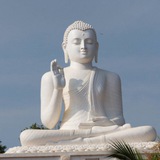
Photo : Big Buddha Dordenma or Thimphu Buddha Point, made of bronze and gilded in gold, Kuenselphodrang palace, Thimphu, Bhutan.
🙏3🔥1👀1🫡1
The Joy of Dharma
Without joy the Buddhist path is very difficult.
By Bhante Buddharakkhita
Today I’m going to talk about the joy of dharma. The dharma is the teaching of the Buddha that leads to happiness, peace, enlightenment, and final enlightenment. Joy is a state of mind that feels fulfilling and satisfying.
One way that you can get joy is by understanding the Buddha’s teaching, the way things are, the truth—that brings a lot of joy. When there’s a lot of confusion, you don’t feel joy. But clarity brings joy. Also, when you practice the dharma, and live according to the dharma, that brings a lot of joy.
Most of the joy we think of is mundane. It is based on external conditions, and it’s fleeting. One moment of joy comes, another moment of joy disappears, based on external conditions. You know what joy is and why you want it, but do you know how to get it? Eating ice cream? It’s good to have that also—enjoy it! But there is a lot more to it than that if we want a more sustainable joy to arise. What I’m talking about now is the joy you cultivate in the dharma.
Joy is necessary to fuel our practice. My experience of becoming a Buddhist, then becoming a monk and starting a dharma center in Uganda, all those experiences have been punctuated by joy. Without joy I think I would not be what I am now. It’s like a well that I draw from in order to practice.
Recently, I was leading a retreat, and one of my students said, “I have a problem. I’ve given many people things, but I never get anything back. Is there something wrong with me?” This person is a teacher in our primary school. He said, Whenever I need help, I don’t get any help, but when I give, I give and I give. I’m exhausted. I don’t get anything back! So I said, “Welcome to human life. Next time, try something different. Just give to others without expecting anything in return. When you give to others, experience the joy of giving in that moment. In that very moment, you are rewarded.” I think his frustration was that he was giving so that he would get something back.
After I had just become a monk, I visited some African countries to do volunteer work. One country I went to was Kenya. The monastery and temple where I stayed were close to the university of agriculture. As part of our tradition as monks, we have to collect alms. We walk with our alms bowl, and then wait for somebody to put some food in. Every day, when I would do that, I would meet this security guard at the gate of the university. I was there for two months, and I kept on doing that, walking back and forth past him. One day he stopped me and asked, What are you doing? I said, I’m looking for food. Where are you from? I’m from Uganda. Where do you live? In the United States. Oh, you live in the United States? Can you give me some money? You have a lot of dollars! I said, No, I’m a monk. So it was a disappointing back-and-forth. He said, Let me see in your bowl. He looked, and it was empty. Nobody was giving me any food. He told me, Tomorrow, when you come, I’ll give you some food. So the next day I came to the gate, and he brought out a banana, one banana, and put it in my bowl. I said, Oh, wow. Finally, there’s a local African who understands what I’m doing! Then I left, and when I came back again, he put one more banana in the bowl. And then I said, I’m going to bless you. He closed his eyes. I said, I wish you a long life, happiness, and all that, and once I finished, I said, you can open your eyes. He said, Is that all? I thought you were going to give me money! In other words, his bananas were an investment.
Without joy I think I would not be what I am now. It’s like a well that I draw from in order to practice.
The key is to give without expectation, and that will bring you a lot of joy. If you get something in return, that’s OK, but really you give just for the joy that arises when you are giving. This is very important, to know that joy can arise from giving. Why you give is to feel happy and joyful. That fuel can help us keep going.
Telegram
Dhammapada - Buddha Dharma Teachings
Daily teachings of the Dhammapada, beloved and favorite teachings of the Buddha
👏1💯1🏆1
That’s what I’ve done as a monk, to enjoy the practice itself. Whenever I’m practicing and I have this kind of joy, it helps me a lot.
I remember when I was in Burma, I was again going for my alms round, and it was a two-month retreat. I was struggling with a lot of pain, and the schedule was very tight. We woke up at 3:00 a.m. to practice meditation until about 10:00 in the evening. Other people I saw were not struggling like me. I would sit for maybe an hour and a half. Other people were sitting for four hours at a stretch.
One day, I was going for my alms round and somebody put some food in my alms bowl. She was about 75 years old, and she was walking very slowly, with a cane, crossing the road to give me some rice. When I went back to the cushion, I asked myself, What can I practice to be worthy of receiving this food from this person? And joy arose at that moment. I had tried all kinds of techniques to overcome pain, and they were not working. But the joy that came, I felt it all over in my body and in my mind. The pain just went out the window. I could keep on practicing after one hour, two hours, three hours, just sitting there feeling very light and buoyed.
Joy is very important in your practice.
It’s a marker to a signpost that says awakening. These are the benefits. You keep on refueling your path to practice knowing that you’re on the right track. If the path is gloomy and you’re just plodding, just trying to get through it, that will be difficult. You don’t feel joy until you see the sign to the place you are going. If you find you are going in the opposite direction, you will feel very stressed. I remember once, when I was teaching in Cambridge, Massachusetts. Afterward, somebody was driving me back to the Insight Meditation Society, in Barre. He was using GPS, but we went in the wrong direction for one hour anyway. Then we saw a sign pointing us in the right direction, and joy arose.
In the scriptures, there are two kinds of people who come face-to-face with suffering. The first kind gets caught up in suffering—in other words, they join the Dukkha Club. They get stuck. But the second kind experiences suffering and sees the exit and knows that there is a way out of it. The Buddha said, when somebody does this, their faith and confidence arise, and they experience gladness, pamojja. Then gladness becomes joy, which is piti. The discourse goes on from joy to calmness, from calmness to happiness, and then from happiness to concentration, from concentration to seeing things as they really are. It keeps on going on and on.
One time we were traveling, I think in Rwanda, and the GPS in the car was saying, Keep going straight. But we were going toward the river! We could not go straight. The GPS was telling us to keep going. Do you want to drive into a river because the GPS tells you to? When you have GPS, you can still get lost.
Even when suffering, once we see the path—the way out of suffering—then faith and confidence arise, and we feel joy. Try to find out, whatever suffering you may be experiencing in your life—can you see the light at the end of the tunnel? Can you glimpse a way out of it? Once you really see the path and you realize that you can get out of this, then there is joy.
Adapted from a talk given at New York Insight Meditation Center in January 2026.
===
Bhante Buddharakkhita is the founder and abbot of the Uganda Buddhist Centre in Kampala, Uganda. He is the spiritual director of Flowering Lotus Meditation Center in Magnolia, Mississippi, a Visiting Professor at Union Theological Seminary in New York, and the author of Planting Dhamma Seeds: The Emergence of Buddhism in Africa and Sowing Seeds of Peace: Mindfulness Meditation for Finding Peace Within.
===
Dhammapada, beloved and favorite teachings of the Buddha channel:
https://xn--r1a.website/dhammapadas
===
Telegram
Dhammapada - Buddha Dharma Teachings
Daily teachings of the Dhammapada, beloved and favorite teachings of the Buddha
❤1👍1💯1🫡1
19. Vàripokkharapatt' eva
àragger' iva sàsapo
Yo na limpati kàmesu
tam aham brumi brahmanam. 401.
HE IS A BRAHMANA WHO CLINGS NOT TO SENSUAL PLEASURES
19. Like water on a lotus leaf, like a mustard seed on the point of a needle, he who clings not to sensual pleasures - him I call a brahmana. 401.
Story
When an Arahant bhikkhunã was raped by a former suitor of hers the monks began wondering whether Arahants are susceptible to sensual pleasures. The Buddha explained that Arahants are not so susceptible.
===
Words of the Buddha channel:
https://xn--r1a.website/wordsofbuddha
===
Telegram
Words of the Buddha
Daily teachings of Buddha Dharma
👏1🙏1🕊1🫡1
Forwarded from Words of the Buddha
At one time the Buddha was staying near Sāvatthī in Jeta’s Grove, Anāthapiṇḍika’s monastery. Then the householder Anāthapiṇḍika went up to the Buddha, bowed, and sat down to one side. The Buddha said to him, “Householder, I wonder whether your family gives gifts?”
“It does, sir. But only coarse gruel with false black pepper.”
Someone might give a gift that’s either coarse or fine. And they give it carefully, thoughtfully, with their own hand. They don’t give the dregs, and they give with consideration for consequences. Then wherever the result of any such gift manifests, their mind inclines toward enjoyment of nice food, clothes, vehicles, or the five refined kinds of sensual stimulation. And their children, wives, bondservants, servants, and workers want to listen. They actively listen and try to understand. Why is that? Because that is the result of deeds done carefully.
Partial excerpts from AN 9.20 : Velama Sutta
❤1✍1🙏1🤝1
“Bhikkhus, there are world interstices, vacant and abysmal regions of blinding darkness and gloom, where the light of the sun and moon, so powerful and mighty, does not reach.”
When this was said, a certain bhikkhu said to the Blessed One: “That darkness, venerable sir, is indeed great; that darkness is indeed very great. But is there, venerable sir, any other darkness greater and more frightful than that one?”
“There is, bhikkhu.”
Those ascetics and brahmins, bhikkhu, who do not understand as it really is: ‘This is suffering’; who do not understand as it really is: ‘This is the origin of suffering’; who do not understand as it really is: ‘This is the cessation of suffering’; who do not understand as it really is: ‘This is the way leading to the cessation of suffering’— they tumble into the darkness of birth, aging, death, sorrow, lamentation, pain, displeasure, and despair.
Partial excerpts from SN 56.46 : Andhakasrasutta : Darkness
Photo: Big Buddha Phuket, Thailand.
🔥1🥰1🙏1🕊1
Forwarded from Words of the Buddha
Songkran, the Thai New Year and world-famous water festival, is celebrated in mid April annually, marking a time for purification, symbolizing washing away misfortune and welcoming the new year with cleansing.
❤2🎉1🐳1😎1
Forwarded from Words of the Buddha
The Path to Peace, A Buddhist Guide to Cultivating Loving Kindness by Ayya Khema
❤1🎉1🕊1🍓1
Forwarded from Words of the Buddha
An Opportunity for Love
If we stop looking for somebody to love us, we can immediately turn that around and just start looking for people to love. And since there are so many people everywhere, there’s no shortage at all; they’re constantly available. Every one of us has constant daily contact with other people. This is our constant daily learning situation. It’s not too difficult to have a sort of friendly feeling toward those people that are halfway acceptable. But that’s not quite enough if we really want to cultivate this heart quality which then becomes like a safety zone within us. Fear is a human condition, but it’s greatly alleviated if we find within us the certitude that we’re going to be loving no matter what happens. This is such a basis for safety, where fear is so much diminished, that our whole inner being changes. Every person we meet is a challenge: a challenge to love. But particularly those who are unpleasant are the greatest challenge. If we want to actually work on this cultivation of the heart, this is where we have that opportunity.
Excerpted from:
The Path to Peace: A Buddhist Guide to Cultivating Loving-Kindness Page 97 By Ayya Khema
===
Words of the Buddha channel:
https://xn--r1a.website/wordsofbuddha
===
Telegram
Words of the Buddha
Daily teachings of Buddha Dharma
🔥1👌1😇1
20. Yo dukkhassa pajànàti
idh' eva khayam attano
Pannabhàram visamyuttam
tam aham brumi brahmanam. 402.
A BRAHMANA IS HE WHO HAS LAID THE BURDEN ASIDE
20. He who realizes here in this world the destruction of his sorrow, who has laid the burden 27 aside and is emancipated, 28 - him I call a brahmana. 402.
Story
Before the promulgation of the rule with regard to the ordination of slaves, a slave belonging to a brahmin ran away and entered the Order. Soon he attained Arahantship. The brahmin, seeing him when he went in quest of alms, held him by the hem of his robe. The Buddha remarked that the slave had laid the burden aside and uttered this verse.
===
Dhammapada, beloved and favorite teachings of the Buddha channel:
https://xn--r1a.website/dhammapadas
===
Telegram
Dhammapada - Buddha Dharma Teachings
Daily teachings of the Dhammapada, beloved and favorite teachings of the Buddha
🙏1🕊1💯1😇1
And how is a noble disciple dedicated to wakefulness? It’s when a noble disciple practices walking and sitting meditation by day, purifying their mind from obstacles. In the first watch of the night, they continue to practice walking and sitting meditation. In the middle watch, they lie down in the lion’s posture—on the right side, placing one foot on top of the other—mindful and aware, and focused on the time of getting up. In the last watch, they get up and continue to practice walking and sitting meditation, purifying their mind from obstacles. That’s how a noble disciple is dedicated to wakefulness.
Partial excerpts from MN 53 : Sekhasutta
🙏1🕊1🍾1😇1
Forwarded from Buddha Dharma books
Free Buddha dharma ebook
An Outline of Buddhism
By Ajahn Sucitto
A great variety of forms of religious practice are associated with the word ‘Buddhism’. However, they all take Siddhattha Gotama, who lived and taught in northern India some 2,500 years ago, as their source or inspiration. It was he who became known as the ‘Buddha’ – that is ‘the Awakened One’, one who has attained great wisdom through their own efforts.
Free download here:
https://cdn.amaravati.org/wp-content/uploads/2020/11/13/An-Outline-of-Buddhism.pdf
===
👍1👌1😇1
Forwarded from Buddha Dharma books
Free Buddha dharma ebook
An Outline of Buddhism
By Ajahn Sucitto
A great variety of forms of religious practice are associated with the word ‘Buddhism’. However, they all take Siddhattha Gotama, who lived and taught in northern India some 2,500 years ago, as their source or inspiration. It was he who became known as the ‘Buddha’ – that is ‘the Awakened One’, one who has attained great wisdom through their own efforts.
Free download here:
https://cdn.amaravati.org/wp-content/uploads/2020/11/13/An-Outline-of-Buddhism.pdf
===
👏1🤝1🆒1
Forwarded from Words of the Buddha
Ghanasārappadittena
Dīpena tama-dhaṃsinā
Tiloka-dīpaṃ sambuddhaṃ
Pūjayāmi tamo-nudaṃ
Ghandha-sambhāra-yuttena
Dhūpenāhaṃ sugandhinā
Pūjaye pūjaneyyaṃ taṃ
Pūjābhajanamuttamaṃ
Pujemi Buddham kusumenanena
Puññenametena ca hotu mokkham
Puppham milāyāti yathā idam me
Kāyo tathā yāti vināsa-bhavam
With lights brightly shining
Abolishing this gloom
I adore the Enlightened One,
The Light of the three worlds.
With perfumed incense
And fragrant smoke
I worship the Exalted One,
Who is great and worthy of worship.
I worship the Buddha with these flowers;
May this virtue be helpful for my emancipation;
Just as these flowers fade,
Our body will undergo decay.
❤🔥1🙏1🍓1🤗1
21. Gambhãrapaññam medhàvim
maggámaggassa kovidam
Uttamattham anuppattam
tam aham brumi brahmanam. 403.
A BRAHMANA IS HE WHO HAS REACHED HIS ULTIMATE GOAL
21. He whose knowledge is deep, who is wise, who is skilled in the right and wrong way, 29 who has reached the highest goal - him I call a brahmana. 403.
Story
The Venerable Khemà bhikkhunã came to pay her respects to the Buddha and seeing Sakka King of the gods, saluted the Buddha and turned back. Sakka inquired of the Buddha who she was. The Buddha answered that she was a daughter of His who was very wise.
===
Vajrayana Tantrayana Buddhism channel:
https://xn--r1a.website/tantrayanabuddhism
Tibetan Buddhism - Vajrayana, Tantrayana and esoteric Buddhism channel:
https://xn--r1a.website/tibetanbuddha
===
Telegram
Vajrayana Tantrayana Buddhism
Buddha teachings from the Vajrayana, esoteric, secret or Tantrayana vehicle
👍1