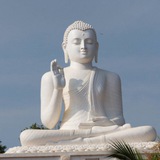
Forwarded from Words of the Buddha
Vayadhamma sankhara, Appamadena sampadetha
At one time the Buddha was staying between a pair of sal trees in the sal forest of the Mallas at Upavattana near Kusinārā at the time of his full extinguishment.
Then the Buddha said to the mendicants: “Come now, mendicants, I say to you all: ‘Conditions fall apart. Persist with diligence.’”
These were the Realized One’s last words.
SN 6.15: Parinibbānasutta
🙏1👌1😇1🤗1
“One who is learning the yellow kasina apprehends the sign in yellow, either in a flower or in a cloth or in a colour element.” Therefore here too, when someone has merit, having had previous practice, the sign arises in him when he sees a flowering bush or flowers spread out, or yellow cloth or colour element, as in the case of the Elder Cittagutta. That venerable one, it seems, saw an offering being made on the flower altar, with pattanga flowers at Cittalapabbata, and as soon as he saw it the sign arose in him the size of the flower altar. Anyone else should make a kasina, in the way described for the blue kasina, with kanikara flowers, etc., or with yellow cloth or with a colour element. He should bring it to mind as “yellow, yellow” in the way already described under the earth kasina.
Partial excerpts from the Visuddhi Maga : Chapter 5 : Sesa Kasina Niddesa
🤩1🏆1🫡1
Helping Yourself Helps Others
Once you’ve gained wisdom, put it to use.
By Bhikkhu P. A. Payutto
Part 1 of 2
The dhamma, when well practiced, is like a medicine for treating the ills of life, enabling us to live our lives well. The Buddha, as the proclaimer of the dhamma, is like a skillful doctor who prescribed particular medicines for particular illnesses. If a doctor is not skillful, even though he may have good medicine, he may prescribe it wrongly. His treatment will then not be very effective. A skillful and wise doctor will be very effective in treating his patients, because he thoroughly understands the properties of the various medicines.
Sometimes we hear it said, “Buddhism has been with us for thousands of years, and yet we still see people fighting and in conflict. Evil still abounds. Buddhism seems incapable of dealing with it; it’s useless. We may as well dispense with it.” Some people see it like this.
Do you think this is true? They say that even though we’ve had this Buddhist religion for so many years, people are still corrupt; they still live in conflict. Religion seems powerless to stop these things. We can see no concrete results from religion at all. Better to do away with it.
To these people I say, “Well, the science of medicine has been with us for many thousands of years. Medicine is plentiful, and there have been doctors curing illnesses throughout the ages, for thousands, even tens of thousands, of years. And yet we see disease and illness still abound. If what you say is true, then we must also say that the science of medicine is redundant; we may as well throw that out too.”
As long as there are people living in this world, there will be suffering, so we must also have a treatment for it. When one person is cured, there are still countless others to follow.
What is the disease that incessantly hounds the mind? It is the disease of defilements (kilesa). Whenever greed, hatred, or delusion arise within the mind, they cause discontent and suffering to arise. Such a mind can be called an ill or diseased mind. When diseases such as greed arise, they stifle and oppress the mind, causing it to become obsessed with some object or other.
When the mind rests with a meditation object, we don’t have to bother with sensations arising from the outside world. Defilements resulting from value judgments about externals do not arise.
This is the most elementary level of meditation practice: concentrating the mind on a harmless object. With the mind coming to rest on that object, we can be said to have accomplished our aim—the mind is in samadhi, being firmly fixed on one object. When talking of samadhi, the word ekaggata (one-pointedness) is used, meaning that the mind rests with one particular object. When it rests on that object, it is calm and undistracted. This is samadhi.
When the mind is one-pointed, it is said to be like a magnifying glass that is used to concentrate the sun’s rays. Using a magnifying glass, a concentration of energy occurs that can even ignite an object in its path. Again, the mind can be compared to water that is released from a great height, such as a mountain. If the water has no channel, it dissipates, but if a pipe is used to channel the water, it flows down in a torrent, sometimes so strong as to sweep all obstacles, such as branches and trees, from its path. Yet again, the calm mind can be compared to still limpid water, which is completely free of ripples, perfectly smooth. If one were to look into the water, one would clearly see a true reflection of one’s features. In the same way, the calm mind sees things without distortion.
The real value of samadhi lies with wisdom. The difference between samadhi and wisdom is that samadhi renders the mind calm and undefiled for only a limited time.
Telegram
Dhammapada - Buddha Dharma Teachings
Daily teachings of the Dhammapada, beloved and favorite teachings of the Buddha
👏1🙏1🤝1
Therefore, the results of practicing samadhi on its own still leave us prone to problems. Suffering still arises; the disease is still with us. Samadhi in itself does not give us a real, lasting result. One who transcends the influence of defilements temporarily, by using samadhi, is said to have experienced transcendence through suppression (vikkhambhana vimutti). The illustration is given of grass covered by a rock. As long as the rock is there, the grass is suppressed and cannot grow, but once the rock is removed, the grass grows as before.
What is the disease that incessantly hounds the mind? It is the disease of defilements.
How can we cure the problem once and for all, so that even when the mind experiences various sensations, no harm or problems arise? One must delve deeper into the problem by destroying the seed of defilement in the mind, so that the mind does not react with defilement to the various sensations. This is called abandoning the defilements through true knowledge and vision of the way things are—that is, by using wisdom. Wisdom on this level is called vipassana (insight).
Thus, when we talk of the higher levels of Buddhist practice, it is said to have two main branches: on one hand, samadhi in itself, which we call samatha (calm), and on the other hand, the use of wisdom, seeing the true nature of things, which is called vipassana. If one develops samadhi and then uses that calm mind in the development of wisdom, one will achieve what in Buddhism we would consider to be comprehensive results.
The practice of the foundations of mindfulness is said to help eradicate desire and aversion and to see things as they are. Now, when we are more adept at seeing things as they arise, we will notice their arising, existence, and cessation. When we perceive the various sensations coming and going as they do, we will be seeing the process by which they function, seeing that they are constantly arising and ceasing. They are impermanent. Seeing impermanence (anicca), we will also see dukkha (suffering) and anatta (selflessness), the three characteristics. So the practice of the foundations of mindfulness on deeper levels enables us to see the arising, changing, and dissolution of all things. This is seeing the three characteristics of conditioned existence, which is the arising of wisdom. The mind will then no longer grasp or be influenced by external sensations. The mind becomes its own master and breaks free, and that freedom is the fruition of wisdom development.
===
Part 1 of 2:
https://xn--r1a.website/dhammapadas/4592
Part 2 of 2:
https://xn--r1a.website/lorddivinebuddha/5118
===
Dhammapada, beloved and favorite teachings of the Buddha channel:
https://xn--r1a.website/dhammapadas
===
Telegram
Dhammapada - Buddha Dharma Teachings
Daily teachings of the Dhammapada, beloved and favorite teachings of the Buddha
👏1💯1🫡1
Forwarded from Buddha
Helping Yourself Helps Others
Once you’ve gained wisdom, put it to use.
By Bhikkhu P. A. Payutto
Part 2 of 2
If the mind knows the truth of life, the disease of ignorance will not arise. The disease of the mind is caused by ignorance, which causes the mind to fabricate. This is the practice of Buddhism. Notice that it all relates to us. The practice I’ve been talking about here is based on this fathom-long body. The truth can be seen right here. Living in this world, we experience the environment as sensations. If we don’t practice appropriately toward those sensations, we experience problems.
In one sense, it’s almost as if we “lie in wait” for sensations to arise and relate to them in such a way as to not give rise to defilements. It is as if we were a passive receiver of sensations. In this sense, we may feel we should sit and wait for things to happen and do our best to avoid getting involved in anything. This is one way of looking at dhamma practice.
Another way is to use our practice to improve the world, by training to see it in a more skillful way. So the initial practice is not only to be a passive experiencer but also to learn to get up and go outside to meet the world. This means practicing toward the world in a good way.
One who practices like this practices correctly in relation to oneself and also, having seen the truth, practices in the world in such a way as to be helpful, not harmful, to others. Helping others also helps us to develop good qualities in ourselves. The mind tends toward skillful reactions in its everyday contact. In this way, the practitioner sees a relationship between their own personal practice and the practice of relating to the world. One sees that all beings are related and so deals with them with goodwill and compassion, helping them in their need. Furthermore, we understand that all other beings are afflicted with the same illness as we are; they are bound by the three characteristics just as we are. Therefore, it is proper that we learn to help one another as fellow travelers on the path of practice.
If the mind knows the truth of life, the disease of ignorance will not arise.
Dhamma practitioners should thus not only consider the right way to relate to the various experiences they encounter in the course of their lives but also to help others. This type of practice was recommended by the Buddha, even up to the level of those who have experienced insight. At one time, the Buddha compared the stream-enterer (sotapanna) to a cow with a calf. The cow eats grass to feed itself and also to feed the calf, which follows her around. “Eating the grass” can be compared to one’s own personal practice of the dhamma. Even though she is eating grass, the mother cow does not neglect her calf; she is constantly looking after it and being watchful to keep it from falling into danger. Likewise, one who practices the teaching of Buddhism practices primarily to train oneself in the correct practice but also gives consideration to one’s fellow people and all other beings, so as to help them with goodwill and compassion.
In helping yourself, you help others; in helping others, you help yourself. All in all, the practice boils down to behaving in the right manner, both to oneself and to others. In this way, dhamma practice leads to progress both for oneself and for others.
There is an apt analogy related by the Buddha in the story of the two acrobats. One form of acrobatics performed in the Buddha’s time involved the use of a long bamboo pole, which was balanced on the head and shoulders of one acrobat, while another acrobat balanced himself on top of the pole. They would perform various tricks and balancing acts in this way. Two of these acrobats, master and apprentice, were traveling around the country performing their art.
Telegram
Buddha
Buddha dharma teachings from the suttas and commentaries
💯1🏆1🫡1
Forwarded from Buddha
One day the master said, “Now, you keep your eye on me, and I’ll keep my eye on you and so keep you from falling off.” The apprentice replied, “Oh, no, master. You should look after yourself while I look after myself. In this way, we can perform our act and earn a living in safety.”
The meaning of the story is: In looking after yourself, you also look after others, and by looking after others, you also look after yourself. In practicing the dhamma we are cultivating virtue, which first arises in ourselves. That virtue can then extend to others, even without our knowing about it. Specifically, when practicing the dhamma we are cultivating morality (sila), concentration (samadhi), and wisdom (panna). When our moral conduct is pure, we don’t harm others. This is one result of dhamma practice. Although we have developed that virtue within ourselves, its good effects extend to others in that we no longer present any danger to them. Again, if we help others, for example, by exercising forbearance (khanti), not harming others through anger but exercising goodwill (metta) and compassion (karuna), we are practicing the dhamma, the fruit of which also arises within ourselves. Thus, it is said that in looking after ourselves, we look after others, and when looking after others, we look after ourselves. The practice of the dhamma is coproductive in that its effects extend to all beings.
Adapted from Voices of Siam: Illuminating the Buddhist Path to Natural Reality.
===
Bhikkhu P. A. Payutto is a revered Thai monk and scholar who has written more than 400 books and booklets since his ordination at 13 years old.
===
Part 1 of 2:
https://xn--r1a.website/dhammapadas/4592
Part 2 of 2:
https://xn--r1a.website/lorddivinebuddha/5118
===
Buddha dharma teachings channel:
https://xn--r1a.website/lorddivinebuddha
===
Telegram
Buddha
Buddha dharma teachings from the suttas and commentaries
⚡1😇1🆒1
16. Chetvà naddhim varattañ ca
sandàmam sahanukkamam
Ukkhittapaëigham buddham
tam aham brumi brahmanam. 398.
A BRAHMANA IS HE WHO HAS NO HATRED
16. He who has cut the strap (hatred), the thong (craving), and the rope (heresies), together with the appendages (latent tendencies), who has thrown up the cross-bar (ignorance), who is enlightened 24 (Buddha) - him I call a brahmana. 398.
Story
Two persons arguing about the comparative strength of their oxen tested them by loading their carts with sand and forcing the oxen to draw them. The carts would not stir an inch but instead the thongs and straps broke. The monks saw this and mentioned it to the Buddha. Thereupon He advised the monks to destroy the thongs and straps in their own minds.
===
Ajahn Chah, Buddhist teacher of Thai forest meditation of Theravada Buddhism channel:
https://xn--r1a.website/ajahnchah_buddhism
===
Telegram
Ajahn Chah - Theravada Thailand Buddhism
Collection of teachings of Venerable Ajahn Chah, a foremost meditation and Buddhist teacher from Thailand
❤2👏1🙏1🏆1
Forwarded from Words of the Buddha
And when the Wheel of the Dhamma had been set in motion by the Blessed One, the earth-dwelling devas raised a cry: “At Baranasi, in the Deer Park at Isipatana, this unsurpassed Wheel of the Dhamma has been set in motion by the Blessed One, which cannot be stopped by any ascetic or brahmin or deva or Mara or Brahma or by anyone in the world.” Having heard the cry of the earth-dwelling devas, the devas of the realm of the Four Great Kings raised a cry: “… this unsurpassed Wheel of the Dhamma has been set in motion by the Blessed One, which cannot be stopped … by anyone in the world.” Having heard the cry of the devas of the realm of the Four Great Kings, the Tavatiṁsa devas … the Yama devas … the Tusita devas … the Nimmanarati devas … the Paranimmitavasavatti devas … the devas of Brahma’s company raised a cry: “... this unsurpassed Wheel of the Dhamma has been set in motion by the Blessed One, which cannot be stopped ... by anyone in the world.”
Partial excerpts from SN 56.12 : Dhammacakkappavattana sutta
⚡1🙏1🤝1🫡1
Vangisa Bhante:
Dear Deva, you are sitting on the back of an elephant that is huge and all white. You travel from park to park, surrounded by goddesses, shining brightly in all directions like the star Osadhi.
What kind of meritorious actions did you do when you were in the human world?
That deva, delighted at being questioned by Arahant Vangisa, gladly explained what he had done that resulted in such great happiness.
Deva:
In my previous life, I was a man in the human world. I was a lay disciple of the Buddha. I abstained from killing, stealing, taking intoxicants, and lying. I was content with my own wife, and did not even think of other women. I offered things with a very happy mind.
Because of these meritorious deeds, I have been born as a very beautiful deva and enjoy all the wonderful things that delight my heart.
Great Bhante, those were the meritorious deeds I did to have such a beautiful body which shines brightly in all directions.
Vv 5.11 Dutiya Nāga Sutta: Second Elephant Mansion
🙏2👌1💯1🫡1
Forwarded from Buddha
Free Buddha Dharma ebook
The Meditative Development of Mindfulness of Breathing
By Bhikkhu Buddhadasa
"Meditative Development of Mindfulness of Breathing" is a book by Bhikkhu Buddhadasa, focusing on the practice of mindfulness of breathing (ānāpānasati). It is a complete meditation practice in itself, encompassing the path to enlightenment (Nibbāna). The book delves into the 16 stages of mindfulness of breathing, which combine both samatha (calm) and vipassana (insight) aspects of the practice.
Free download here:
https://drive.google.com/file/d/1yt2_heUSoq-nAoBPuQ2HWMwQ3uNEYxMW/view?usp=drive_link
===
❤1🙏1👌1🕊1
Forwarded from Buddha
Free Buddha Dharma ebook
The Meditative Development of Mindfulness of Breathing
By Bhikkhu Buddhadasa
"Meditative Development of Mindfulness of Breathing" is a book by Bhikkhu Buddhadasa, focusing on the practice of mindfulness of breathing (ānāpānasati). It is a complete meditation practice in itself, encompassing the path to enlightenment (Nibbāna). The book delves into the 16 stages of mindfulness of breathing, which combine both samatha (calm) and vipassana (insight) aspects of the practice.
Free download here:
https://drive.google.com/file/d/1yt2_heUSoq-nAoBPuQ2HWMwQ3uNEYxMW/view?usp=drive_link
===
😇1🤝1😎1
17. Akkosam vadhabandhañ ca
aduññho yo titikkhati
Khantibalam balàuãkam
tam aham brumi brahmanam. 399.
A BRAHMANA IS HE WHO IS PATIENT
17. He who, without anger, endures reproach, flogging and punishments, whose power and potent army is patience - him I call a brahmana. 399.
Story
A certain wife used to ejaculate words of praise to the Buddha whenever the slightest mishap occurred. Her husband objected to her habit but she persisted. The provoked husband went to the Buddha and angrily put some questions to the Buddha. Hearing His reply, which was marked by great patience, the irate husband became a convert and entered the Order. His brothers came and abused the Buddha for converting him. The Buddha patiently endured their reproach and preached to them. They were also converted. When the monks extolled His patience the Buddha uttered this verse.
===
Free Buddhism books, teachings, podcasts and videos from Theravada, Mahayana and Vajrayana traditions:
https://xn--r1a.website/buddha_ebooks
===
Telegram
Buddha Dharma books
Free Buddhism books, teachings, podcasts and videos from Theravada, Mahayana and Vajrayana traditions
⚡1👏1🙏1😇1
Forwarded from Words of the Buddha
Do we really give the Buddha a bath in the ceremony? No, it is rather to cleanse the Buddha within by way of a ceremony involving the external Buddha, and the emphasis is on purifying the heart. Therefore, the celebration of the birth of the Buddha should be conducted with solemn attitudes encompassing moral development, compassion and respect.
👍1🥰1🎉1🍓1
Relying on this supreme purity of mindfulness & equanimity, that noble disciple recollects their many kinds of past lives. That is: 1, 2, 3, 4, 5, 10, 20, 30, 40, 50, 100, 1000, 100,000 rebirths; many eons of the world contracting & expanding, & so they recollect their many kinds of past lives, with features & details. This is their first breaking out, like a chick from an eggshell.
... with clairvoyance that is purified & superhuman, sees sentient beings passing away & being reborn—inferior & superior, beautiful & ugly, in a good place or a bad place. … They understand how sentient beings pass on according to their deeds. This is their second breaking out, like a chick from an eggshell.
... that noble disciple realizes the undefiled freedom of heart & freedom by wisdom. And they live having realized it with their own insight in this very life due to the ending of defilements. This is their third breaking out, like a chick from an eggshell.
Partial excerpts from MN 53 : Sekhasutta
👏1🤗1🫡1
Forwarded from Words of the Buddha
Bon Om Touk "Boat Paddling Festival", also known as the Cambodian Water and Moon Festival, is celebrated in late October or early November, often corresponding with the lunar Mid-Autumn Festival. It marks the end of the monsoon season. The festivities are accompanied by dragon boat races, similar to those seen in the Lao Boun Suang Huea festival.
❤2🥰1🎉1🍓1
18. Akkodhanam vatavantam
sãlavantam anussutam
Dantam antimasàrãram
tam aham brumi brahmanam. 400.
A BRAHMANA IS HE WHO IS NOT WRATHFUL
18. He who is not wrathful, but is dutiful, 25 virtuous, free from craving, self-controlled and bears his final body, 26 - him I call a brahmana. 400.
Story
The Venerable Sàriputta was reviled by his own mother as she resented his taking of the monastic life, but he was patient. Hearing of his patience, the Buddha uttered this verse in praise of him.
===
Buddha dharma teachings channel:
https://xn--r1a.website/lorddivinebuddha
===
Telegram
Buddha
Buddha dharma teachings from the suttas and commentaries
❤1🏆1😇1