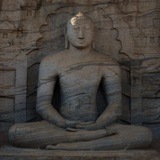
Forwarded from Dhammapada - Buddha Dharma Teachings
Vangisa Bhante:
Dear Deva, you are sitting on the back of an elephant that is huge and all white. You travel from park to park, surrounded by goddesses, shining brightly in all directions like the star Osadhi.
What kind of meritorious actions did you do when you were in the human world?
That deva, delighted at being questioned by Arahant Vangisa, gladly explained what he had done that resulted in such great happiness.
Deva:
In my previous life, I was a man in the human world. I was a lay disciple of the Buddha. I abstained from killing, stealing, taking intoxicants, and lying. I was content with my own wife, and did not even think of other women. I offered things with a very happy mind.
Because of these meritorious deeds, I have been born as a very beautiful deva and enjoy all the wonderful things that delight my heart.
Great Bhante, those were the meritorious deeds I did to have such a beautiful body which shines brightly in all directions.
Vv 5.11 Dutiya Nāga Sutta: Second Elephant Mansion
🙏5💯1🤗1
“Suppose, mendicants, there was a lake that was cloudy, murky, and muddy. A person with clear eyes standing on the bank would not see the clams and mussels, and pebbles and gravel, and schools of fish swimming about or staying still. [...]
“Suppose, mendicants, there was a lake that was transparent, clear, and unclouded. A person with clear eyes standing on the bank would see the clams and mussels, and pebbles and gravel, and schools of fish swimming about or staying still. Why is that? Because the water is unclouded. In the same way, that a mendicant whose mind is not clouded would know what’s for their own good, the good of another, or the good of both; or that they would realize any superhuman distinction in knowledge and vision worthy of the noble ones: this is quite possible. Why is that? Because their mind is unclouded.”
AN 1.45-46 : Udakarahaka Suttas: A Pool of Water
🙏4👏1🤝1
October 31
AN 4.233 Vitthārasutta: Deeds in Detail
“Mendicants, I declare these four kinds of deeds, having realized them with my own insight. What four?
There are dark deeds with dark results;
bright deeds with bright results;
dark and bright deeds with dark and bright results; and
neither dark nor bright deeds with neither dark nor bright results, which lead to the ending of deeds.
And what are dark deeds with dark results? It’s when someone makes hurtful choices by way of body, speech, and mind. Having made these choices, they’re reborn in a hurtful world, where hurtful contacts strike them. Touched by hurtful contacts, they experience hurtful feelings that are exclusively painful—like the beings in hell. These are called dark deeds with dark results.
And what are bright deeds with bright results? It’s when someone makes pleasing choices by way of body, speech, and mind. Having made these choices, they’re reborn in a pleasing world, where pleasing contacts strike them. Touched by pleasing contacts, they experience pleasing feelings that are exclusively happy—like the gods replete with glory. These are called bright deeds with bright results.
And what are dark and bright deeds with dark and bright results? It’s when someone makes both hurtful and pleasing choices by way of body, speech, and mind. Having made these choices, they are reborn in a world that is both hurtful and pleasing, where hurtful and pleasing contacts strike them. Touched by both hurtful and pleasing contacts, they experience both hurtful and pleasing feelings that are a mixture of pleasure and pain—like humans, some gods, and some beings in the underworld. These are called dark and bright deeds with dark and bright results.
And what are neither dark nor bright deeds with neither dark nor bright results, which lead to the ending of deeds? It’s the intention to give up dark deeds with dark results, bright deeds with bright results, and both dark and bright deeds with both dark and bright results. These are called neither dark nor bright deeds with neither dark nor bright results, which lead to the ending of deeds.
These are the four kinds of deeds that I declare, having realized them with my own insight.”
===
Vajrayana Tantrayana Buddhism channel:
https://xn--r1a.website/tantrayanabuddhism
Tibetan Buddhism - Vajrayana, Tantrayana and esoteric Buddhism channel:
https://xn--r1a.website/tibetanbuddha
===
Telegram
Vajrayana Tantrayana Buddhism
Buddha teachings from the Vajrayana, esoteric, secret or Tantrayana vehicle
👍1🙏1
Free Buddha Dharma ebook
KAMMA VIPAKA
By Ven. Ridiyagama Sudhammabhivaṃsa Translated by Ven. Silagama Nanasiri
Free download here:
https://ftp.budaedu.org/ebooks/pdf/EN470.pdf
===
🙏1🤝1
Free Buddha Dharma ebook
KAMMA VIPAKA
By Ven. Ridiyagama Sudhammabhivaṃsa Translated by Ven. Silagama Manasiri
Kamma Vipāka is an informative guide on the nature, maturation, and ethical implications of kamma in Buddhism—highlighting both its power over existence and the mindful path to liberation.
Ultimate Responsibility: Every individual creates their own destiny through intentional actions—“Beings are heirs of their deeds.”
Complex Maturation: Kamma doesn’t ripen predictably; it arises through multi-layered processes across lifetimes.
Ethical Compass Over Fatalism: Teachings encourage mindful moral conduct without clinging to outcomes—emphasizing the Noble Eightfold Path rather than speculative vipaka.
Free download here:
https://ftp.budaedu.org/ebooks/pdf/EN470.pdf
===
👏1💯1
Forwarded from Dhammapada - Buddha Dharma Teachings
Buddham Saranam Gacchami
Dhammam Saranam Gacchami
Sangham Saranam Gacchami
I take refuge to the Buddha.
I take refuge to the Dhamma.
I take refuge to the Sangha.
बुद्धं शरणं गच्छामि।
धर्मं शरणं गच्छामि।
संघं शरणं गच्छामि।
බුදුන් සරණං ගච්ඡාමි
ධම්මං සරණං ගච්ඡාමි
සංඝං සරණං ගච්ඡාමි
ข้าพเจ้าขอพึ่งพระพุทธเจ้า
ข้าพเจ้าขอพึ่งพระธรรม
ข้าพเจ้าขอพึ่งพระสงฆ์
မြတ်စွာဘုရားကို ဆည်းကပ်ပါ၏။
တရား၌ ခိုလှုံပါ၏။
သံဃာ၌ ခိုလှုံပါ၏။
🙏3🤗1🫡1
Caganussati
As long as he recollects his own generosity in its special qualities of freedom from stain by avarice, etc., then: “On that occasion his mind is not obsessed by greed, hate, or delusion; his mind being inspired by generosity”.
[...] jhana factors arise in a single conscious moment. But owing to the profundity of the generosity’s special qualities, or owing to his being occupied in recollecting the generosity’s special qualities, the jhana is only access & does not reach absorption. And that access jhana is known as “recollection of generosity” because it arises with the generosity’s special qualities as the means.
And when a bhikkhu is devoted to this recollection of generosity, he becomes ever more intent on generosity, his preference is for non-greed, he acts in conformity with loving-kindness, he is fearless. He has much happiness and gladness. And if he penetrates no higher, he is at least headed for a happy destiny.
Partial excerpts from the Visuddhimagga Chapter 7 : Six Recollections
🙏4👏1💯1
November 1
Dhp 372 From… Bhikkhuvagga: The Monk
[In this verse, paññña is translated as insight instead of the more common wisdom.]
There is no meditative concentration for him who lacks insight,
and no insight for him who lacks meditative concentration.
He in whom are found both meditative concentration and insight,
indeed, is close to Nibbana.
===
Buddha dharma teachings channel:
https://invite.viber.com/?g2=AQAKw1y3rv%2F6sk61PI2W4izuIiaEZj8YZujhY1tSzL%2B07s7rFnVFDAd0bAYFaMLw
===
Viber
Buddha
Buddha dharma teachings from the suttas and commentaries from Theravada tradition
👏1🙏1💯1
November 2
AN 1.336 Catutthavagga: The Wise are Few
“Just as, mendicants, in India the delightful parks, woods, meadows, and lotus ponds are few, while the hilly terrain, inaccessible riverlands, stumps and thorns, and rugged mountains are many; so too the sentient beings who are wise, bright, clever, and able to distinguish what is well said from what is poorly said are few, while the sentient beings who are witless, dull, stupid, and unable to distinguish what is well said from what is poorly said are many.
===
Words of the Buddha channel:
https://invite.viber.com/?g2=AQAFqzqlj7FmI061PX17rxWMAtZ%2BRuso%2FH2KmHKZSgnv7v9DD8X0bDkKnZDr9JDq
===
Viber
Words Of The Buddha
Daily teachings from Buddha Dharma
👌1🤝1
Forwarded from Buddha Dharma books
Free Buddha Dharma ebook
The Sublime Attitudes
A Study Guide on the Brahmaviharas
By Thanissaro Bhikkhu
Free download here:
https://www.lotuslibrary.com/wp-content/uploads/2024/12/2041-sublim-attitudes_Thanissaro.pdf
===
❤1👏1🕊1
Forwarded from Buddha Dharma books
Free Buddha Dharma ebook
The Sublime Attitudes
A Study Guide on the Brahmaviharas
By Thanissaro Bhikkhu
The sublime attitudes (brahmavihāras) are the Buddha’s primary heart teachings—the ones that connect most directly with our desire for true happiness. They’re the qualities of heart that motivated the Buddha to find awakening and then to teach the path of awakening to others. At the same time, they function as part of the path itself. This means that the wisdom of the Buddha’s teachings—its “head” aspect—has to be understood in terms of these heart qualities. At the same time, though, these heart qualities have to be understood in terms of the “head” teachings on how cause and effect, in our actions, can bring about genuine happiness. Only when head and heart are brought together in this way can the path yield its full results.
Free download here:
https://www.lotuslibrary.com/wp-content/uploads/2024/12/2041-sublim-attitudes_Thanissaro.pdf
===
🥰1😍1
November 3
AN 5.12 Kūṭasutta: Peak (1)
“Bhikkhus, there are these five trainee’s powers. What five? The power of faith, the power of moral shame, the power of moral dread, the power of energy, and the power of wisdom. These are the five trainee’s powers. Among these five trainee’s powers, the power of wisdom is foremost, the one that holds all the others in place, the one that unifies them. Just as the peak is the chief part of a peaked-roof house, the part that holds all the others in place, that unifies them, so among these five trainee powers, the power of wisdom is foremost, the one that holds all the others in place, the one that unifies them.
“Therefore, bhikkhus, you should train yourselves thus: (1) ‘We will possess the power of faith, a trainee’s power; (2) the power of moral shame, a trainee’s power; (3) the power of moral dread, a trainee’s power; (4) the power of energy, a trainee’s power; (5) the power of wisdom, a trainee’s power.’ Thus, bhikkhus, should you train yourselves.”
===
Dhammapada, beloved and favorite teachings of the Buddha channel:
https://invite.viber.com/?g2=AQBLD6phsgvP%2F061YjEM3K%2BNeH1Yb372b9mtfQX2EmuBpgoLUoc99BDMfzHghrme
===
Viber
Dhammapada - Buddha Dharma Teachings
Daily teachings of the Dhammapada, beloved and favorite teachings of the Buddha
👍1🙏1
Forwarded from Dhammapada - Buddha Dharma Teachings
Grande Buda de Ibiraçu, gigantic Buddha statue located in Morro da Vargem Zen Buddhism Monastery,
Ibiraçu, Espírito Santo, Brazil, the largest Buddha statue in America continent.
🙏2👌1🏆1🤝1
November 4
AN 10.23 Kāyasutta: Body
“Bhikkhus, there are things to be abandoned by body, not by speech. There are things to be abandoned by speech, not by body. There are things to be abandoned neither by body nor by speech but by having repeatedly seen with wisdom.
“And what, bhikkhus, are the things to be abandoned by body, not by speech? Here, a bhikkhu has committed a particular unwholesome deed with the body. His wise fellow monks investigate him and say thus: ‘You have committed a particular unwholesome deed with the body. It would really be good if you would abandon bodily misconduct and develop bodily good conduct.’ When his wise fellow monks investigate him and speak to him, he abandons bodily misconduct and develops bodily good conduct. These are called things to be abandoned by body, not by speech.
“And what are the things to be abandoned by speech, not by body? Here, a bhikkhu has committed a particular unwholesome deed by speech. His wise fellow monks investigate him and say thus: ‘You have committed a particular unwholesome deed by speech. It would really be good if you would abandon verbal misconduct and develop verbal good conduct.’ When his wise fellow monks investigate him and speak to him, he abandons verbal misconduct and develops verbal good conduct. These are called things to be abandoned by speech, not by body.
“And what are the things to be abandoned neither by body nor by speech but by having repeatedly seen with wisdom? Greed is to be abandoned neither by body nor by speech but by having repeatedly seen with wisdom. Hatred … Delusion … Anger … Hostility … Denigration … Insolence … Miserliness is to be abandoned neither by body nor by speech but by having repeatedly seen with wisdom.
“Evil envy, bhikkhus, is to be abandoned neither by body nor by speech but by having repeatedly seen with wisdom. And what is evil envy? Here, a householder or householder’s son is prospering in wealth or grain, in silver or gold. A slave or dependent might think of him: ‘Oh, may this householder or householder’s son not prosper in wealth or grain, in silver or gold!’ Or else an ascetic or brahmin gains robes, almsfood, lodging, and medicines and provisions for the sick. Another ascetic or brahmin might think of him: ‘Oh, may this venerable one not gain robes, almsfood, lodging, and medicines and provisions for the sick!’ This is called evil envy. Evil envy is to be abandoned neither by body nor by speech but by having repeatedly seen with wisdom.
“Evil desire, bhikkhus, is to be abandoned neither by body nor by speech but by having repeatedly seen with wisdom. And what is evil desire? Here, one without faith desires: ‘Let them know me as one endowed with faith.’ An immoral person desires: ‘Let them know me as virtuous.’ One with little learning desires: ‘Let them know me as learned.’ One who delights in company desires: ‘Let them know me as solitary.’ One who is lazy desires: ‘Let them know me as energetic.’ One who is muddle-minded desires: ‘Let them know me as mindful.’ One who is unconcentrated desires: ‘Let them know me as concentrated.’ One who is unwise desires: ‘Let them know me as wise.’ One whose taints are not destroyed desires: ‘Let them know me as one whose taints are destroyed.’ This is called evil desire. Evil desire is to be abandoned neither by body nor by speech but by having repeatedly seen with wisdom.
“If, bhikkhus, greed overcomes that bhikkhu and continues on; if hatred … delusion … anger … hostility … denigration … insolence … miserliness … evil envy … evil desire overcomes that bhikkhu and continues on, he should be understood thus: ‘This venerable one does not understand in such a way that he would have no greed; thus greed overcomes him and continues on. This venerable one does not understand in such a way that he would have no hatred … no delusion … no anger … no hostility … no denigration … no insolence … no miserliness … no evil envy … no evil desire; thus evil desire overcomes him and continues on.’
Telegram
Ajahn Chah - Theravada Thailand Buddhism
Collection of teachings of Venerable Ajahn Chah, a foremost meditation and Buddhist teacher from Thailand
🥰1👏1
“If, bhikkhus, greed does not overcome that bhikkhu and continue on; if hatred … delusion … anger … hostility … denigration … insolence … miserliness … evil envy … evil desire does not overcome that bhikkhu and continue on, he should be understood thus: ‘This venerable one understands in such a way that he would have no greed; thus greed does not overcome him and continue on. This venerable one understands in such a way that he would have no hatred … no delusion … no anger … no hostility … no denigration … no insolence … no miserliness … no evil envy … no evil desire; thus evil desire does not overcome him and continue on.’”
===
Ajahn Chah, Buddhist teacher of Thai forest meditation of Theravada Buddhism channel:
https://xn--r1a.website/ajahnchah_buddhism
===
Telegram
Ajahn Chah - Theravada Thailand Buddhism
Collection of teachings of Venerable Ajahn Chah, a foremost meditation and Buddhist teacher from Thailand
❤1👌1