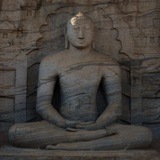
Forwarded from Buddha
"Luminous, bhikkhus, is this mind, but it is defiled by adventitious defilements. The uninstructed worldling does not understand this as it really is; therefore I say that for the uninstructed worldling there is no development of the mind ."
"Luminous, bhikkhus, is this mind, and it is freed from adventitious defilements. The instructed noble disciple understands this as it really is; therefore I say that for the instructed noble disciple there is development of the mind."
AN 1.51-52 : The Chapter on A Finger-snap
Photo : Buddha inside a stupa, Borobudur temple, world largest lava stone stupa, Java island, Indonesia.
⚡1🔥1🙏1😇1
November 25
SN 45.16 Paṭhamaparisuddhasutta: Purified (1st)
At Sāvatthī.
“Mendicants, these eight things don’t arise to be purified, bright, flawless, and rid of corruptions except when a Realized One, a perfected one, a fully awakened Buddha has appeared. What eight? They are: right view, right thought, right speech, right action, right livelihood, right effort, right mindfulness, and right immersion. These eight things don’t arise to be purified, bright, flawless, and rid of corruptions except when a Realized One, a perfected one, a fully awakened Buddha has appeared.”
===
Dhammapada, beloved and favorite teachings of the Buddha channel:
https://invite.viber.com/?g2=AQBLD6phsgvP%2F061YjEM3K%2BNeH1Yb372b9mtfQX2EmuBpgoLUoc99BDMfzHghrme
===
Viber
Dhammapada - Buddha Dharma Teachings
Daily teachings of the Dhammapada, beloved and favorite teachings of the Buddha
🙏1👌1
Forwarded from Buddha
Giant Sitting Buddha statue at the Chin Swee Caves Temple in Genting Highlands, Malaysia.
🙏1👌1🕊1
Likewise with the red kasina; for this is said: “One who is learning the red kasina apprehends the sign in red, either in a flower or in a cloth or in a colour element.” Therefore here too, when someone has merit, having had previous practice, the sign arises in him when he sees a bandhujivaka (hibiscus) bush, etc., in flower, or such flowers spread out, or a red cloth or gem or colour element.
But anyone else should make a kasina, in the way already described for the blue kasina, with jayasumana flowers or bandhujivaka or red korandaka flowers, etc., or with red cloth or with a colour element. He should bring it to mind as “red, red.” The rest is as before in the way already described under the earth kasina.
Partial excerpts from the Visuddhi Maga : Chapter 5 : Sesa Kasina Niddesa
🙏1🍓1🎄1
An Opportunity for Love
If we stop looking for somebody to love us, we can immediately turn that around and just start looking for people to love. And since there are so many people everywhere, there’s no shortage at all; they’re constantly available. Every one of us has constant daily contact with other people. This is our constant daily learning situation. It’s not too difficult to have a sort of friendly feeling toward those people that are halfway acceptable. But that’s not quite enough if we really want to cultivate this heart quality which then becomes like a safety zone within us. Fear is a human condition, but it’s greatly alleviated if we find within us the certitude that we’re going to be loving no matter what happens. This is such a basis for safety, where fear is so much diminished, that our whole inner being changes. Every person we meet is a challenge: a challenge to love. But particularly those who are unpleasant are the greatest challenge. If we want to actually work on this cultivation of the heart, this is where we have that opportunity.
Excerpted from:
The Path to Peace: A Buddhist Guide to Cultivating Loving-Kindness Page 97 By Ayya Khema
===
Words of the Buddha channel:
https://xn--r1a.website/wordsofbuddha
===
Telegram
Words of the Buddha
Daily teachings of Buddha Dharma
👍1🤗1
November 26
SN 35.245 Kiṁsukopamasutta: The Simile of the Parrot Tree
Then one mendicant went up to another mendicant and asked, “Reverend, at what point is a mendicant’s vision well purified?”
“When a mendicant truly understands the origin and ending of the six fields of contact, at that point their vision is well purified.”
Not content with that answer, that mendicant went up to a series of other mendicants and received the following answers:
“When a mendicant truly understands the origin and ending of the five grasping aggregates, at that point their vision is well purified.”
“When a mendicant truly understands the origin and ending of the four principal states, at that point their vision is well purified.”
“When a mendicant truly understands that everything that has a beginning has an end, at that point their vision is well purified.”
Not content with any of those answers, that mendicant went up to the Buddha and told him what had happened. Then he asked, “Sir, at what point is a mendicant’s vision well purified?”
“Mendicant, suppose a person had never seen a parrot tree. They’d go up to someone who had seen a parrot tree and ask them, ‘Mister, what’s a parrot tree like?’
They’d say, ‘A parrot tree is blackish, like a charred stump.’ Now, at that time a parrot tree may well have been just as that person saw it.
Not content with that answer, that person would go up to a series of other people and receive the following answers: ‘A parrot tree is reddish, like a scrap of meat.’ ‘A parrot tree has flaking bark and burst pods, like a sirisa.’ ‘A parrot tree has luxuriant, shady foliage, like a banyan.’ Now, at each of those times a parrot tree may well have been just as those people saw them.
In the same way, those true persons each answered according to what they were focused on when their vision was well purified.
Suppose there was a king’s frontier citadel with fortified embankments, ramparts, and arches, and six gates. And it has a gatekeeper who is astute, competent, and clever. He keeps strangers out and lets known people in.
A swift pair of messengers would arrive from the east and say to the gatekeeper, ‘Mister, where is the lord of the city?’
They’d say, ‘There he is, sirs, seated at the central square.’
Then that swift pair of messengers would deliver a message of truth to the lord of the city and depart the way they came.
A swift pair of messengers would come from the west … north … south … deliver a message of truth to the lord of the city and depart the way they came.
I’ve made up this simile to make a point. And this is the point.
‘City’ is a term for this body made up of the four principal states, produced by mother and father, built up from rice and porridge, liable to impermanence, to wearing away and erosion, to breaking up and destruction.
‘Six gates’ is a term for the six interior sense fields.
‘Gatekeeper’ is a term for mindfulness.
‘A swift pair of messengers’ is a term for serenity and discernment.
‘The lord of the city’ is a term for consciousness.
‘The central square’ is a term for the four principal states: the elements of earth, water, fire, and air.
‘A message of truth’ is a term for extinguishment.
‘The way they came’ is a term for the noble eightfold path, that is, right view, right thought, right speech, right action, right livelihood, right effort, right mindfulness, and right immersion.”
===
Ajahn Chah, Buddhist teacher of Thai forest meditation of Theravada Buddhism channel:
https://xn--r1a.website/ajahnchah_buddhism
===
Telegram
Ajahn Chah - Theravada Thailand Buddhism
Collection of teachings of Venerable Ajahn Chah, a foremost meditation and Buddhist teacher from Thailand
⚡1🙏1🏆1
“There are four persons, ananda, worthy of a stupa. Who are the four? A Tathagata, a Fully Awakened Buddha; a Paccekabuddha; a disciple of the Tathagata who is an Arahant; and a universal monarch (Chakravartin).”
“And why, Ananda, is a stupa for the Tathagata worthy of a stupa? At the thought: ‘This is the stupa of the Tathagata, the Arahant, the Fully Awakened Buddha,’ the hearts of many people are inspired, and they gain in happiness and faith, leading to a good rebirth.”
“And likewise with regard to the other three: a Paccekabuddha, an Arahant disciple of the Tathagata, and a universal monarch. That is why, ananda, there are four persons worthy of a stupa.”
Digha Nikaya, Sutta 16 : Mahaparinibbana Sutta
🙏2🫡1
Forwarded from Buddha Dharma books
Free Buddha dharma ebook
An Outline of Buddhism
By Ajahn Sucitto
A great variety of forms of religious practice are associated with the word ‘Buddhism’. However, they all take Siddhattha Gotama, who lived and taught in northern India some 2,500 years ago, as their source or inspiration. It was he who became known as the ‘Buddha’ – that is ‘the Awakened One’, one who has attained great wisdom through their own efforts.
Free download here:
https://cdn.amaravati.org/wp-content/uploads/2020/11/13/An-Outline-of-Buddhism.pdf
===
🙏1🫡1
Forwarded from Buddha Dharma books
Free Buddha dharma ebook
An Outline of Buddhism
By Ajahn Sucitto
A great variety of forms of religious practice are associated with the word ‘Buddhism’. However, they all take Siddhattha Gotama, who lived and taught in northern India some 2,500 years ago, as their source or inspiration. It was he who became known as the ‘Buddha’ – that is ‘the Awakened One’, one who has attained great wisdom through their own efforts.
Free download here:
https://cdn.amaravati.org/wp-content/uploads/2020/11/13/An-Outline-of-Buddhism.pdf
===
✍1👍1
November 27
SN 45.34 Pāraṅgamasutta: Going to the Far Shore
At Sāvatthī.
“Mendicants, when these eight things are developed and cultivated they lead to going from the near shore to the far shore. What eight? They are right view, right thought, right speech, right action, right livelihood, right effort, right mindfulness, and right immersion. When these eight things are developed and cultivated they lead to going from the near shore to the far shore.”
That is what the Buddha said. Then the Holy One, the Teacher, went on to say:
“Few are those among humans
who cross to the far shore.
The rest just run
around on the near shore.
When the teaching is well explained,
those who practice accordingly
are the ones who will cross over
Death’s domain so hard to pass.
Rid of dark qualities,
an astute person should develop the bright.
Leaving home behind
for the seclusion so hard to enjoy,
you should try to find delight there,
having left behind sensual pleasures.
With no possessions, an astute person
should cleanse themselves of mental corruptions.
And those whose minds are rightly developed
in the awakening factors;
letting go of attachments,
they delight in not grasping.
With defilements ended, brilliant,
they are quenched in this world.”
===
Free Buddhism books, teachings, podcasts and videos from Theravada, Mahayana and Vajrayana traditions:
https://xn--r1a.website/buddha_ebooks
===
Telegram
Buddha Dharma books
Free Buddhism books, teachings, podcasts and videos from Theravada, Mahayana and Vajrayana traditions
👍1🙏1😇1
Forwarded from Buddha
Giant Buddha in Bhoomisparsha Mudra, Kande Vihara Buddhist temple, Kalutara, Sri Lanka. One of the largest sitting Buddha statue in the world.
🙏1😍1🏆1🤝1
At Sāvatthī.
“Mendicants, dragons grow and wax strong supported by the Himalayas, the king of mountains. When they’re strong they dive into the pools. Then they dive into the lakes, the streams, the rivers, and finally the ocean. There they acquire a great and abundant body.
In the same way, a mendicant develops and cultivates the seven awakening factors depending on and grounded on ethics, acquiring great and abundant good qualities. And how does a mendicant develop the seven awakening factors depending on and grounded on ethics, acquiring great and abundant good qualities?
It’s when a mendicant develops the awakening factor of mindfulness, which relies on seclusion, fading away, and cessation, and ripens as letting go.
They develop the awakening factor of investigation of principles, energy, rapture, tranquility, immersion, and equanimity, which relies on seclusion, fading away, and cessation, and ripens as letting go.
SN 46.1 : Himavantasutta
🙏1🕊1🦄1
November 28
SN 45.1 Avijjāsutta: Ignorance
Saṁyutta Nikāya
Connected Discourses on the Path
45.1. Ignorance
Thus have I heard. On one occasion the Blessed One was dwelling at Savatthī in Jeta’s Grove, Anathapiṇḍika’s Park. There the Blessed One addressed the bhikkhus thus: “Bhikkhus!”
“Venerable sir!” those bhikkhus replied. The Blessed One said this:
“Bhikkhus, ignorance is the forerunner in the entry upon unwholesome states, with shamelessness and fearlessness of wrongdoing following along. For an unwise person immersed in ignorance, wrong view springs up. For one of wrong view, wrong intention springs up. For one of wrong intention, wrong speech springs up. For one of wrong speech, wrong action springs up. For one of wrong action, wrong livelihood springs up. For one of wrong livelihood, wrong effort springs up. For one of wrong effort, wrong mindfulness springs up. For one of wrong mindfulness, wrong concentration springs up.
“Bhikkhus, true knowledge is the forerunner in the entry upon wholesome states, with a sense of shame and fear of wrongdoing following along. For a wise person who has arrived at true knowledge, right view springs up. For one of right view, right intention springs up. For one of right intention, right speech springs up. For one of right speech, right action springs up. For one of right action, right livelihood springs up. For one of right livelihood, right effort springs up. For one of right effort, right mindfulness springs up. For one of right mindfulness, right concentration springs up.”
===
Buddha dharma teachings channel:
https://xn--r1a.website/lorddivinebuddha
===
Telegram
Buddha
Buddha dharma teachings from the suttas and commentaries
👏1🙏1😇1
Free Buddha Dharma ebook
Factors for Awakening
Ten Dhamma Talks
By Thanissaro Bhikkhu
The seven factors for awakening (bojjhanga) are a set of qualities explaining how right view helps to develop right mindfulness into right concentration.
Free download here:
https://www.dhammatalks.org/Archive/Writings/Ebooks/FactorsforAwakening_251113.pdf
===
👍1👌1🏆1
Free Buddha Dharma ebook
Factors for Awakening
Ten Dhamma Talks
By Thanissaro Bhikkhu
The seven factors for awakening (bojjhanga) are a set of qualities explaining how right view helps to develop right mindfulness into right concentration.
Free download here:
https://www.dhammatalks.org/Archive/Writings/Ebooks/FactorsforAwakening_251113.pdf
===
🙏1💯1🤝1
Forwarded from Buddha
“Mendicants, towards evening the lion, king of beasts, emerges from his den, yawns, looks all around the four quarters, and roars his lion’s roar three times. Then he sets out on the hunt. If he strikes an elephant, he does it carefully, not carelessly. If he strikes a buffalo … a cow … a leopard … or any smaller creatures—even a hare or a cat—he does it carefully, not carelessly. Why is that? Thinking: ‘May I not lose my way.’
‘Lion’ is a term for the Realized One, the perfected one, the fully awakened Buddha. When the Realized One teaches Dhamma to an assembly, this is his lion’s roar. When the Realized One teaches the monks … nuns … laymen … laywomen … or ordinary people—even food-carriers and hunters—he teaches them carefully, not carelessly. Why is that? Because the Realized One has respect and reverence for the teaching.”
AN 5.99 Sīhasutta: The Lion
===
🙏1🫡1🦄1
“And how does a lodging possess five factors?
(6) “Here, the lodging is neither too far from a place for alms nor too close, and it possesses a means for going and returning.
(7) “During the day it is not disturbed by people and at night it is quiet and still.
(8) “There is little contact with flies, mosquitoes, wind, the burning sun, and serpents.
(9) “One dwelling in that lodging can easily obtain robes, almsfood, lodging, and medicines and provisions for the sick.
(10) “In that lodging elder bhikkhus are dwelling who are learned, heirs to the heritage, experts on the Dhamma, experts on the discipline, experts on the outlines. He approaches them from time to time and inquires: ‘How is this, Bhante? What is the meaning of this?’ Those venerable ones then disclose to him what has not been disclosed, clear up what is obscure, and dispel his perplexity about numerous perplexing points.
Partial excerpts from AN 10.11 Senāsanasutta: Lodging
👍1🙏1🆒1