Forwarded from Buddha Dharma books
Free Buddhism ebook
The Four Noble Truths (Illustrated Edition)
Ajahn Sumedho (2020)
A small booklet of edited talks given by Ajahn Sumedho on the central teaching of the Buddha: that the unhappiness of humanity can be overcome through spiritual means.
This new edition contains illustrations by Ajahn Sucitto.
Free download available:
https://cdn.amaravati.org/wp-content/uploads/2014/09/19/The-Four-Noble-Truth%E2%80%93Illust%E2%80%93Web.pdf
===
👍1👌1🤝1
6. Bàhitapàpo'ti bràhmauo
samacariyà samauo' ti vuccati
Pabbàjay' attano malam
tasmà pabbajito' ti vuccati. 388.
HE IS HOLY WHO HAS DISCARDED ALL EVIL
6. Because he has discarded evil, he is called a bràhmaua; because he lives in peace, 16 he is called a samana; because he gives up the impurities, he is called a pabbajita - recluse. 388.
Story
An ascetic of an alien sect approached the Buddha and requested Him to address Him as "pabbajita" - recluse. In reply the Buddha uttered this verse.
===
Ajahn Chah, Buddhist teacher of Thai forest meditation of Theravada Buddhism channel:
https://xn--r1a.website/ajahnchah_buddhism
===
Telegram
Ajahn Chah - Theravada Thailand Buddhism
Collection of teachings of Venerable Ajahn Chah, a foremost meditation and Buddhist teacher from Thailand
🙏2👍1👏1
“Mendicants, towards evening the lion, king of beasts, emerges from his den, yawns, looks all around the four quarters, and roars his lion’s roar three times. Then he sets out on the hunt. If he strikes an elephant, he does it carefully, not carelessly. If he strikes a buffalo … a cow … a leopard … or any smaller creatures—even a hare or a cat—he does it carefully, not carelessly. Why is that? Thinking: ‘May I not lose my way.’
‘Lion’ is a term for the Realized One, the perfected one, the fully awakened Buddha. When the Realized One teaches Dhamma to an assembly, this is his lion’s roar. When the Realized One teaches the monks … nuns … laymen … laywomen … or ordinary people—even food-carriers and hunters—he teaches them carefully, not carelessly. Why is that? Because the Realized One has respect and reverence for the teaching.”
AN 5.99 Sīhasutta: The Lion
===
❤1🤩1🙏1😍1👻1
Forwarded from Buddha Dharma books
Free Buddha Dharma ebook
The Noble Eightfold Path
13 Meditation Talks
By Thanissaro Bhikkhu
The Noble Eightfold Path forms the framework for all the Buddha’s teachings. It was the first topic he mentioned in his first sermon, and the last topic he mentioned in his last. Originally published in December 2014, this collection consists of edited transcripts of 13 evening Dhamma talks given at Metta Forest Monastery. The talks treat the Eightfold Path not simply as a collection of abstract concepts, but as a practical, interconnected set of skills and strategies to be developed directly in meditation and daily life.
Free download available:
https://www.dhammatalks.org/Archive/Writings/Ebooks/NobleEightfoldPath_251113.pdf
===
👍1🔥1🙏1💯1
Forwarded from Buddha Dharma books
Free Buddha Dharma ebook
The Noble Eightfold Path
13 Meditation Talks
By Thanissaro Bhikkhu
The Noble Eightfold Path forms the framework for all the Buddha’s teachings. It was the first topic he mentioned in his first sermon, and the last topic he mentioned in his last. Originally published in December 2014, this collection consists of edited transcripts of 13 evening Dhamma talks given at Metta Forest Monastery. The talks treat the Eightfold Path not simply as a collection of abstract concepts, but as a practical, interconnected set of skills and strategies to be developed directly in meditation and daily life.
Free download available:
https://www.dhammatalks.org/Archive/Writings/Ebooks/NobleEightfoldPath_251113.pdf
===
❤1👏1😇1🤝1
Forwarded from Buddha Dharma books
Free Buddha dharma ebook
Sitting in the Buddha’s Waiting Room
By Ajahn Munindo
Buddhist contemplations on: 5 spiritual faculties, faith, energy, mindfulness, collectedness, discernment, going forth, ignorance, saying ‘no’, confidence, sickness, joy, security, meaninglessness, patience, waiting and other things…
Free download available:
https://cdn.amaravati.org/wp-content/uploads/2021/08/14/sitting-in-the-Buddha-s-waiting-room-2021-08-11.pdf
===
✍1🆒1😘1
Forwarded from Buddha Dharma books
Free Buddha dharma ebook
Sitting in the Buddha’s Waiting Room
By Ajahn Munindo
Buddhist contemplations on: 5 spiritual faculties, faith, energy, mindfulness, collectedness, discernment, going forth, ignorance, saying ‘no’, confidence, sickness, joy, security, meaninglessness, patience, waiting and other things…
Free download available:
https://cdn.amaravati.org/wp-content/uploads/2021/08/14/sitting-in-the-Buddha-s-waiting-room-2021-08-11.pdf
===
👏1👌1🕊1
7. Na brahmanassa pahareyya
n' ássa muñcetha bràhmano
Dhã brahmanassa hantàram
tato dhã yassa muñcati. 389.
8. Na brahmanass' etadakiñci seyyo
yadà nisedho manaso piyehi
Yato yato himsamano nivattati
tato tato sammatimeva dukkham. 390.
HARM NOT AN ARAHANT
7. One should not strike a brahmana, 17 nor should a brahmana vent (his wrath) on one who has struck him. Shame on him who strikes a brahmana! More shame on him who gives vent (to his wrath)! 389.
AN ARAHANT DOES NOT RETALIATE
8. Unto a brahmana that (non-retaliation) is of no small advantage. When the mind is weaned from things dear, whenever the intent to harm ceases, then and then only doth sorrow subside. 390.
Story
Once a certain brahmin struck the Venerable Sàriputta to test his patience. The latter did not get angry. Instead of retaliating, he pardoned him and also ate food in his house. Praising the Venerable Sàriputta for his outstanding patience, the Buddha explained the attitude of a real brahmana (Arahant).
===
Free Buddhism books, teachings, podcasts and videos from Theravada, Mahayana and Vajrayana traditions:
https://xn--r1a.website/buddha_ebooks
===
Telegram
Buddha Dharma books
Free Buddhism books, teachings, podcasts and videos from Theravada, Mahayana and Vajrayana traditions
💯1😇1🤝1
Forwarded from Words of the Buddha
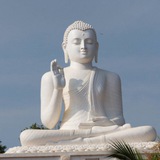
Big Buddha Dordenma or Thimphu Buddha Point, made of bronze and gilded in gold, Kuenselphodrang palace, Thimphu, Bhutan.
👏2🔥1🥰1🙏1
The Peacock: a past life story
This Clear-eyed One arises, the One King, palomino-colored, shining over the earth. I bow especially to you, palomino-colored, shining over the earth: guarded by you let us live out this day.
Those brahmins who are knowledge-masters with respect to all things, I worship them, may they keep me safe. Hail the Awakened Ones, hail Awakening! Homage to the freed ones, homage to freedom! Having made this protection, the peacock wanders seeking.
This Clear-eyed One sets, the One King, palomino-colored, shining over the earth. I bow especially to you, palomino-colored, shining over the earth: guarded by you let us live out this night.
Those brahmins who are knowledge-masters with respect to all things, I worship them, may they keep me safe. Hail the Awakened Ones, hail Awakening! Homage to the freed ones, homage to freedom! Having made this protection, the peacock made his home.
Ja 159 : Mora Jataka
🙏1👌1💯1
Forwarded from Buddha
Just Another Thing in the Forest
Ajahn Amaro, the co-abbot of Abhayagiri forest monastery in northern California, on the renunciant life, divesting the heart of baggage, and feeding the mosquitoes.
Part 1 of 3
Venerable Ajahn Amaro has been a monk in the Thai forest tradition for twenty years and is the co-abbot of Abhayagiri, a monastery he helped to found two years ago in northern California. He grew up J. C. Horner in the English countryside and studied physiology and psychology at the University of London, where he realized that “after forty years of studying the mind, my professors were no happier or wiser than I was.” As a student, his mind-expansion technology consisted of listening to music, reading mystical literature—”Ramakrishna and the like”—and pursuing Dionysian revelry. But a Rudolf Steiner-school philosopher, Trevor Ravenscroft, pointed him toward Asia. At the age of twenty-one, he landed at Wat Pah Nanachat, a monastery in the forest tradition for the Western disciples of meditation master Ajaan Chah.
Ajaan Chah ordained him sometime after his twenty-second birthday, and Amaro Bhikkhu, as he was then known, spent two years training in Thailand before returning to England. Here he joined the man who would be his teacher, Ajahn Sumedho, an American disciple of Ajaan Chah, at the newly founded Chithurst Monastery in the woods seventy miles southwest of London.
Abhayagiri sits on 250 mountain acres in Mendocino County that were donated to Ajahn Sumedho and the order by the late Master Hsuan Hua, the Chinese Buddhist teacher and founder of the California temple City of Ten Thousand Buddhas. Nestled amidst madrone-covered hills are the meditation hall, a common building with kitchen and offices, and a half-dozen isolated wooden huti, or meditation huts, where nine monastics—seven men and two women—live and practice, each hut adjoining a shaded path for walking meditation. Some of the monastics as well as lay visitors to the community stay in tents and trailers. Abhayagiri, unlike its sister monasteries, whose funding comes largely from Thailand and other Asian communities, is supported by “good old Caucasian middle-class intellectual meditators.” Ajahn Amaro is the author of Silent Rain, a collection of journal entries and dharma talks.
The Buddha got enlightened in a forest. What is it about being in the forest that helps people? The ignorance that human beings experience is largely based around the identification that we have with our bodies, with our personalities, our families, and our work, and because we’re so woven into those identities—in the midst of our family, in our role as a doctor or teacher, parent, or child, as a personality among other personalities—it’s very difficult to get any kind of perspective. Being in natural surroundings, you don’t have to perform; you don’t have to be anything. Your role as someone with a university degree or as the third sibling in your family is irrelevant to the lizards and the trees. You’re just another thing in the forest. And those cultural identities fall into a much more diminished position in your consciousness. When you’re around other people—and this is true in monastic life as well—it’s hard to keep that perspective. But life in the forest gives you that contrast, where you can exist and not be anything. You’re able to look at the flow of consciousness—thoughts, feelings, memories, ideas—without having to act on any of them. And you’re there with the simplest elements of your being: breathing, feeling the heat or cold, learning to live with the other creatures of the forest. You’re moving from a person-centered perspective to one centered on nature.
How does this get worked out day after day? One example is that I’d never related to myself as a food source before. We talk about precepts of nonviolence, and there you are faced with mosquitoes and other critters and you’re moaning and complaining when they come along to bite you. But when you look at it, you’ve just brought this huge, luscious, pungent piece of meat into their midst.
Telegram
Buddha
Buddha dharma teachings from the suttas and commentaries
👍1😁1😇1
Forwarded from Buddha
You’re like a huge flashing sign outside of Dunkin’ Donuts that says “Eat Me! Free Food! Help Yourself!”
Do you have to be a monastic to take full advantage of the forest? It’s not required. But renunciation has to do with simplicity, so there’s no condition in which your heart is invested. The principle of renunciation is not to encourage a state of lack, but to establish as complete a state of simplicity as possible. In that simplicity you can more clearly see those patterns of wanting, not wanting, fearing, hoping, as they take shape. And the more complex our life is, the harder it is—particularly those emotional involvements with other people that create the most dense and potent conditions or qualities of mind that we deal with. The more charged-up our emotional bonds, the more difficult it is to get objectivity on them. It’s not a moral judgment; it’s just physics. Picking up a one-hundred-pound bag takes more effort than picking up a twenty-pound bag.
What’s been hardest for you about the renunciant life? Different things hit you at different phases of your evolution. Early on, I had a lot of restlessness and youthful physical energy. I was twenty-one when I started. Just finding a place to put all that energy was hard work. But Ajahn Sumedho helped me channel that. At other points, it’s been conflicting with people. When you’re living in community you can’t just say, “I’m out of here.” You actually have to stay and work things through.
===
Buddha dharma teachings channel:
https://xn--r1a.website/lorddivinebuddha
===
Telegram
Buddha
Buddha dharma teachings from the suttas and commentaries
🏆1👻1🫡1
Forwarded from Words of the Buddha
“Bhikkhus, there are world interstices, vacant and abysmal regions of blinding darkness and gloom, where the light of the sun and moon, so powerful and mighty, does not reach.”
When this was said, a certain bhikkhu said to the Blessed One: “That darkness, venerable sir, is indeed great; that darkness is indeed very great. But is there, venerable sir, any other darkness greater and more frightful than that one?”
“There is, bhikkhu.”
Those ascetics and brahmins, bhikkhu, who do not understand as it really is: ‘This is suffering’; who do not understand as it really is: ‘This is the origin of suffering’; who do not understand as it really is: ‘This is the cessation of suffering’; who do not understand as it really is: ‘This is the way leading to the cessation of suffering’— they tumble into the darkness of birth, aging, death, sorrow, lamentation, pain, displeasure, and despair.
Partial excerpts from SN 56.46 : Andhakasrasutta : Darkness
⚡1🔥1🙏1😇1
Just Another Thing in the Forest
Ajahn Amaro, the co-abbot of Abhayagiri forest monastery in northern California, on the renunciant life, divesting the heart of baggage, and feeding the mosquitoes.
Part 2 of 3
And celibacy? That’s on the other side of the scale: attraction to other people. You recognize that as part of the human condition there are urges and fear and aggression and sexual desire and ambition, and they’re always easily ignited in any kind of community because of our biological makeup. The Buddha said that sexual energy is the most powerful force in the universe. It’s extraordinarily powerful, because it has to be. If it wasn’t so compelling as to override all sons of fear and discernment, then you’d never engage with another person in that way.
How do you practice with that? Looking at a tree, I would say, that’s a beautiful tree. Or a horse. That beauty isn’t having the same confusing effect as when I think about So-and-So. So comparing, and really studying the chemistry of it. When I look at this tree and this horse, the mind is clear and open. When I look at this person, I can see it in a clear and open way momentarily, but it gets confused. Now, what’s causing that? When you know how it works, it’s much easier not to be fooled by it. When you’re a monastic and you’re functioning in a nonsexual way, you’re consciously laying aside that manner of relating. So you’re better able to function with other beings on the basis of being-to-being rather than “Am I attractive? Is she attractive?”
What rules have you had to modify for this monastery? Adherence to the rule might be very faithful but totally impractical, perhaps totally stupid. A temple in England spent £37,000 on a heating bill because the monks went bare-shouldered in an English winter. All of the adaptations we’ve made we waited until there was a real need, and then we changed. When Ajahn Sumedho was in Thailand and preparing to come to England, he decided: we’ll just do what we do until we need to change it. So first of all, they went out on alms-round every day barefoot. And then they got to their first winter, and then they’d come back to the vihara and their feet would be blue. There were so many complaints and fears from the laypeople who saw what they were doing that they decided to go out with shoes and socks. If you look at the Vinaya, it says over and over again, “The laypeople saw such and such and they were upset so they took the matter to the Buddha and the Buddha said, ‘Monks, I allow you to do such and such.'” There are a number of rules that even highly observant monks in Asia break quite cheerfully on a daily basis. In Thailand, for instance, the size of the robes is vastly greater than what’s allowed in the Vinaya, which is supposed to be nine hand spans of the Buddha by six hand spans of the Buddha. And the robes we have are two meters by three meters. And they get around that by saying, “Well, the Buddha was eighteen feet tall.” Which is, in my humble opinion, patently absurd. But every monk in the country wears a robe that’s too big compared to the size allowed in the Vinaya. And it’s against the Vinaya to travel in a vehicle. But that’s because a vehicle would have been a cart pulled by an animal and you don’t want to burden another being.
Here, it seems that you’ve departed pretty radically from the Thai forest tradition by creating your own nuns’ rules. That’s the biggest change we’ve made. Thailand is probably the worst situation for women’s training in monastic life. There’s only the Eight Precept ordination. And in Thailand, for a woman of an upper-class family, it’s basically a disgrace to be ordained. She would not be allowed by her family to ordain. It would be as bad as becoming a streetwalker. It’s believed that a woman who ordains would do so only if she were socially inept, couldn’t bear children, couldn’t find husband—it’s like you’re a failed being. And it brings a kind of shadow into the family. Which is bizarre, because to be a monk is considered the most meritorious thing you can do in a family.
Telegram
Dhammapada - Buddha Dharma Teachings
Daily teachings of the Dhammapada, beloved and favorite teachings of the Buddha
✍1💯1🎃1
What did you base your nunnery on? When we opened up Chithurst, the monastery in England, in 1979, Ajahn Sumedho gave four women the Eight Precept ordination, and everything was dandy. But after a couple of years, we realized that men who had just arrived were getting higher places in the community and the nuns were still in the kitchen, wondering if they would still be cooking the beans in forty years.
In the Buddha’s time, the women’s order had many more rules than the men’s. Right. Three hundred thirteen to the men’s 227. When we were discussing all this—and it took seven years to come up with the current structure—it became clear that none of the women in our community wanted to live according to most of those rules. One of the rules—and it’s a serious offense to break it—is that you may never sleep more than a forearm’s distance from another nun. So if you’re a bhikkhuni, you can never sleep in your own room ever again. You can never travel alone, you can never sleep in your own bed.
Why would a rule like that exist in the first place? A huge portion of the rules for nuns had to do with safety. Because a woman in India at that time had to be under the protection of her father, her brother, her husband, or her son, or some other male relative. A woman on her own was extraordinarily vulnerable. A lot of the nuns’ Vinaya was about safety—they can’t travel alone, they can’t sleep alone, they couldn’t go out in the forest because of the danger of being molested and raped. In a way, it’s almost a blessing that the nuns’ order died out in the Theravada so you can reestablish it according to the culture as it exists.
===
Part 1 of 3:
https://xn--r1a.website/lorddivinebuddha/5060
Part 2 of 3:
https://xn--r1a.website/dhammapadas/4541
Part 3 of 3:
https://xn--r1a.website/wordsofbuddha/6337
===
Dhammapada, beloved and favorite teachings of the Buddha channel:
https://xn--r1a.website/dhammapadas
===
Telegram
Buddha
Just Another Thing in the Forest
Ajahn Amaro, the co-abbot of Abhayagiri forest monastery in northern California, on the renunciant life, divesting the heart of baggage, and feeding the mosquitoes.
Part 1 of 3
Venerable Ajahn Amaro has been a monk in the…
⚡1🤮1💯1🤗1
9. Yassa kàyena vàcàya
manasà natthi dukkatam
Samvutam tãhi ñhànehi
tam aham brumi brahmanam. 391.
HE IS A TRUE BRAHMANA WHO IS WELL-RESTRAINED
9. He that does no evil through body, speech or mind, who is restrained in these three respects - him I call a brahmana. 391.
Story
Some nuns would not observe the vinaya ceremonies with the Venerable Mahà Pajàpati Gotami since they doubted her authenticity as a bhikkhunã (nun). The Buddha explained matters and remarked that no doubts should be entertained with regard to a Passionless One who is restrained in the three doors (i.e., body, speech and mind).
===
Buddha dharma teachings channel:
https://xn--r1a.website/lorddivinebuddha
===
Telegram
Buddha
Buddha dharma teachings from the suttas and commentaries
🙏2❤1👌1💯1
“Suppose, mendicants, there was a lake that was cloudy, murky, and muddy. A person with clear eyes standing on the bank would not see the clams and mussels, and pebbles and gravel, and schools of fish swimming about or staying still. [...]
“Suppose, mendicants, there was a lake that was transparent, clear, and unclouded. A person with clear eyes standing on the bank would see the clams and mussels, and pebbles and gravel, and schools of fish swimming about or staying still. Why is that? Because the water is unclouded. In the same way, that a mendicant whose mind is not clouded would know what’s for their own good, the good of another, or the good of both; or that they would realize any superhuman distinction in knowledge and vision worthy of the noble ones: this is quite possible. Why is that? Because their mind is unclouded.”
AN 1.45-46 : Udakarahaka Suttas: A Pool of Water
👏1🙏1🕊1😇1