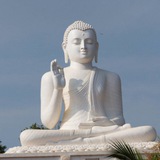
When you’ve laid down arms toward all creatures, not harming even a single one, don’t wish for a child, let alone a companion: live alone like a horned rhino.
When feelings for friends and loved ones are tied up in selfish love, you miss out on the goal. Seeing this peril in intimacy, live alone like a horned rhino.
As a spreading bamboo gets entangled, so does concern for partners and children. Like a bamboo shoot unobstructed, live alone like a horned rhino.
At ease in any quarter, unresisting, content with whatever comes your way; prevailing over adversities, dauntless, live alone like a horned rhino.
Having shed the marks of the home life, like the fallen leaves of the Shady Orchid Tree; having cut the bonds of the home life, a hero would live alone like a horned rhino.
Clearly we praise the blessing of a friend, it’s good to be with friends your equal or better. but failing to find them, eating blamelessly, live alone like a horned rhino.
Partial excepts from Snp 1.3 : Khaggavisāṇasutta
===
🙏4🔥1👌1😇1
Forwarded from Buddha
Free Buddhism ebook
From Heart and Hand
By Ajahn Jayasaro
A collection of one-page Dhamma summaries handwritten daily by Ajahn Jayasaro “to all those with limited time at their disposal.”
Free download here:
https://www.abhayagiri.org/media/books/jayasaro_from.heart.and.hand.pdf
https://www.abhayagiri.org/media/books/jayasaro_from.heart.and.hand_vol2.pdf
https://www.abhayagiri.org/media/books/jayasaro_from.heart.and.hand_vol3.pdf
===
🕊1💘1
Forwarded from Words of the Buddha
Wat Arun Ratchawararam Ratchawaramahawihan Buddhist temple, Thonburi, on the west bank of the Chao Phraya River, Bangkok, Thailand.
🤩2😍1😎1
Forwarded from Buddha Dharma books
Free Buddhism ebook
Times and the Timeless
By Ajahn Candasiri
Free download available:
https://cdn.amaravati.org/wp-content/uploads/2022/12/25/Times-and-the-Timeless-Web.pdf
===
👍1👏1🏆1
Forwarded from Buddha Dharma books
Free Buddhism ebook
Times and the Timeless
By Ajahn Candasiri
This little collection was never intended as a ‘collection of teachings.’ It came about in response to a request and a suggestion. The request was from Sarah Wallis who wanted to sponsor a publication in celebration of her sixtieth birthday, and to mark thirty years of the Banbury Buddhist Group. The suggestion, also from Sarah, was to gather together the reflections that had been individually prepared for the twice-yearly editions of our Milntuim Hermitage Newsletter.
It was a surprise to find that there are twenty of these – and even more of a surprise to find that the reflections are all quite different. Every time I wrote a reflection, my intention was to offer encouragement for practice with the prevailing conditions; it seemed to me that it was always the same Dhamma1 practice that I pointed to. However, what I had failed to appreciate was that the actual conditions were different each time!
So, after an initial hesitation, I asked some of my monastic and lay friends to read what was there. Ajahn Sucitto, Ajahn Munindo and Ajahn Sundarā all offered encouraging and helpful feedback, as did several kind lay friends. Members of the Lotus Volunteer Group gathered the material in one place, and Mariah O’Neill gave it a thorough edit. Eleonora Monti has helped to prepare the text for publication. Nicholas Halliday offered his expertise in preparing the practical and artistic elements, patiently to-ing and fro-ing with proof-readers until it was ‘just about right’ enough.
May it serve as an encouragement to attune to the Dhamma, the Timeless, as we navigate the uncharted waters of the times to come.
Free download available:
https://cdn.amaravati.org/wp-content/uploads/2022/12/25/Times-and-the-Timeless-Web.pdf
===
☃1👍1🫡1
16. Ekàsanam ekaseyyam
eko caram atandito
Eko damayam attànam
vanante ramito siyà. 305.
ALONE ONE DELIGHTS IN SOLITUDE
16. He who sits alone, rests alone, walks alone, unindolent, who in solitude controls himself, will find delight in the forest. 305.
Story
Praising the life of solitude led by a monk, the Buddha uttered this verse.
===
Dhammapada, beloved and favorite teachings of the Buddha channel:
https://invite.viber.com/?g2=AQBLD6phsgvP%2F061YjEM3K%2BNeH1Yb372b9mtfQX2EmuBpgoLUoc99BDMfzHghrme
===
Viber
Dhammapada - Buddha Dharma Teachings
Daily teachings of the Dhammapada, beloved and favorite teachings of the Buddha
👍1👏1🤝1
“Guttā, why did you go forth?
You have left behind child, wealth, and all that is dear.
Practice in this way,
do not be controlled by the mind.
Sentient beings are misguided by the mind,
enjoying the realm of Māra.
Fools wander along in saṁsāra,
running through countless births.
Interest in sensual pleasures, ill will,
attachment to self-identity,
clinging to rites and rituals,
and the fifth is doubt—
once you abandon these fetters,
Bhikkhunī,
you will not return
to the near shore again.
Once you forsake passion, conceit, ignorance,
and restlessness,
having cut off the fetters,
you will bring suffering to an end.
Once you have discarded birth in saṁsāra,
having fully understood how existence is renewed,
seeing the Dhamma, without cravings,
you will walk in peace.”
Thig 6.7 Guttātherīgāthā: Verses of the Elder Guttā
👏3🕊1😇1
Forwarded from Words of the Buddha
Poy Sang Long, a Shan ceremony, a rite of passage for boys between 7 and 14 years old in Myanmar and northern Thailand. It involves the ordination of boys as novice monks, a symbolic representation of the Buddha's renunciation of worldly life. The ceremony includes a parade where the boys, dressed in elaborate costumes, are carried on the shoulders of their relatives.
🎉1🍓1🍾1
Chapter 22
Niraya Vagga
Woeful State
(Text and Translation by Ven. Nàrada)
1. Abhutavàdã nirayam upeti
yo c'àpi katvà na karomã'ti c'àha
Ubho' pi te pecca samà bhavanti
nihãnakammà manujà parattha. 306.
LIARS SUFFER
1. The speaker of untruth goes to a woeful state, and also he who, having done aught, says, "I did not". Both after death become equal, men of base actions in the other world. 306.
Story
In order to disparage the Buddha a woman was killed by some villains hired by a heretical sect and the corpse was concealed in a rubbish heap near the Buddha's Perfumed Chamber. Later, the murderers confessed their guilt implicating the heretics. Discoursing on the evil of false accusation, the Buddha uttered this verse.
===
Ajahn Chah, Buddhist teacher of Thai forest meditation of Theravada Buddhism channel:
https://xn--r1a.website/ajahnchah_buddhism
===
Telegram
Ajahn Chah - Theravada Thailand Buddhism
Collection of teachings of Venerable Ajahn Chah, a foremost meditation and Buddhist teacher from Thailand
⚡1👍1👏1👀1
Free Buddha Dharma ebook
Invitation to Insight Meditation
By Visuddhacara
Free download available:
https://www.lotuslibrary.com/wp-content/uploads/2024/08/1910-Invitation-to-Insight-Meditation_Vishuddhacara.pdf
===
👌1😇1
Free Buddha Dharma ebook
Invitation to Insight Meditation
By Visuddhacara
This book contains two sections: 1. Invitation to Vipassana and 2. Basic Instructions. In the first part, I have endeavoured to explain:
a) the basic principles underlying the Vipassana practice, how it is essentially the observation of physical and mental processes that occur in the body and mind,
b) how this observation leads to the understanding of the truths
of impermanence, suffering and not-self as taught by the Buddha,
c) how the application of mindfulness is required for this observation,
d) how the Wisdom of impermanence, etc. is important, making us wiser, stronger, etc. – i.e. the benefits we can get from this understanding, how it helps us in our daily life, and shape our whole outlook and attitude towards life, and
e) various other aspects of the benefits of mindfulness and living in the present, such as the curtailment of worries and anxieties, improvement in health, concentration and memory.
Free download available:
https://www.lotuslibrary.com/wp-content/uploads/2024/08/1910-Invitation-to-Insight-Meditation_Vishuddhacara.pdf
===
👍1🕊1🤝1
Forwarded from Words of the Buddha
"Reflecting well, I use this food not for pleasure, nor for pleasure, nor for fattening, nor for embellishment, but only for the maintenance and feeding of this body, to maintain it Healthy, to help with spiritual life."
🙏3❤1👏1👌1
Dhammanussati Bhavana, recollection of the qualities of the Dhamma
“Mahanama, when a noble disciple has reached the fruit and understood the instructions they frequently practice this kind of meditation.
...... A noble disciple recollects the teaching: ‘The teaching is well explained by the Buddha (Svakkhato) —apparent in the present life (Sanditthiko), immediately effective (Akaliko), inviting inspection (Ehipassiko), relevant, so that sensible people can know it for themselves (Opanayiko).’ When a noble disciple recollects the teaching their mind is not full of greed, hate, and delusion. … This is called a noble disciple who lives in balance among people who are unbalanced, and lives untroubled among people who are troubled. They’ve entered the stream of the teaching and develop the recollection of the teaching.
Source: Mahanamasutta, Anguttara Nikaya 6.10
🙏1🏆1😇1
Forwarded from Words of the Buddha
The Ten Armies of Mara
This legendary trickster infiltrates our lives in numerous ways.
By Venerable Upekkha
Part 1 of 2
In Buddhism, Mara is what we would think of as the devil. But is it so? What is Mara? Who is Mara? Does Mara really exist?
For Buddhists, Mara is often just the psychology of our deluded mind. But when you read the suttas, Mara is more than just psychology. He turns up in various places. He often comes to the Buddha and whispers things in his ear. For example, after the Buddha was fully enlightened and sitting in the bliss of jhana, he was contemplating whether to teach or not. Then Mara went up to him and said, “Don’t bother. These people are difficult to teach.
They won’t get what you say. It will be much easier for you just to enjoy your peace.” If Mara were just defilements in the mind, that wouldn’t have turned up in a Buddha’s mind. Someone who has been practicing for eons would not have this thought.
So it seems that Mara is more than just a personification of evil. Based on the suttas, Mara is a real person. He lives somewhere. And he doesn’t live in some cauldron of oil, ready to pull somebody in. He lives in the Paranirmitavashavartin realm, a heavenly realm. The name translates as “the heaven where beings delight in controlling the creation of others.” In other words, they manipulate. They delight in controlling other people’s stuff, other people’s delights, other people’s projections, other people’s creations.
There is a sutta on the ten armies of Mara. It’s good to be aware of how the little things we do are feeding into this trap that Mara perpetuates. This trap keeps you ticking over in samsara and telling you that if you try hard enough, get the right house, get the right car, and find the right partner, you will live happily ever after! We all buy into it, right? It is only when you are out of the sense world and in the jhanas that you have escaped Mara. But in the meantime, we can be aware of Mara’s realm so that we can recognize and turn away from the very things that cause us to perpetuate suffering. These are ten armies of Mara:
The first army is sensual pleasures. It’s like our bread and butter. The economy thrives on it. We buy the latest iPhone, thinking that it’s going to be exactly what we need. We go out to dinner. We spend ages finding the right food. Have sensual pleasures ever given you everlasting happiness? No. But you keep pursuing them, because somewhere deep inside you think that you’re going to find that sweet chili.
The next time you’re going on the internet to find the perfect thing for the corner of your room, just hold back. Is that thing going to bring ultimate happiness? Is it better to buy that thing, or just sit down and do something more meaningful with your time? The internet is like heaven for Mara. He doesn’t even have to bother. He probably created the internet. Maybe he did. . . . Anyway, I won’t go down that road.
The second army is boredom. We are encouraged to not waste a moment by sitting down and doing nothing. We go on our phones to see if something needs to be done or if someone has replied to us. We can’t just sit, read the newspaper, and finish our work. We can’t “do nothing.” I was on the train going to Sydney the other day, and I noticed this glassy look in people’s eyes when they weren’t on their phones. We have difficulty with just doing nothing. We stare into outer space, and we look dead.
We are afraid to get out of the box that we have put ourselves into. And Mara loves it.
Allow yourself to be bored. Allow yourself to not pick up your phone. Allow yourself to not go to the fridge and find something to put in your mouth just to entertain yourself. In other words, boredom and discontent take us away from being silent and looking inside our bodies and minds.
Telegram
Words of the Buddha
Daily teachings of Buddha Dharma
🔥2👏1
Forwarded from Words of the Buddha
The third army is something, fortunately, that most of us don’t have to deal with: hunger and thirst. I am sure few of us have had to genuinely experience hunger, but if we did, we’d kill somebody. Do you know how many wars are fought over water or land that is fertile, just because of hunger and thirst? On the other side of it, obesity is also an obsession with hunger and the desire to feed our bodies. So this one is still relevant, even in our modern times.
===
Words of the Buddha channel:
https://xn--r1a.website/wordsofbuddha
===
Telegram
Words of the Buddha
Daily teachings of Buddha Dharma
🆒2😍1
Forwarded from Buddha
The Ten Armies of Mara
This legendary trickster infiltrates our lives in numerous ways.
By Venerable Upekkha
Part 2 of 2
The fourth army is craving. This may seem like a repeat, since sensual pleasures are all about craving. But craving is not just for sense pleasures. It’s also our craving to be somebody. We want to be known at work. We want to be the person who does a good job. We are constantly trying to be the one that people like, the one that people go to. It’s all good stuff, but it’s still rooted in desire. We feed on that drive.
There’s the desire not to be as well. This is a bit anarchistic. It says, “Oh, who cares? I’m just going to do whatever I want.” The desire for annihilation is the precursor to not keeping your precepts.
The fifth army is dullness and drowsiness. We work like crazy and we sleep like crazy. We have no time to meditate because we’re so busy doing one or the other. Notice how we tend to push ourselves to the max and then collapse. We have no time to just be mindful, clear, and aware. Dullness and drowsiness could also be dulling our senses with alcohol, or simply falling asleep in front of the television. Notice your tendency to switch off, rather than being with your mind and being with the uncomfortable feeling of wanting to fall asleep. Notice it, but don’t buy into it.
The sixth army is cowardice. It is not taking a risk, not going outside your comfort zone, not leaving the job you hate. It’s the voice of your mother saying, “Don’t do it! Why are you wasting your time going to monasteries? Just do what everybody else does!” Cowardice often stops us from getting out of the comfort zones that we put our minds in. We do the same old thing, go to the same old places on holiday, and talk to the same old people about the same old stuff, because we are afraid. We are afraid to get out of the box that we have put ourselves into. And Mara loves it. He doesn’t want you to look outside.
The seventh army is doubt. Nowadays, we have 10 million religions to choose from. Each of them says “This is the path to enlightenment!” Some say you can have your cake and eat it too. We have so many teachings to choose from. How do we know which one is the right one?
The eighth army is contempt and obstinacy. Contempt is putting someone down. We enjoy that, don’t we? We feel superior when we think, “They don’t really know what they’re doing, but I know what I’m doing.” We delight in that, and it stops us from looking within and seeing our own faults. Quite often, what we don’t like about others are the very things that we don’t like about ourselves. Contempt is another one that Mara loves. And obstinacy is simply being stubborn. “I know what I’m doing. You don’t tell me what to do. I’m going to keep doing it my way.”
It’s good to be aware of how the little things we do are feeding into this trap that Mara perpetuates.
The ninth army is praise and honor. We like doing a good job. We’re suckers for people liking us. We’re suckers for people. This isn’t a bad thing on its own, but it drives us in a certain direction. It drives us to do what people want us to do. It drives us to do what Mara wants us to do. It drives us to not do something that is different from what the sheep are doing.
The last army is extolling oneself and scorning others, or putting ourselves up and disparaging others. Again, we do this all the time. We do it in innocuous ways, like criticizing the government. We think that’s all right because the government doesn’t talk back. The TV doesn’t talk back to us either. But think: What does it do to our mind when we belittle someone? What does it do to our hearts when we think of ourselves as slightly superior to someone else?
These are the ten armies of Mara. I hope I didn’t depress anyone. It’s good to be aware of them, because they’re not inherently evil but, rather, subtle ways that we waste our life. Becoming aware of these tendencies helps us to pull back every time we are about to bite the hook.
Telegram
Buddha
Buddha dharma teachings from the suttas and commentaries
🙏1🕊1🫡1
Forwarded from Buddha
And, of course, we can then turn our attention to the far more beautiful things that we can do with our minds, like having thoughts of generosity, caring, sharing, and compassion. These things are what the Buddha encouraged us to develop to find true joy that leads to a purified mind.
===
Adapted from the dharma talk “Venerable Upekkhā: Ten Armies of Mara,” based on Letter from Mara by Ajahn Punnadhammo, uploaded to the Anukampa Bhikkhuni Project YouTube channel.
Venerable Upekkhā is a Sri Lankan Australian Theravada nun. She resides at Santi Forest Monastery in Australia.
===
Part 1 of 2:
https://xn--r1a.website/wordsofbuddha/5882
Part 2 of 2:
https://xn--r1a.website/lorddivinebuddha/4729
===
Buddha dharma teachings channel:
https://xn--r1a.website/lorddivinebuddha
===
Telegram
Words of the Buddha
The Ten Armies of Mara
This legendary trickster infiltrates our lives in numerous ways.
By Venerable Upekkha
Part 1 of 2
In Buddhism, Mara is what we would think of as the devil. But is it so? What is Mara? Who is Mara? Does Mara really exist?
For…
🆒2🎉1👌1