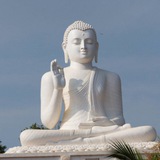
Forwarded from Words of the Buddha
“Suppose, mendicants, there was a lake that was cloudy, murky, and muddy. A person with clear eyes standing on the bank would not see the clams and mussels, and pebbles and gravel, and schools of fish swimming about or staying still. [...]
“Suppose, mendicants, there was a lake that was transparent, clear, and unclouded. A person with clear eyes standing on the bank would see the clams and mussels, and pebbles and gravel, and schools of fish swimming about or staying still. Why is that? Because the water is unclouded. In the same way, that a mendicant whose mind is not clouded would know what’s for their own good, the good of another, or the good of both; or that they would realize any superhuman distinction in knowledge and vision worthy of the noble ones: this is quite possible. Why is that? Because their mind is unclouded.”
AN 1.45-46 : Udakarahaka Suttas: A Pool of Water
❤1👌1🕊1
7. Sabbe dhammà anattà' ti
yadà paññàya passati
Atha nibbindati dukkhe
esa maggo visuddhiyà. 279.
EVERYTHING IS SOULLESS
7. "All Dhammas are without a soul": 9 when this, with wisdom, one discerns, then is one disgusted with ill; this is the path to purity. 279.
Story
The Buddha, perceiving that many monks had meditated on nor-soul in the past, advised them to continue that meditation.
===
Free Buddhism books, teachings, podcasts and videos from Theravada, Mahayana and Vajrayana traditions:
https://xn--r1a.website/buddha_ebooks
===
Telegram
Buddha Dharma books
Free Buddhism books, teachings, podcasts and videos from Theravada, Mahayana and Vajrayana traditions
🔥1👏1🙏1💯1
Forwarded from Words of the Buddha
The Watt Munisotaram, Cambodian Buddhist temple, Hampton, Minnesota, USA.
😇2☃1🕊1🎄1
Forwarded from Words of the Buddha
Preah Vihear temple, built in the 11th century by King Suryavarman of Khmer empire, located in Dangrek Mountain, at the unresolved border between Khmer Empire and Kingdom of Siam.
❤1👍1👏1🕊1
Forwarded from Buddha Dharma books
Free Buddhism ebook
Noble Warrior
A Life of the Buddha Compiled from the Pali Cannon
By Thanissaro Bhikkhu
Free download available:
https://drive.google.com/file/d/1VeTMFIaswUzfCl8ap_3uS8hIJXHT9ays/view?usp=drive_link
===
👏1🤗1🆒1
Forwarded from Buddha Dharma books
Free Buddhism ebook
Noble Warrior
A Life of the Buddha Compiled from the Pali Cannon
By Thanissaro Bhikkhu
A biography of the Buddha using passages collected exclusively from the Pāli Canon. The translated passages are interspersed with a minimum of explanation, allowing the compilers of the Canon to speak for themselves. While the passages in the Canon are not sufficient for a strictly chronological account, they do contain ample material for a thematic one that highlights the Buddha’s three main accomplishments: 1) finding the path and attaining awakening, 2) teaching that path to his contemporaries, establishing a living apprenticeship for awakening, and 3) establishing the Dhamma and Vinaya to give structure to that apprenticeship so that the True Dhamma would last for many generations. Particular attention is given to the many accounts of the Buddha’s awakening and the role that his awakening played in shaping the Dhamma he taught.
Free download available:
https://drive.google.com/file/d/1VeTMFIaswUzfCl8ap_3uS8hIJXHT9ays/view?usp=drive_link
===
✍1🎉1🏆1
8. Uññhànakàlamhi anuññhahàno
yuvà balã àlasiyam upeto
Samsannasaïkappamano kusãto
paññàya maggam alaso na vindati. 280.
THE SLOTHFUL DO NOT REALIZE THE PATH
8. The inactive idler who strives not when he should strive, who, though young and strong, is slothful, with (good) thoughts depressed, 10 does not by wisdom realize the Path. 280.
Story
Many fellow monks excluding one who remained behind in the monastery, went to the forest and attained Arahantship. when they returned the Buddha exchanged friendly greetings with them but not with the one who had remained behind. This action of the Buddha stimulated him to strive to attain Arahantship. He strove hard in the night but unfortunately met with an accident which brought his fellow monks to attend on him. The Buddha commented on the difficulty of realization by an idler.
===
Buddha dharma teachings channel:
https://xn--r1a.website/lorddivinebuddha
===
Telegram
Buddha
Buddha dharma teachings from the suttas and commentaries
👏1💯1🤝1
Forwarded from Words of the Buddha
Big Amitabha Buddha Taiwan, Fu Guang Shan monastery, Kaohsiung, Taiwan.
🥰2❤1👏1😇1
9. Vàcànurakkhã manasà susamvuto
kàyena ca akusalam na kayirà
Ete tayo kammapathe visodhaye
àràdhaye maggam isippaveditam. 281.
PURIFY THOUGHTS, WORDS AND DEEDS
9. Watchful of speech, well restrained in mind, let him do nought unskilful through his body. Let him purify these three ways of action and win the path realized by the sages. 281.
Story
A monk, having divided by slander two monks who were friends, was reborn as a hideous Peta. The Venerable Moggallàna saw him and mentioned it to the Buddha, who also had seen him on an earlier occasion. The Buddha thereupon commented on the evil consequences of slandering.
===
Words of the Buddha channel:
https://xn--r1a.website/wordsofbuddha
===
Telegram
Words of the Buddha
Daily teachings of Buddha Dharma
🙏1👌1💯1
Abhinhapaccavekkhana
Buddha's teachings for contemplation
Jarā-dhammomhi
jaram anatīto.
Byādhi-dhammomhi
byādhim anatīto.
Maraṇa-dhammomhi
maraṇam anatīto.
Sabbehi me piyehi manāpehi nānā-bhāvo vinā-bhāvo.
Kammassakomhi
kamma-dāyādo
kamma-yoni
kamma-bandhu
kamma-paṭisaraṇo.
Yam kammam karissāmi kalyāṇam vā pāpakam vā tassa dāyādo
bhavissāmi.
Evam amhehi abhiṇham paccavekkhitabbam.
I am subject to aging;
I have not gone beyond aging.
I am subject to illness;
I have not gone beyond illness.
I am subject to death;
I have not gone beyond death.
I must be separated and parted from all that is dear and pleasing to me.
I am the owner of my karma,
the heir to my karma,
born of my karma,
related to my karma,
and supported by my karma.
Whatever karma I shall do, whether good or bad,
of those I shall be the heir.
✍1🙏1🤝1🫡1
Forwarded from Buddha
Free Buddha dharma ebook
Serenity Is the Final Word
By Ajahn Amaro
Free download here:
https://cdn.amaravati.org/wp-content/uploads/2022/08/27/Ajahn-Amaro-Serenity-is-the-Final-Word.pdf
===
👏1🍾1🫡1
Forwarded from Buddha
Free Buddha dharma ebook
Serenity Is the Final Word
By Ajahn Amaro
"I thought I would begin by offering a few reflections about equanimity or upekkhā. This is one of the most significant psychological, emotional qualities talked about in the Buddhist tradition. However, because we commonly translate the word upekkhā in English as ‘equanimity’, it can easily be overlooked or seen as something a bit insignificant, not so practical or even heartwarming, as the word ‘equanimity’ in English can easily mean ‘indifference’, not really caring – it can be taken to be a switched-off, disconnected and somewhat numb attitude towards things."
Free download here:
https://cdn.amaravati.org/wp-content/uploads/2022/08/27/Ajahn-Amaro-Serenity-is-the-Final-Word.pdf
===
🕊1💯1🆒1
Forwarded from Words of the Buddha
Since I’ve gone forth
from the lay life to homelessness,
I’m not aware of any intention
that is ignoble and hateful.
I have been aware of loving-kindness,
limitless and well-developed;
gradually consolidated
as it was taught by the Buddha.
I’m friend and comrade to all,
compassionate for all beings!
I develop a mind of love,
always delighting in harmlessness.
Unfaltering, unshakable,
I gladden the mind.
I develop the divine meditation,
which sinners do not cultivate.
Having entered a meditation state without thought,
a disciple of the Buddha
is at that moment blessed
with noble silence.
I’ve served the teacher
and fulfilled the Buddha’s instructions.
The heavy burden is laid down,
the conduit to rebirth is eradicated.
I’ve attained the goal
for the sake of which I went forth
from the lay life to homelessness—
the ending of all fetters.
Persist with diligence:
this is my instruction.
Come, I’ll be fully extinguished—
I’m liberated in every way.
Thag 14.1 Khadiravaniyarevatattheragāthā
🙏4❤1👌1😇1
10. Yogà ve jàyati bhuri
ayogà bhurisaïkhayo
Etam dvedhà pathamñatvà
bhavàya vibhavàya ca
Tath' attànam niveseyya
yathà bhuri pavaddhati. 282.
ACT IN SUCH A WAY THAT YOU INCREASE YOUR WISDOM
10. Verily, from meditation arises wisdom. Without meditation wisdom wanes. Knowing this twofold path of gain and loss, let one so conduct oneself that wisdom may increase. 282.
Story
A monk, named Poñhila, though well versed in the Dhamma was constantly addressed by the Buddha as "Empty Poñhila" in order to stimulate him to attain Arahantship. The monk took the hint and went to a distant place to meditate. Accepting the advice of a young novice, he meditated in order to attain Arahantship. The Buddha, perceiving him with His Divine Eye, projected His image before him and uttered this verse.
===
Dhammapada, beloved and favorite teachings of the Buddha channel:
https://xn--r1a.website/dhammapadas
===
Telegram
Dhammapada - Buddha Dharma Teachings
Daily teachings of the Dhammapada, beloved and favorite teachings of the Buddha
🙏2🔥1👏1🤝1
Forwarded from Words of the Buddha
After seven days, the Buddha came out from that stillness and went from the goatherd’s banyan tree to a powderpuff tree. There too he sat cross-legged for seven days without moving, experiencing the bliss of freedom.
Just then an unseasonal storm was approaching, bringing seven days of rain, cold winds, and clouds. Mucalinda, the dragon king, came out from his abode. He encircled the body of the Buddha with seven coils and spread his large hood over his head, thinking, “May the Buddha not be hot or cold, nor be bothered by horseflies or mosquitoes, by the wind or the burning sun, or by creeping animals or insects.”
After seven days, when he knew the sky was clear, Mucalinda unraveled his coils from the Buddha’s body and transformed himself into a young brahmin. He then stood in front of the Buddha, raising his joined palms in veneration.
Partial excerpts from Vinaya Pitaka, Mahavagga, Mahakhandhaka 3 : Mucalinda tree
🙏4👏1