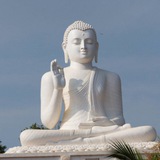
Forwarded from Words of the Buddha
So I have heard. At one time the Buddha was staying near Sāvatthī in Jeta’s Grove, Anāthapiṇḍika’s monastery. The Buddha said this:
“There are 32 marks of a great man. A great man who possesses these has only two possible destinies, no other. If he stays at home he becomes a king, a wheel-turning monarch, a just and principled king. [...] He has the following seven treasures: the wheel, the elephant, the horse, the jewel, the woman, the householder, and the commander as the seventh treasure. He has over a thousand sons who are valiant and heroic, crushing the armies of his enemies. After conquering this land girt by sea, he reigns by principle, without rod or sword. But if he goes forth from the lay life to homelessness, he becomes a perfected one, a fully awakened Buddha, who draws back the veil from the world.
And what are the 32 marks?
He is golden colored; his skin shines like lustrous gold.
Partial excerpts from DN 30 : Lakkhanasutta : Marks of a Great Man
🥰1🙏1👌1🏆1
Now how is mindfulness of in-&-out breathing developed & pursued so as to be of great fruit, of great benefit?
"There is the case where a monk, having gone to the wilderness, to the shade of a tree, or to an empty building, sits down folding his legs crosswise, holding his body erect, and setting mindfulness to the fore. Always mindful, he breathes in; mindful he breathes out.
"Breathing in long, he discerns, 'I am breathing in long'; or breathing out long, he discerns, 'I am breathing out long.' Or breathing in short, he discerns, 'I am breathing in short'; or breathing out short, he discerns, 'I am breathing out short.' He trains himself, 'I will breathe in sensitive to the entire body.'He trains himself, 'I will breathe out sensitive to the entire body.' He trains himself, 'I will breathe in calming bodily fabrication.' He trains himself, 'I will breathe out calming bodily fabrication.'
Partially excerpted from MN 118 : Anapanasati Sutta.
🔥1🙏1👌1🤝1
Forwarded from Words of the Buddha
King Milinda asks:
"What is the benefit of building stupas and paying respect to them? The Buddha has passed away, so how can such acts bring merit?"
Nagasena replies:
"Great king, even though the Buddha has passed away, his relics remain as a focus of veneration. When people build stupas or offer respect to them, they create merit. Just as the fragrance of a flower spreads with the wind, the act of reverence brings joy and spiritual benefit to the devotees."
He further explains:
"The stupa is like a great rain cloud, bringing blessings and relief to those who seek it. By honoring the stupa, one honors the Buddha, his teachings, and the Sangha, cultivating wholesome qualities and a peaceful mind."
Milindapanha, Chapter 4 (Veneration of Stupas)
👏1🎉1🙏1🫡1
Forwarded from Words of the Buddha
Free Buddha Dharma ebook
The Shrine of Steadfast Gaze. Where is it?
By Bhante Shravasti Dhammika
According to the introduction to the Jātaka, after the Buddha’s awakening he spent seven weeks at Uruvelā, the modern Bodh Gaya, and during the second week he sat gazing at the Bodhi Tree without blinking. In time, a shrine called the Animisa Cetiya, in English the Shrine of Steadfast Gaze or sometimes the Unblinking Shrine, came to be built on this site and became one of the seven sacred locations (sattamahātthāna) at Bodh Gaya.
Free download available:
https://budblooms.org/the-shrine-of-steadfast-gaze-where-is-it/
===
👏1👻1🤝1
Forwarded from Words of the Buddha
Free Buddha Dharma ebook
The Shrine of Steadfast Gaze. Where is it?
By Bhante Shravasti Dhammika
According to the introduction to the Jātaka, after the Buddha’s awakening he spent seven weeks at Uruvelā, the modern Bodh Gaya, and during the second week he sat gazing at the Bodhi Tree without blinking. In time, a shrine called the Animisa Cetiya, in English the Shrine of Steadfast Gaze or sometimes the Unblinking Shrine, came to be built on this site and became one of the seven sacred locations (sattamahātthāna) at Bodh Gaya.
Free download available:
https://budblooms.org/the-shrine-of-steadfast-gaze-where-is-it/
===
👍1🥰1
5. Sabbe saïkhàrà aniccà'ti
yadà paññàya passati
Atha nibbindati dukkhe
esa maggo visuddhiyà. 277.
TRANSIENT ARE CONDITIONED THINGS
5. "Transient are all conditioned things": 7 when this, with wisdom, one discerns, then is one disgusted with ill; 8 this is the path to purity. 277.
Story
The Buddha, perceiving that many monks had meditated on impermanence in the past, advised them to continue that meditation.
===
Dhammapada, beloved and favorite teachings of the Buddha channel:
https://invite.viber.com/?g2=AQBLD6phsgvP%2F061YjEM3K%2BNeH1Yb372b9mtfQX2EmuBpgoLUoc99BDMfzHghrme
===
Viber
Dhammapada - Buddha Dharma Teachings
Daily teachings of the Dhammapada, beloved and favorite teachings of the Buddha
🙏2👌1🕊1
Pabhassara citta
“Pabhassaram idaṁ, bhikkhave, cittaṁ. Tañca kho āgantukehi upakkilesehi upakkiliṭṭhaṁ.
Pabhassaram idaṁ, bhikkhave, cittaṁ. Tañca kho āgantukehi upakkilesehi vippamuttaṁ.”
“Bhikkhus, this mind is luminous, but it is defiled by incoming defilements.
Bhikkhus, this mind is luminous, and it is free from incoming defilements.”
Anguttara Nikaya 1.49–52
⚡1🔥1🍓1
6. Sabbe saïkhàrà dukkhà'ti
yadà paññàya passati
Atha nibbindati dukkhe
esa maggo visuddhiyà. 278.
SORROWFUL ARE ALL CONDITIONED THINGS
6. "Sorrowful are all conditioned things": when this, with wisdom, one discerns, then is one disgusted with ill; this is the path to purity. 278.
Story
The Buddha, perceiving that many monks had meditated on sorrow in the past, advised them to continue that meditation.
===
Ajahn Chah, Buddhist teacher of Thai forest meditation of Theravada Buddhism channel:
https://xn--r1a.website/ajahnchah_buddhism
===
Telegram
Ajahn Chah - Theravada Thailand Buddhism
Collection of teachings of Venerable Ajahn Chah, a foremost meditation and Buddhist teacher from Thailand
🙏1💯1🆒1
Free Buddha dharma ebook
Living in the Present without Past, without Future
BUDDHADASA BHIKKHU
Free download available:
https://www.suanmokkh.org/system/books/files/000/000/013/original/Buddhadasa-Living-in-the-present.pdf
===
👏1🤝1
Free Buddha dharma ebook
Living in the Present without Past, without Future
BUDDHADASA BHIKKHU
“The Buddha is recorded as saying that anyone who gets rid of taṇhā (ignorant desire) is someone who eats time. Usually it’s time that devours; it devours people and all other living things. But anyone who puts an end to desire, that one turns around and eats time, which means that time becomes a small matter, something to smile at, an inconsequential matter that can’t eat or bite us. If there is desire, there will be time too, and then time will bite. If desire is ended, there’s no time, and one turns and eats it,which means one makes time pass away by not giving it meaning. Then it’s as if there’s no time, as if we live above it...”
Free download available:
https://www.suanmokkh.org/system/books/files/000/000/013/original/Buddhadasa-Living-in-the-present.pdf
===
👍1💯1😇1
Forwarded from Words of the Buddha
"Monks, one should pay homage to a stupa (thūpa) or shrine (cetiyagara) with a composed mind. A monk should not disrespect or disregard a stupa, whether it contains relics of the Tathagata, relics of disciples, or is merely symbolic (representing the Buddha). Doing so leads to a fault."
Cullavagga VI.10: Respect for Stupas (Thupas)
❤1👏1🙏1💯1
Forwarded from Words of the Buddha
“Suppose, mendicants, there was a lake that was cloudy, murky, and muddy. A person with clear eyes standing on the bank would not see the clams and mussels, and pebbles and gravel, and schools of fish swimming about or staying still. [...]
“Suppose, mendicants, there was a lake that was transparent, clear, and unclouded. A person with clear eyes standing on the bank would see the clams and mussels, and pebbles and gravel, and schools of fish swimming about or staying still. Why is that? Because the water is unclouded. In the same way, that a mendicant whose mind is not clouded would know what’s for their own good, the good of another, or the good of both; or that they would realize any superhuman distinction in knowledge and vision worthy of the noble ones: this is quite possible. Why is that? Because their mind is unclouded.”
AN 1.45-46 : Udakarahaka Suttas: A Pool of Water
❤1👌1🕊1
7. Sabbe dhammà anattà' ti
yadà paññàya passati
Atha nibbindati dukkhe
esa maggo visuddhiyà. 279.
EVERYTHING IS SOULLESS
7. "All Dhammas are without a soul": 9 when this, with wisdom, one discerns, then is one disgusted with ill; this is the path to purity. 279.
Story
The Buddha, perceiving that many monks had meditated on nor-soul in the past, advised them to continue that meditation.
===
Free Buddhism books, teachings, podcasts and videos from Theravada, Mahayana and Vajrayana traditions:
https://xn--r1a.website/buddha_ebooks
===
Telegram
Buddha Dharma books
Free Buddhism books, teachings, podcasts and videos from Theravada, Mahayana and Vajrayana traditions
🔥1👏1🙏1💯1
Forwarded from Words of the Buddha
The Watt Munisotaram, Cambodian Buddhist temple, Hampton, Minnesota, USA.
😇2☃1🕊1🎄1
Forwarded from Words of the Buddha
Preah Vihear temple, built in the 11th century by King Suryavarman of Khmer empire, located in Dangrek Mountain, at the unresolved border between Khmer Empire and Kingdom of Siam.
❤1👍1👏1🕊1
Forwarded from Buddha Dharma books
Free Buddhism ebook
Noble Warrior
A Life of the Buddha Compiled from the Pali Cannon
By Thanissaro Bhikkhu
Free download available:
https://drive.google.com/file/d/1VeTMFIaswUzfCl8ap_3uS8hIJXHT9ays/view?usp=drive_link
===
👏1🤗1🆒1
Forwarded from Buddha Dharma books
Free Buddhism ebook
Noble Warrior
A Life of the Buddha Compiled from the Pali Cannon
By Thanissaro Bhikkhu
A biography of the Buddha using passages collected exclusively from the Pāli Canon. The translated passages are interspersed with a minimum of explanation, allowing the compilers of the Canon to speak for themselves. While the passages in the Canon are not sufficient for a strictly chronological account, they do contain ample material for a thematic one that highlights the Buddha’s three main accomplishments: 1) finding the path and attaining awakening, 2) teaching that path to his contemporaries, establishing a living apprenticeship for awakening, and 3) establishing the Dhamma and Vinaya to give structure to that apprenticeship so that the True Dhamma would last for many generations. Particular attention is given to the many accounts of the Buddha’s awakening and the role that his awakening played in shaping the Dhamma he taught.
Free download available:
https://drive.google.com/file/d/1VeTMFIaswUzfCl8ap_3uS8hIJXHT9ays/view?usp=drive_link
===
✍1🎉1🏆1