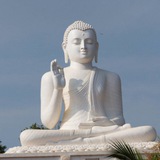
Forwarded from Words of the Buddha
Dhammapada Verse 305
Ekaviharitthera Vatthu
Ekasanam ekaseyyam
eko caramatandito
eko damayamattanam
vanante ramito siya.
Verse 305: He who sits alone, lies down alone, walks alone, in diligent practice, and alone tames himself should find delight in living in the forest.
The Story of the Thera Who Stayed Alone
While residing at the Jetavana monastery, the Buddha uttered Verse 305 with reference to a bhikkhu who stayed by himself. Because he usually stayed alone, he was known as Thera Ekavihari.
Thera Ekavihari did not mix much with other bhikkhus, but usually stayed by himself. All alone, he would sleep or lie down, or stand, or walk. Other bhikkhus thought ill of Ekavihari and told the Buddha about him. But the Buddha did not blame him; instead he said, "Yes, indeed, my son has done well; for, a bhikkhu should stay in solitude and seclusion".
🙏3🕊1🎄1😎1
Forwarded from Buddha Dharma books
Free Buddha Dharma ebook
Beyond Desire & Passion
The Buddha’s Training for Freedom
By Thanissaro Bhikkhu
Ven. Sāriputta once proposed introducing the Buddha’s teachings to intelligent foreigners by saying, “Our teacher teaches the subduing of desire and passion.” This book explores the implications of taking this sentence as a starting point for understanding the Dhamma.
Free download here:
https://www.dhammatalks.org/Archive/Writings/Ebooks/BeyondDesirePassion_251113.pdf
===
👍1😍1🤝1
Forwarded from Buddha Dharma books
Free Buddha Dharma ebook
Beyond Desire & Passion
The Buddha’s Training for Freedom
By Thanissaro Bhikkhu
Ven. Sāriputta once proposed introducing the Buddha’s teachings to intelligent foreigners by saying, “Our teacher teaches the subduing of desire and passion.” This book explores the implications of taking this sentence as a starting point for understanding the Dhamma.
Free download here:
https://www.dhammatalks.org/Archive/Writings/Ebooks/BeyondDesirePassion_251113.pdf
===
👏1👌1🕊1
Forwarded from Words of the Buddha
Mikoshi arai, purification ceremony by bringing Kaisuka Kashima shrine to the sea, Japan.
🐳1🍾1🆒1
16. Na sãlabbatamattena
bàhusaccena và puna
Atha và samàdhilàbhena
vivicca sayanena và 271.
17. Phusàmi nekkhammasukham
aputhujjanasevitam
Bhikkhu vissàsam àpàdi
appatto àsavakkhayam. 272.
A BHIKKHU SHOULD NOT BE CONTENTED UNTIL HE DESTROYS ALL PASSIONS
16-17. Not only by mere morality and austerities, 13 nor again by much learning, 14 nor even by developing mental concentration, nor by secluded lodging, (thinking) "I enjoy the bliss of renunciation not resorted to by the worldling" 15 (not with these) should you, O bhikkhu, rest content 16 without reaching the extinction of the corruptions. 17 271-272.
Story
Some monks who had attained various spiritual heights did not strive to become Arahants, thinking that they could become Arahants at any time. The Buddha advised them not to be contented until they had reached their ultimate Goal (Arahantship).
===
Buddha dharma teachings channel:
https://invite.viber.com/?g2=AQAKw1y3rv%2F6sk61PI2W4izuIiaEZj8YZujhY1tSzL%2B07s7rFnVFDAd0bAYFaMLw
===
Viber
Buddha
Buddha dharma teachings from the suttas and commentaries from Theravada tradition
👌1🕊1
Forwarded from Words of the Buddha
I have heard that on one occasion the Blessed One was staying near Savatthi in Jeta's Grove, Anathapindika's monastery. There Ven. Sariputta addressed the monks, saying, "Friend monks!"
"Yes, friend," the monks responded.
Ven. Sariputta said: "Friends, just as the footprints of all legged animals are encompassed by the footprint of the elephant, and the elephant's footprint is reckoned the foremost among them in terms of size; in the same way, all skillful qualities are gathered under the four noble truths. Under which four? Under the noble truth of sufferings, under the noble truth of the origination of sufferings, under the noble truth of the cessation of sufferings, and under the noble truth of the path of practice leading to the cessation of sufferings.
Maha-hatthipadopama Sutta: The Great Elephant Footprint Simile.
MN 28
Photo: the foot of Leshan giant Buddha, the tallest pre-modern statue in the world built during Tang dynasty era, Sichuan, China.
👏1🙏1😇1🫡1
And how does a mendicant meditate observing an aspect of the mind?
It’s when a mendicant understands mind with greed as ‘mind with greed,’ and mind without greed as ‘mind without greed.’ They understand mind with hate as ‘mind with hate,’ and mind without hate as ‘mind without hate.’ They understand mind with delusion as ‘mind with delusion,’ and mind without delusion as ‘mind without delusion.’ They know constricted mind as ‘constricted mind,’ and scattered mind as ‘scattered mind.’ They know expansive mind as ‘expansive mind,’ and unexpansive mind as ‘unexpansive mind.’ They know mind that is not supreme as ‘mind that is not supreme,’ and mind that is supreme as ‘mind that is supreme.’ They know mind immersed in samādhi as ‘mind immersed in samādhi,’ and mind not immersed in samādhi as ‘mind not immersed in samādhi.’ They know freed mind as ‘freed mind,’ and unfreed mind as ‘unfreed mind.’
Partial excerpts from MN 10: Mahasatipatthanasutta
😇2🥰1🙏1🤝1
Forwarded from Buddha Dharma books
Free Buddhism ebook
A Moving Balance
By Ajahn Sucitto
A guide to walking meditation, emphasising awareness of the whole body and a fluidity of movement.
Free download here:
https://cdn.amaravati.org/wp-content/uploads/2022/07/08/A-Moving-Balance-Web.pdf
===
❤1🔥1🥰1🙏1
Forwarded from Buddha Dharma books
Free Buddhism ebook
A Moving Balance
By Ajahn Sucitto
A guide to walking meditation, emphasising awareness of the whole body and a fluidity of movement.
Free download here:
https://cdn.amaravati.org/wp-content/uploads/2022/07/08/A-Moving-Balance-Web.pdf
===
🔥1👌1💯1
Forwarded from Words of the Buddha
Sunrise at Ulun Danu Tamblingan water temple during monsoon season, Lake Tamblingan, North Bali, Indonesia.
⚡1🕊1😍1
Chapter 20
Magga Vagga
The Way Or The Path
(Text and Translation by Ven. Nàrada)
1. Maggàn' aññhaïgiko seññho
saccànam caturo padà
Viràgo seññho dhammànam
dipadànañ ca cakkhumà. 273.
2. Eso'va maggo natth' añño
dassanassa visuddhiyà
Etamhi tumhe pañipajjatha
màrass' etam pamohanam. 274.
3. Etamhi tumhe pañipannà
dukkhassantam karissatha
Akkhàto ve mayà maggo
aññàya sallasatthanam. 275.
4. Tumhehi kiccam àtappam
akkhàtàro tathàgatà
Pañipannà pamokkhanti
jhàyino màrabandhanà. 276.
THE EIGHTFOLD PATH IS THE BEST
FOLLOW THIS PATH FOR PURITY
FOLLOWING THIS PATH YOU CAN PUT AN END TO SUFFERING
YOU MUST EXERT YOURSELVES
1. The best of paths is the Eightfold Path. 1 The best of truths are the four Sayings. 2 Non-attachment 3 is the best of states. The best of bipeds is the Seeing One. 273.
2. This is the only Way. There is none other for the purity of vision. Do you follow this path. This is the bewilderment of Màra. 274.
3. Entering upon that path, you will make an end of pain. Having learnt the removal of thorns, 4 have I taught you the path. 275.
4. Striving should be done by yourselves; 5 the Tathàgatas 6 are only teachers. The meditative ones, who enter the way, are delivered from the bonds of Màra. 276.
Story
When the Buddha returned to the monastery after his preaching tours some bhikkhus were discussing the smooth or the rough state of the paths they had trod. The Buddha remarked that those paths were irrelevant to their emancipation and advised them to follow the Eightfold path.
===
Words of the Buddha channel:
https://invite.viber.com/?g2=AQAFqzqlj7FmI061PX17rxWMAtZ%2BRuso%2FH2KmHKZSgnv7v9DD8X0bDkKnZDr9JDq
===
Viber
Words Of The Buddha
Daily teachings from Buddha Dharma
👍1👏1💯1🏆1
Forwarded from Words of the Buddha
So I have heard. At one time the Buddha was staying near Sāvatthī in Jeta’s Grove, Anāthapiṇḍika’s monastery. The Buddha said this:
“There are 32 marks of a great man. A great man who possesses these has only two possible destinies, no other. If he stays at home he becomes a king, a wheel-turning monarch, a just and principled king. [...] He has the following seven treasures: the wheel, the elephant, the horse, the jewel, the woman, the householder, and the commander as the seventh treasure. He has over a thousand sons who are valiant and heroic, crushing the armies of his enemies. After conquering this land girt by sea, he reigns by principle, without rod or sword. But if he goes forth from the lay life to homelessness, he becomes a perfected one, a fully awakened Buddha, who draws back the veil from the world.
And what are the 32 marks?
He is golden colored; his skin shines like lustrous gold.
Partial excerpts from DN 30 : Lakkhanasutta : Marks of a Great Man
🥰1🙏1👌1🏆1
Now how is mindfulness of in-&-out breathing developed & pursued so as to be of great fruit, of great benefit?
"There is the case where a monk, having gone to the wilderness, to the shade of a tree, or to an empty building, sits down folding his legs crosswise, holding his body erect, and setting mindfulness to the fore. Always mindful, he breathes in; mindful he breathes out.
"Breathing in long, he discerns, 'I am breathing in long'; or breathing out long, he discerns, 'I am breathing out long.' Or breathing in short, he discerns, 'I am breathing in short'; or breathing out short, he discerns, 'I am breathing out short.' He trains himself, 'I will breathe in sensitive to the entire body.'He trains himself, 'I will breathe out sensitive to the entire body.' He trains himself, 'I will breathe in calming bodily fabrication.' He trains himself, 'I will breathe out calming bodily fabrication.'
Partially excerpted from MN 118 : Anapanasati Sutta.
🔥1🙏1👌1🤝1
Forwarded from Words of the Buddha
King Milinda asks:
"What is the benefit of building stupas and paying respect to them? The Buddha has passed away, so how can such acts bring merit?"
Nagasena replies:
"Great king, even though the Buddha has passed away, his relics remain as a focus of veneration. When people build stupas or offer respect to them, they create merit. Just as the fragrance of a flower spreads with the wind, the act of reverence brings joy and spiritual benefit to the devotees."
He further explains:
"The stupa is like a great rain cloud, bringing blessings and relief to those who seek it. By honoring the stupa, one honors the Buddha, his teachings, and the Sangha, cultivating wholesome qualities and a peaceful mind."
Milindapanha, Chapter 4 (Veneration of Stupas)
👏1🎉1🙏1🫡1
Forwarded from Words of the Buddha
Free Buddha Dharma ebook
The Shrine of Steadfast Gaze. Where is it?
By Bhante Shravasti Dhammika
According to the introduction to the Jātaka, after the Buddha’s awakening he spent seven weeks at Uruvelā, the modern Bodh Gaya, and during the second week he sat gazing at the Bodhi Tree without blinking. In time, a shrine called the Animisa Cetiya, in English the Shrine of Steadfast Gaze or sometimes the Unblinking Shrine, came to be built on this site and became one of the seven sacred locations (sattamahātthāna) at Bodh Gaya.
Free download available:
https://budblooms.org/the-shrine-of-steadfast-gaze-where-is-it/
===
👏1👻1🤝1
Forwarded from Words of the Buddha
Free Buddha Dharma ebook
The Shrine of Steadfast Gaze. Where is it?
By Bhante Shravasti Dhammika
According to the introduction to the Jātaka, after the Buddha’s awakening he spent seven weeks at Uruvelā, the modern Bodh Gaya, and during the second week he sat gazing at the Bodhi Tree without blinking. In time, a shrine called the Animisa Cetiya, in English the Shrine of Steadfast Gaze or sometimes the Unblinking Shrine, came to be built on this site and became one of the seven sacred locations (sattamahātthāna) at Bodh Gaya.
Free download available:
https://budblooms.org/the-shrine-of-steadfast-gaze-where-is-it/
===
👍1🥰1
5. Sabbe saïkhàrà aniccà'ti
yadà paññàya passati
Atha nibbindati dukkhe
esa maggo visuddhiyà. 277.
TRANSIENT ARE CONDITIONED THINGS
5. "Transient are all conditioned things": 7 when this, with wisdom, one discerns, then is one disgusted with ill; 8 this is the path to purity. 277.
Story
The Buddha, perceiving that many monks had meditated on impermanence in the past, advised them to continue that meditation.
===
Dhammapada, beloved and favorite teachings of the Buddha channel:
https://invite.viber.com/?g2=AQBLD6phsgvP%2F061YjEM3K%2BNeH1Yb372b9mtfQX2EmuBpgoLUoc99BDMfzHghrme
===
Viber
Dhammapada - Buddha Dharma Teachings
Daily teachings of the Dhammapada, beloved and favorite teachings of the Buddha
🙏2👌1🕊1
Pabhassara citta
“Pabhassaram idaṁ, bhikkhave, cittaṁ. Tañca kho āgantukehi upakkilesehi upakkiliṭṭhaṁ.
Pabhassaram idaṁ, bhikkhave, cittaṁ. Tañca kho āgantukehi upakkilesehi vippamuttaṁ.”
“Bhikkhus, this mind is luminous, but it is defiled by incoming defilements.
Bhikkhus, this mind is luminous, and it is free from incoming defilements.”
Anguttara Nikaya 1.49–52
⚡1🔥1🍓1