Free Buddha dharma ebook
Fear and Fearlessness
By Ajahn Pasanno, Ajahn Amaro
A compilation of four talks on the theme of fear and fearlessness.
Free download here:
https://cdn.amaravati.org/wp-content/uploads/2025/04/25/Fear-and-Fearlessness-Web.pdf
===
❤1👍1🔥1
Forwarded from Ajahn Chah - Theravada Thailand Buddhism
Ajahn Sucitto Parami Cards - Metta - Goodwill
👏1💯1
20. âkàse padam natthi
samauo natthi bàhire
Papañcábhiratà pajà
nippapañcà tathàgatà. 254.
21. âkàse padam natthi
samauo natthi bàhire
Saïkhàrà sassatà natthi
natthi buddhànam iñjitam. 255.
OUTSIDE THERE ARE NO SAINTS WHO HAVE REALISED NIBBâNA
THERE ARE NO AGGREGATES WHICH ARE ETERNAL
20. In the sky there is no track. Outside 10 there is no Saint. 11 Mankind delights in obstacles. 12 The Tathàgatas 13 are free from obstacles. 254.
21. In the sky there is no track. Outside there is no Saint. There are no conditioned things 14 that are eternal. There is no instability 15 in the Buddhas. 255.
Story
As the Buddha was about to pass away Subhadda, a wandering ascetic approached the Buddha and wished to know about ascetics and teachers who belonged to other orders. In reply the Buddha uttered these verses.
===
Buddha dharma teachings channel:
https://invite.viber.com/?g2=AQAKw1y3rv%2F6sk61PI2W4izuIiaEZj8YZujhY1tSzL%2B07s7rFnVFDAd0bAYFaMLw
===
Viber
Buddha
Buddha dharma teachings from the suttas and commentaries from Theravada tradition
✍1👍1👏1
I have heard that on one occasion the Blessed One was staying near Savatthi in Jeta's Grove, Anathapindika's monastery. There Ven. Sariputta addressed the monks, saying, "Friend monks!"
"Yes, friend," the monks responded.
Ven. Sariputta said: "Friends, just as the footprints of all legged animals are encompassed by the footprint of the elephant, and the elephant's footprint is reckoned the foremost among them in terms of size; in the same way, all skillful qualities are gathered under the four noble truths. Under which four? Under the noble truth of sufferings, under the noble truth of the origination of sufferings, under the noble truth of the cessation of sufferings, and under the noble truth of the path of practice leading to the cessation of sufferings.
Maha-hatthipadopama Sutta: The Great Elephant Footprint Simile.
MN 28
🙏3🔥1👏1😇1
Forwarded from Words of the Buddha
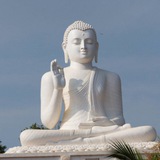
Phra Phuttha Mahanawamintra Sakayamunee Sri Visejchaicharn, Big Buddha at Wat Muang temple in Ang Thong Province, Thailand
❤3👏1🏆1🤝1
Chapter 19
Dhammaññha Vagga
The Just Or Righteous
(Text and Translation by Ven. Nàrada)
1. Na tena hoti dhammaññho
yen' attham sahasà naye
Yo ca attham anatthañ ca
ubho niccheyya paudito 256.
2. Asàhasena dhammena
samena nayatã pare
Dhammassa gutto medhàvã
dhammaññho' ti pavuccati. 257.
THE JUST SHOULD MAKE A PROPER INVESTIGATION
THE IMPARTIAL ARE CALLED THE TRUE JUSTICES
1. He is not thereby just because he hastily arbitrates cases. The wise man should investigate both right and wrong. 256.
2. The intelligent person who leads others not falsely but lawfully and impartially, who is a guardian of the law, is called one who abides by the law (dhammaññha). 257.
Story
Some monks observed that certain judges accepted bribes and adjudged cases unjustly. Hearing this matter, the Buddha described the state of a true justice.
===
Words of the Buddha channel:
https://invite.viber.com/?g2=AQAFqzqlj7FmI061PX17rxWMAtZ%2BRuso%2FH2KmHKZSgnv7v9DD8X0bDkKnZDr9JDq
===
Viber
Words Of The Buddha
Daily teachings from Buddha Dharma
👍1👏1🙏1🫡1
Forwarded from Buddha Dharma books
Free Buddhism ebook
Santacittarama
The First Thirty Years
By Ajahn Chandapalo
An album of photos, with accompanying text, that tells the story of the first Theravada monastery in Italy. Santacittarama, established in 1990, is now a thriving forest monastery in the lineage of Ajahn Chah and Ajahn Sumedho located in the Sabina hills, not far from Rome.
Free download available:
https://drive.google.com/file/d/1PF3y0dJLtKFWEEZtfC9ai6-c465tPokp/view?usp=drive_link
===
❤1👍1🎄1
Forwarded from Buddha Dharma books
Free Buddhism ebook
Santacittarama
The First Thirty Years
By Ajahn Chandapalo
An album of photos, with accompanying text, that tells the story of the first Theravada monastery in Italy. Santacittarama, established in 1990, is now a thriving forest monastery in the lineage of Ajahn Chah and Ajahn Sumedho located in the Sabina hills, not far from Rome.
Free download available:
https://drive.google.com/file/d/1PF3y0dJLtKFWEEZtfC9ai6-c465tPokp/view?usp=drive_link
===
👏1💯1
Forwarded from Words of the Buddha
“With plows young men plough the field,
sowing seeds in the earth.
As they nourish wife and children,
young men find wealth.
I have perfect morality,
I follow the teaching of the Teacher,
I am not lazy nor conceited,
so why have I not attained Nirvana?
After washing the feet,
I observed the water,
and noticed the foot-washing water
flowing from top to bottom.
From there I sought one-pointedness of mind,
like a good thoroughbred horse.
Later, I took the lamp,
and entered my dwelling.
I checked the bed
and took a seat on a mat.
I took the needle
and pulled out the wick.
My emancipation of mind
was like the going out of the lamp.”
Thig 5.10 Paṭācārātherīgāthā: Verses of the Elder Paṭācārā
👏1👌1😇1
Forwarded from Words of the Buddha
Vayadhamma sankhara, Appamadena sampadetha
At one time the Buddha was staying between a pair of sal trees in the sal forest of the Mallas at Upavattana near Kusinārā at the time of his full extinguishment.
Then the Buddha said to the mendicants: “Come now, mendicants, I say to you all: ‘Conditions fall apart. Persist with diligence.’”
These were the Realized One’s last words.
SN 6.15: Parinibbānasutta
👌1🕊1
Forwarded from Words of the Buddha
The Story about the Wanderer Subhadda from the Dhammapada Atthakatha verse 254-255
Subhaddaparibbajakavatthu
Because of past deeds the wanderer Subhadda did not go to meet the Buddha until the latter was on his death-bed; Elder Ananda wanted to stop him, but the Buddha allowed him to approach, and he asked three questions, the verses here being the reply; Subhadda was the last person ordained while the Buddha yet lived and he soon became an Arahat.
“There is no footprint in the sky,” this Dhamma teaching was given by the Teacher with reference to the Wanderer Subhadda. It was while the Teacher was lying on the Parinibbana bed in the Sala-forest of the Mallas at Upavattana in the city of Kusinara.
It seems that in times long past, when Subhadda's younger brother gave alms nine times of the first fruits of a certain crop, Subhadda himself had no desire to give alms and refused, but in the end he did give alms. As the result of this, he failed to see the Teacher both in the first period after Awakening and in the second. In the last period of Awakening, however, when the Teacher was come to the time of the Parinibbana, he thought to himself: “I have entertained doubts on three points and have asked the old wanderers to resolve my doubts for me.
But because I have looked upon the ascetic Gotama as a youngster, I never asked him. Now, however, the time of his Parinibbana is come, and if I do not ask him now, I may be sorry hereafter.” Accordingly he approached the Teacher.
Elder Ananda sought to prevent him. But the Teacher gave him leave to approach, saying to the elder: “Ananda, do not keep Subhadda away; let him ask me his question.” Therefore Subhadda entered within the curtain, seated himself at the foot of the bed, and asked the Teacher the following questions: “Good ascetic, is there such a thing as a path through the air? Can one be called an ascetic who is an outsider? Are the conditions constant?” Thereupon the Teacher informed him that these things have no real existence, expounding the Dhammain the following verses:
254. Ākāse va padaṁ natthi, samaṇo natthi bāhire,
papañcābhiratā pajā, nippapañcā Tathāgatā.
There is no footprint in the sky,
no ascetic on the outside,
folk delight in impediments,
the Realised are free of them.
255. Ākāse va padaṁ natthi, samaṇo natthi bāhire,
saṅkhārā sassatā natthi, natthi Buddhānam-iñjitaṁ.
There is no footprint in the sky,
no ascetic on the outside,
there are no constant conditions,
no disturbance for the Buddhas.
At the end of the teaching Subaddha was established in the fruition of Non- returning, and the assembly had benefit from the Dhamma teaching.
===
Words of the Buddha channel:
https://xn--r1a.website/wordsofbuddha
===
Telegram
Words of the Buddha
Daily teachings of Buddha Dharma
✍1👌1💯1
Thus I heard: At one time the Gracious One was dwelling near Sāvatthī, in Jetavana, at Anāthapiṇḍika’s monastery. Then at that time the Gracious One was instructing, rousing, enthusing, & cheering the monks with a Dhamma talk connected with Emancipation. Those monks, after making it their goal, applying their minds, considering it with all their mind, were listening to Dhamma with an attentive ear.
Then the Gracious One, having understood the significance of it, on that occasion uttered this exalted utterance:
“There is that sphere,where there is no earth, no water, no fire, no air, no sphere of infinite space, no sphere of infinite consciousness, no sphere of nothingness, no sphere of neither perception nor non-perception, no this world, no world beyond, neither Moon nor Sun. There, I say there is surely no coming, no going, no persisting, no passing away, no rebirth It is quite without support, unmoving, without an object,—just this is the end of suffering.”
Udana 8.1: Paṭhamanibbānapaṭi saṁyutta sutta
⚡1🔥1🍾1
Vayadhamma sankhara, Appamadena sampadetha
At one time the Buddha was staying between a pair of sal trees in the sal forest of the Mallas at Upavattana near Kusinārā at the time of his full extinguishment.
Then the Buddha said to the mendicants: “Come now, mendicants, I say to you all: ‘Conditions fall apart. Persist with diligence.’”
These were the Buddha’s last words.
When the Buddha was fully quenched, along with the full extinguishment, the divinity Sahampati recited this verse:
“All creatures in this world must lay down this bag of bones. For even a Teacher such as this, unrivaled in the world, the Realized One, attained to power, the Buddha was fully quenched.”
Ven. Anuruddha recited this verse:
“There was no more breathing for the unaffected one of steady heart. Imperturbable, committed to peace, the Clear-eyed One was fully quenched.
He put up with painful feelings without flinching. The liberation of his heart was like the extinguishing of a lamp.”
SN 6.15: Parinibbānasutta
❤1👏1🙏1🕊1
The Story about the Elder Tissa from the Dhammapada Atthakatha verse 205
Tissattheravatthu
When Elder Tissa heard the Buddha declare his intention to finally Parinibbana in four months time, rather than attend on the Buddha, he went to the forest to practice the teaching; the Buddha lauded him and said this is how one truly honours him, and spoke a verse.
“Savouring the taste of solitude,” this Dhamma teaching was given by the Teacher while he was in residence at Vesali with reference to a certain bhikkhu.
For when the Teacher said: “Bhikkhus, four months hence I shall pass into Parinibbana,” seven hundred bhikkhus of his retinue were overwhelmed with shock, the Arahats experienced spiritual urgency, while those who were unattained were unable to restrain their tears. The bhikkhus gathered in little groups and went about consulting each other and asking: “What are we to do?”
Now a certain bhikkhu named Elder Tissa thought to himself: “If it be true that at the expiration of four months the Teacher will pass into Parinibbana, inasmuch as I am not yet free from passion, it is necessary for me to win Arahatship while the Teacher yet remains alive.” Accordingly he adopted the four postures and kept residence by himself, never associating with the other bhikkhus and never talking or conversing with any one. The bhikkhus said to him: “Friend Tissa, why do you act in this manner?” Tissa, however, paid no attention to what they said.
The bhikkhus therefore reported the matter to the Teacher, saying: “Venerable Sir, Elder Tissa has no affection for you.” The Teacher caused Tissa to be summoned and asked him: “Tissa, why do you act in this manner?” When Tissa told the motive that actuated him, the Teacher applauded his conduct, saying: “Well done, Tissa.”
Then said the Teacher to the bhikkhus: “Bhikkhus, he only that is like Tissa has real affection for me. For though men honor me with perfumes and garlands, they honor me not. But they that practice in accordance with the Dhamma, they alone truly honor me.” So saying, he pronounced the following verse:
205. Pavivekarasaṁ pitvā, rasaṁ upasamassa ca,
niddaro hoti nippāpo, Dhammapītirasaṁ pivaṁ.
Savouring the taste of solitude,
and savouring the taste of peace,
he is fearless, faultless, savouring
the joyful taste of the Dhamma.
At the end of the teaching the Elder Tissa reached Arahatship, and many people had benefit from the Dhamma teaching.
===
Dhammapada, beloved and favorite teachings of the Buddha channel:
https://xn--r1a.website/dhammapadas
===
Telegram
Dhammapada - Buddha Dharma Teachings
Daily teachings of the Dhammapada, beloved and favorite teachings of the Buddha
💯1🏆1🍾1
3. Na tena paudito hoti
yàvatà bahu bhàsati
Khemã averã abhayo
paudito' ti pavuccati. 258.
ONE IS NOT DEEMED WISE BECAUSE ONE IS GARRULOUS
3. One is not thereby a learned man merely because one speaks much. He who is secure, without hate, and fearless is called "learned". 258.
Story
A group of six monks went about calling themselves wise and thus creating disorder. The Buddha uttered this verse in explanation.
===
Dhammapada, beloved and favorite teachings of the Buddha channel:
https://invite.viber.com/?g2=AQBLD6phsgvP%2F061YjEM3K%2BNeH1Yb372b9mtfQX2EmuBpgoLUoc99BDMfzHghrme
===
Viber
Dhammapada - Buddha Dharma Teachings
Daily teachings of the Dhammapada, beloved and favorite teachings of the Buddha
👍1👏1🏆1
Forwarded from Buddha
Free Buddha dharma ebook
Happily Ever After
By Ajahn Amaro
Reflections on life goals and priorities in six volumes.
Free download available:
https://cdn.amaravati.org/wp-content/uploads/2024/07/31/HEA-1-Reality-Web.pdf
https://cdn.amaravati.org/wp-content/uploads/2024/07/31/HEA-2-Emotion-Web.pdf
https://cdn.amaravati.org/wp-content/uploads/2024/07/31/HEA-3-People-Web.pdf
https://cdn.amaravati.org/wp-content/uploads/2024/07/31/HEA-4-Money-Web.pdf
https://cdn.amaravati.org/wp-content/uploads/2024/07/31/HEA-5-Beyond-Web.pdf
https://cdn.amaravati.org/wp-content/uploads/2024/10/07/HEA-Anthology-Web.pdf
===
❤1🏆1🤝1