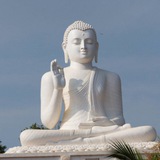
AN 6.25 From… Anussatiṭṭhānasutta: Topics for Recollection—The Buddha
“Mendicants, there are these six topics for recollection. What six?
Firstly, a noble disciple recollects the Realized One: ‘That Blessed One is perfected, a fully awakened Buddha, accomplished in knowledge and conduct, holy, knower of the world, supreme guide for those who wish to train, teacher of gods and humans, awakened, blessed.’ When a noble disciple recollects the Realized One their mind is not full of greed, hate, and delusion. At that time their mind is unswerving. They’ve left behind greed; they’re free of it and have risen above it. ‘Greed’ is a term for the five kinds of sensual stimulation. Relying on this, some sentient beings are purified in this way.…
👏1🙏1👌1🫡1
Forwarded from Words of the Buddha
If no-one else is found
in front or behind,
it’s extremely pleasant
to be dwelling alone in a forest grove.
Come now, I’ll go alone
to the wilderness praised by the Buddha.
It’s pleasant for a mendicant
to be dwelling alone and resolute.
When will I dwell alone,
without a companion,
in the great wood, so delightful,
my task complete, free of defilements?
This is what I want to do:
may my wish succeed!
I’ll make it happen myself,
for no-one can do another’s duty.
Fastening my armor,
I’ll enter the forest.
I won’t leave
without attaining the end of defilements.
As the cool breeze blows
with fragrant scent,
I’ll split ignorance apart,
sitting on the mountain-peak.
In a forest grove covered with blossoms,
in a cave so very cool,
I take pleasure in the Mountainfold,
happy with the happiness of freedom.
I’ve got all I wished for
like the moon on the fifteenth day.
With the utter ending of all defilements,
now there’ll be no more future lives.
Partially excerpted from Thag 10.2 Ekavihāriyattheragāthā
🥰2👌1🎄1
Taking the Long View
A Thai forest meditation master on developing qualities that protect the heart from inner and outer evils.
By Ajaan Lee Dhammadharo
Most of us tend to concern ourselves only with short, small, and narrow things. For instance, we think that there isn’t much to human life—we’re born and then we die—so we pay attention only to our stomachs and appetites. There’s hardly anyone who thinks further than that, who thinks out past death. This is why we’re short-sighted and don’t think of developing any goodness or virtues within ourselves, because we don’t see the truth and the extremely important benefits we’ll gain from these things in the future.
Actually, the affairs of each person are really long and drawn out, and not at all short. If they were short, we’d all know where we came from and how we got where we are. The same would hold true for the future: If our affairs were really a short story, we’d know where we’re going and what we’ll be after death.
But the truth of the matter is that almost no one knows these things about themselves. The only ones who do know are those whose minds are strong in goodness and virtue, and who have developed purity to the point where they gain the intuitive understanding that enables them to see where they’ve come from and where they’re going. These people have the inner eye, which is why they are able to see things past and future. Sometimes they can see not only their own, but also other people’s affairs. This is what makes them realize the hardships and difficulties suffered by human beings and other living beings born into this world. They see the cycle of birth, aging, illness, and death. They see their past lives, both good and bad, and this makes them feel a sense of dismay and dispassion, disenchanted with the idea of ever being born again. As a result, they try to develop their goodness and virtues even further so that they can reduce the number of times they’ll have to be reborn. For example, Stream-winners—those who have entered the stream to Liberation (nibbana)—will be reborn at most only seven more times and then will never have to be reborn again. Once-returners will be reborn in the human world only once more, while Non-returners will be reborn in the Brahma worlds and gain Liberation there.
As for Stream-winners, even though they have to be reborn, they’re reborn in secure places. They aren’t reborn in states of deprivation, such as the realms of hungry shades, angry demons, or common animals. They’re reborn as human beings, but as special human beings, not like the rest of us. How are they special? They have few defilements in their hearts, not thick defilements like ordinary people. They have a built-in sense of conscience and scrupulousness. Even though they may do wrong from time to time, they see the damage it does and feel a sense of shame, so that they won’t want their various defilements to lead them into doing wrong ever again.
As the Buddha said, ‘Happy is the person content in seclusion.’
People disenchanted with rebirth make an extra effort to build up their virtues so that they won’t have to come back and be reborn. If you want to cut down the number of times you’ll take rebirth, you should steadily increase your inner quality and worth. In other words, make your heart clean and bright with generosity, moral virtue, and meditation. Keep your thoughts, words, and deeds at equilibrium, secluded from evil both inside and out. If you have no vices in word and deed, that’s called being secluded from outside evil. If your mind is firmly centered in concentration and free from obstructing distractions, that’s called being secluded from inside evil. This way you can be at peace and at ease both within and without. As the Buddha said, ‘Happy is the person content in seclusion.’
Telegram
Dhammapada - Buddha Dharma Teachings
Daily teachings of the Dhammapada, beloved and favorite teachings of the Buddha
💯2🤝1
When this kind of seclusion arises in the mind, all sorts of worthwhile qualities will come flowing in without stop. The heart will keep growing higher and higher, until it no longer wants anything at all. If you used to eat a lot, you won’t want to eat a lot. If you used to eat in moderation, there’ll be times when you won’t want to eat at all. If you used to talk a lot, you won’t want to talk a lot. If you used to sleep a lot, you’ll want to sleep only a little. However you live, the heart will be entirely happy, with no more danger to fear from anyone.
From Food for Thought: Eighteen Talks on the Training of the Heart by Ajaan Lee Dhammadharo, translated from Thai by Thanissaro Bhikkhu.
===
Ajaan Lee (1907–1961) was a prominent meditation master of the Thai forest tradition in the Dhammayuttika Nikaya order of Theravada Buddhism. He was a direct disciple of Ajaan Mun Bhuridatta Thera, and later became the founding abbot of Wat Asokaram. Lee is remembered for devising comprehensive meditation instructions and detailed expositions of the jhanas, as well as for bringing the practices of the forest tradition into the mainstream of Thai religious life.
===
Dhammapada, beloved and favorite teachings of the Buddha channel:
https://xn--r1a.website/dhammapadas
===
Telegram
Dhammapada - Buddha Dharma Teachings
Daily teachings of the Dhammapada, beloved and favorite teachings of the Buddha
🙏2✍1👌1
17. Natthi ràgasamo aggi
natthi dosasamo gaho
Natthi mohasamam jàlam
natthi tauhàsamà nadi. 251.
THERE IS NO RIVER LIKE CRAVING
17. There is no fire like lust, no grip like hate, no net like delusion, no river like craving. 251.
Story
Once the Buddha was preaching the Dhamma to six persons. Five were inattentive, and only one was attentive. The Buddha attributed their inattentiveness to their past tendencies. When the Venerable Ananda inquired the reason the Buddha replied that it was due to their respective lust, hatred, ignorance, and craving.
===
Words of the Buddha channel:
https://xn--r1a.website/wordsofbuddha
===
Telegram
Words of the Buddha
Daily teachings of Buddha Dharma
👍1🔥1👏1🙏1
Forwarded from Words of the Buddha
Shanta Citta Bhuwana temple, Kallenkote, near Amsterdam, Netherlands.
❤1🕊1😍1
Forwarded from Buddha Dharma books
Free Buddha Dharma ebook
Lumbini – Birth and Rebirth
By Bhante Shravasti Dhammika
Free download available:
https://budblooms.org/lumbini-birth-and-rebirth/
===
👍1👏1🤝1
Forwarded from Buddha Dharma books
Free Buddha Dharma ebook
Lumbini – Birth and Rebirth
By Bhante Shravasti Dhammika
As is well-known, Lumbini is the first of the four major holy places of Buddhism, it being where the person who was to become the Buddha was born. Almost every account of the Buddha’s life, traditional or contemporary, recounts the incidents that supposedly occurred at his conception and birth: his mother dreaming of a white elephant before or as she conceived; giving birth to him while grasping the branch of a tree; and he emerging from her right side. Some later accounts even add that Mahamaya was a virgin when she gave birth. None of these stories are mentioned in the Tipitaka.
Free download available:
https://budblooms.org/lumbini-birth-and-rebirth/
===
❤1🆒1
Forwarded from Words of the Buddha
There are four places that a pious person should visit and look upon with feelings of reverence, said the Buddha.
Lumbini is where the Tathagata was born.
Bodhgaya is where the Tathagata became fully enlightened in unsurpassed, supreme Enlightenment.
Sarnath is where the Tathagata set rolling the unexcelled Wheel of the Dharma.
Kushinagar is where the Tathagata passed away into the state of Parinirvana in which no element of clinging remains.
These, Ananda, are the four places that a pious person should visit and look upon with feelings of reverence. And truly there will come to these places pious monks and nuns, and laymen and laywomen to reflect on the life of the Tathagata.
~paraphrased from Mahaparinibbana Sutta
❤2🥰1😍1
18. Sudassam vajjam aññesam
attano pana duddasam
Paresam hi so vajjàni
opuuàti yathà bhusam
Attano pana chàdeti
kalim' va kitavà sañho. 252.
EASY TO SEE ARE OTHERS' FAULTS
18. Easily seen are others' faults, hard indeed to see are one's own. Like chaff one winnows others' faults, but one's own (faults) one hides, as a crafty fowler conceals himself 7 by camouflage. 8 252.
Story
A wealthy person who desired to see the Buddha was dissuaded from meeting Him by the other ascetics, speaking in dispraise of Him. Hearing of it, the Buddha remarked that some find in others faults that do not exist, but fail to see their own faults.
===
Dhammapada, beloved and favorite teachings of the Buddha channel:
https://xn--r1a.website/dhammapadas
===
Telegram
Dhammapada - Buddha Dharma Teachings
Daily teachings of the Dhammapada, beloved and favorite teachings of the Buddha
👏2👌1🤝1
Forwarded from Words of the Buddha
Symbolic meanings of a stupa:
Structure and the Path to Enlightenment
Base: Represents the earth and the foundation of mindfulness.
Dome: Symbolizes water and the vastness of the cosmos.
Square Harmika: Represents air and the spiritual focus; it holds the relics of the Buddha or other revered figures.
Spire or Pinnacle: Represents fire and the stages of enlightenment.
Umbrella (Chattras): Represents the highest level of spiritual attainment and protection from evil.
Lotus Throne: Symbolizes purity, enlightenment, and detachment from material existence.
🥰1😇1
Forwarded from Words of the Buddha
Free Buddhism ebook
Virtue and Reality
By Ajahn Kalyano
A book on the nature of virtue and the nature of reality and on the relationship between these two. In Virtue and Reality the focus is on the inner world of meditation and contemplative practice.
Free download available:
https://drive.google.com/file/d/1ljhgiimaXuv3dPEsxDHj44qbGcURQawr/view?usp=drive_link
===
❤1🥰1🎄1
Forwarded from Words of the Buddha
Free Buddhism ebook
Virtue and Reality
By Ajahn Kalyano
A book on the nature of virtue and the nature of reality and on the relationship between these two. In Virtue and Reality the focus is on the inner world of meditation and contemplative practice.
Free download available:
https://drive.google.com/file/d/1ljhgiimaXuv3dPEsxDHj44qbGcURQawr/view?usp=drive_link
===
✍1🙏1🍾1
Forwarded from Words of the Buddha
Ceningan Buddha Point, Ceningan island, Nusa Penida, Bali, Indonesia.
👍2❤🔥1😎1
19. Paravajjànupassissa
niccam ujjhànasaññino
âsavà tassa vaddhanti
àrà so àsavakkhayà. 253.
DEFILEMENTS MULTIPLY IN THOSE WHO SEEK OTHERS' FAULTS
19. He who sees others' faults, and is ever irritable - the corruptions of such a one grow. He is far from the destruction of corruptions. 9 253.
Story
The Buddha uttered this verse concerning a monk who was always seeking others' faults.
===
Vajrayana Tantrayana Buddhism channel:
https://xn--r1a.website/tantrayanabuddhism
Tibetan Buddhism - Vajrayana, Tantrayana and esoteric Buddhism channel:
https://xn--r1a.website/tibetanbuddha
===
Telegram
Vajrayana Tantrayana Buddhism
Buddha teachings from the Vajrayana, esoteric, secret or Tantrayana vehicle
🔥1👏1🙏1💯1