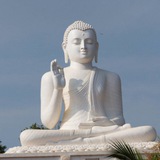
Forwarded from Buddha
But the reality is quite different from the name.
When it comes to discussing a topic like meditation, difficulties in communication are bound to arise because we all have our own ideas and our own unique inner experiences. In using language to convey our meaning, we have to turn those concepts into spoken words. Words are sounds that others pick up and turn into meaningful concepts inside themselves. They take the spoken sound, the word, and refer it to memory to find out their own understanding of it. That understanding depends largely on the listener’s background. Even with a similar background in Buddhist practice, we can never be sure that any two people will understand a word in the same way.
Language is necessary for communication, but it is also a minefield for misunderstanding. It’s useful to study how language works, how it conveys meaning. Basically, language is a symbolic process. When we think of an object, we are reminded of the word for that object, which has specific connotations attached to it. But the connotations for the same word may differ between the speaker and the listener, which easily causes misinterpretations to arise. The same word, the same symbol, conveys different shades of meaning to different people.
===
Buddha dharma teachings channel:
https://xn--r1a.website/lorddivinebuddha
===
Telegram
Buddha
Buddha dharma teachings from the suttas and commentaries
✍1🆒1
10. Sujãvam ahirãkena
kàkasurena dhamsinà
Pakkhandinà pagabbhena
samkiliññhena jãvitam. 244.
11. Hirãmatà ca dujjãvam
niccam sucigavesinà
Alãnen' àpagabbhena
suddhàjãvena passatà. 245.
IT IS EASY TO LEAD A SHAMELESS LIFE IT IS HARD TO LEAD A MODEST LIFE
10. Easy is the life of a shameless one who is as impudent as a crow, back-biting, presumptuous, arrogant, and corrupt. 244.
11. Hard is the life of a modest one who ever seeks purity, is detached, humble, clean in life, and reflective. 245.
Story
A young monk offered same choice food to another monk and promised to offer such food whenever be obtained it. The latter, however departed without even thanking him for the offer. Hearing the story, the Buddha commented on courtesy and rudeness.
===
Ajahn Chah, Buddhist teacher of Thai forest meditation of Theravada Buddhism channel:
https://xn--r1a.website/ajahnchah_buddhism
===
Telegram
Ajahn Chah - Theravada Thailand Buddhism
Collection of teachings of Venerable Ajahn Chah, a foremost meditation and Buddhist teacher from Thailand
❤1👍1👏1👌1
Forwarded from Words of the Buddha
King Milinda asks:
"What is the benefit of building stupas and paying respect to them? The Buddha has passed away, so how can such acts bring merit?"
Nagasena replies:
"Great king, even though the Buddha has passed away, his relics remain as a focus of veneration. When people build stupas or offer respect to them, they create merit. Just as the fragrance of a flower spreads with the wind, the act of reverence brings joy and spiritual benefit to the devotees."
He further explains:
"The stupa is like a great rain cloud, bringing blessings and relief to those who seek it. By honoring the stupa, one honors the Buddha, his teachings, and the Sangha, cultivating wholesome qualities and a peaceful mind."
Milindapanha, Chapter 4 (Veneration of Stupas)
❤2🙏1👌1🕊1
Dainichi Nyorai (Mahavairochana Buddha) rock carvings Ima-kumanosan Taizōji temple, Mount Tawarayama in the Kunisaki Peninsula, Ōita Prefecture, Japan built during Heian period (794–1185). Dainichi is the central Buddha in Japanese Tendai Buddhism and above his head are three mandalas expressing the secret truths of Mikkyō in Sanskrit letters.
❤1🔥1🏆1
The Delusion of Memory
A monk in the Thai forest tradition presents a teaching on the essential differences between intellectual understanding and direct insight.
By Ajaan Pannavaddho, Translated by Ajaan Dick Silaratano
Part 3 of 3
When speaking about physical objects in the world, like trees, the differences are unlikely to be a problem. We can point to a tree. But when it comes to concepts like virtue or concentration or wisdom, there’s nothing concrete that we can point to. Because of that, it is very easy for people with limited genuine experience in these matters to misunderstand the meaning of these concepts. Because they’ve never seen virtue, concentration, and wisdom as objects, most people are bound to develop wrong views about them.
When a student is unfamiliar with the terminology, the teacher must carefully explain the path of practice, step by step, and gradually build up an understanding of the basic concepts involved. However, only someone who has really mastered the practice and knows what he’s talking about can teach like that. Otherwise, the teacher will be left to explain the practice according to what has been handed down in the Buddhist texts. Because of a lack of profound personal insight into the dhamma, the teacher is using concepts that he does not fully understand himself, which easily causes misunderstanding to arise in his students as well.
When practicing on one’s own without a teacher, the Buddhist texts can be a useful reference. But we should not depend on them too much. Following the texts as a guide to meditation has its drawbacks because our inexperienced minds are not equipped to unravel their deeper meaning. So we should use the technical terms in the books with caution, as it is very easy to misinterpret their intended meaning.
In the Thai forest tradition, a distinction is made between sanna and panna. Sanna is traditionally translated as “perception.” Although that is not entirely incorrect, the best translation of sanna is “memory.” Panna is best translated as “wisdom.” The difference between the two is similar to the difference between appearance and reality; supposition and truth; or intellectual understanding and direct insight. In other words, sanna is analogous to the intellectual understanding arrived at by thinking; whereas panna is the direct knowing of essential truths.
To give you an example: Thoughts are usually formed in words, which are symbols stored in memory. A thought that comes up in words originates from a nucleus or seed of that thought located deep inside. When you trace the thought process back to that original seed, you will find that the entire idea expressed in that thought is contained in the seed. Thinking attempts to express that idea in a dialogue. But on a fundamental level, the idea behind that thought is complete in the seed. Realizing that, you also realize that you know the fully-formed idea already, so there’s no need to think about it. In fact, thinking about it at length merely dilutes the essence of it and distorts the meaning.
Panna or wisdom is knowing and understanding, but in an active sense, as in the act of knowing or the act of understanding. Although that knowing is usually based on the Buddha’s teaching, it does not rely solely on conceptual interpretations learned beforehand to recognize the truth in meditation experiences. A thorough conceptual understanding of the teaching is useful as a background to wisdom practice, but it should not assert itself as the main player when wisdom’s direct non-conceptual insight is active.
As a spiritual training, wisdom shines a light on the nature of present moment reality in an intensely focused way which allows no time gaps for fact checking with our intellectual understanding. This is the nature of panna: cause-and-effect understanding grounded in the interaction between present moment conditions.
Telegram
Dhammapada - Buddha Dharma Teachings
Daily teachings of the Dhammapada, beloved and favorite teachings of the Buddha
👌1🏆1
When you start practicing meditation, your mind is out in the world ninety percent of the time. You have accumulated a storehouse of knowledge about the world around you. You have extensive knowledge of the external world, but you know nothing about what goes on inside your own mind. As you learn how to investigate the nature of your mind to see how it works, you come to the conclusion that your view of the world is fundamentally wrong. You realize that the symbols you have accumulated to structure the world around you are false. That realization comes, not from remembered concepts, but from the insights that gradually change your understanding. By using wisdom to analyze and investigate, you will begin to illuminate the true nature of things. The insights that arise from that effort change your overall understanding of dhamma.
Concentrate on the truth of what wisdom reveals and let that truth speak for itself.
As you progress in the practice, you should investigate with wisdom repeatedly until you become skilled in its use. Avoid speculation or conjecture. Don’t allow thoughts of what you should be doing, or what the results might mean, to interfere with your present-moment focus. Just concentrate on the truth of what wisdom reveals and let that truth speak for itself. In this way, you can maintain a proper balance between memory and wisdom as you advance, stage by stage, to the attainment of purity of mind and freedom from suffering.
Excerpted and adapted from Uncommon Wisdom by Ajaan Pannavaddho, translated by Ajaan Dick Silaratano. 2014 Forest Dhamma Monastery Organization.
===
Ajaan Pannavaddho is a Welsh Theravada Buddhist monk in the Thai forest tradition and the senior-most Western monk following Ajaan Mun’s path of practice. Ajaan Pannavaddho, or Ajaan Panna as he was called, became a pioneer of the Western Sangha whose leadership influenced countless monks and laypeople to practice Ajaan Mun’s teachings; and whose translations and interpretations of Ajaan Maha Boowa’s dhamma talks introduced generations of Buddhists to the Thai forest tradition.
Ajaan Dick Silaratano is an American Theravada Buddhist monk in the Thai forest tradition and the abbot of the Forest Dhamma Monastery in southwestern Virginia. Silaratano has been writing English translations of biographies of Thai forest meditation masters and books on Buddhist meditation as taught in the Thai forest tradition for many years.
===
Part 1 of 3:
https://xn--r1a.website/wordsofbuddha/5538
Part 2 of 3:
https://xn--r1a.website/lorddivinebuddha/4452
Part 3 of 3:
https://xn--r1a.website/dhammapadas/3979
===
Dhammapada, beloved and favorite teachings of the Buddha channel:
https://xn--r1a.website/dhammapadas
===
Telegram
Dhammapada - Buddha Dharma Teachings
Daily teachings of the Dhammapada, beloved and favorite teachings of the Buddha
❤1🔥1🕊1💯1
12. Yo pàuam atipàteti
musàvàdañ ca bhàsati
Loke adinnam àdiyati
paradàrañ ca gacchati 246.
13. Suràmerayapànañ ca
yo naro anuyuñjati
Idh' evam eso lokasmim
mulam khauati attano. 247.
14. Evam bho purisa jànàhi
pàpadhammà asaññatà.
Mà tam lobho adhammo ca
ciram dukkhàya randhayum. 248.
HE WHO DOES NOT OBSERVE THE FIVE PRECEPTS RUINS HIMSELF
BE NOT AVARICIOUS AND DO NO WRONG
12-13. Whoso in this world destroys life, tells lies, takes what is not given, goes to others' wives, and is addicted to intoxicating drinks, such a one digs up his own root in this world. 246-247.
14. Know thus O good man: "Not easy of restraint are evil things". Let not greed and wickedness 5 drag you to protracted misery. 248.
Story
Many followers each of whom was observing one of the five precepts spoke of the difficulty of practising their respective precepts. Hearing their story, the Buddha spoke of the difficulty of practising them all without stating a single one as of lesser importance.
===
Free Buddhism books, teachings, podcasts and videos from Theravada, Mahayana and Vajrayana traditions:
https://xn--r1a.website/buddha_ebooks
===
Telegram
Buddha Dharma books
Free Buddhism books, teachings, podcasts and videos from Theravada, Mahayana and Vajrayana traditions
🙏2👍1🆒1
Forwarded from Words of the Buddha
“Pañcime, bhikkhave, ānisaṃsā sappurisaṃ sevato, sappurisasamāsevanāya, sappurisūpadāsanāya. Katame pañca? Saddho hoti, sīlavā hoti, bahussuto hoti, cāgī hoti, paññavā hoti. Ime kho, bhikkhave, pañcānisaṃsā sappurisaṃ sevato, sappurisasamāsevanāya, sappurisūpadāsanāya.”
"Monks, there are these five benefits of associating with a good person, keeping their company, and attending on them. What five? One becomes faithful, virtuous, learned, generous, and wise. These, monks, are the five benefits of associating with a good person."
Mitta Sutta (AN 5.55)
❤1🥰1🙏1😘1
Mendicants, I will teach you a simile of the teaching as a raft: for crossing over, not for holding on.
“Suppose there was a person traveling along the road. They’d see a large deluge, whose near shore was dubious and perilous, while the far shore was a sanctuary free of peril. But there was no bridge for crossing over. They’d think, ‘Why don’t I make a raft? Riding on the raft, I can safely reach the far shore.’ And when they’d crossed over to the far shore, they’d think, ‘This raft has been very helpful to me.
When they’d crossed over they should think, ‘This raft has been very helpful to me. … Why don’t I beach it on dry land or set it adrift on the water and go wherever I want?’ That’s what that person should do with the raft.
I have taught a simile of the teaching as a raft: for crossing over, not for holding on. By understanding the simile of the raft, you will even give up the teachings, let alone what is not the teachings.
Partial excerpts from MN 22: Alagaddupamasutta
👌2😇1
Forwarded from Buddha Dharma books
Free Buddha dharma ebook
No Religion
BUDDHADASA BHIKKHU
Free download here:
https://www.suanmokkh.org/system/books/files/000/000/127/original/Buddhadasa-No-religion-20200319.pdf
===
👍1🔥1👌1
Forwarded from Buddha Dharma books
Free Buddha dharma ebook
No Religion
BUDDHADASA BHIKKHU
“Although we call ourselves ‘Buddhists’ and profess Buddhism, we haven't yet realized the truth of Buddhism, for we are acquainted with only a tiny aspect of our own Buddhism. Although we be monks, nuns, novices, lay devotees, or whatever, we are aware of only the bark, the outer covering which makes us think our religion is different from the other religions. Because we have failed to understand and haven't yet realized our own truth, we look down upon other religions and praise only our own. We think of ourselves as a special group and of others as outsiders or foreigners. We believe that they are wrong and only we are right, that we are special and have a special calling, and that only we have the truth and the way to salvation. We have many of these blind beliefs. Such ideas and beliefs show that we are still ignorant, very foolish indeed, just like little babies who know only their own bellies.”
Free download here:
https://www.suanmokkh.org/system/books/files/000/000/127/original/Buddhadasa-No-religion-20200319.pdf
===
✍1👏1😱1
Forwarded from Words of the Buddha
Pradakshina (known as padakkhinā in Pāli) is the act of circumambulating a sacred object or place, such as a stupa, Bodhi tree, or statue of the Buddha. This practice is a physical expression of devotion and respect, often done as a meditative or mindful activity. It symbolizes reverence, veneration, and a mental focus on the Triple Gem: the Buddha, the Dhamma (his teachings), and the Sangha (the community of practitioners).
❤1👌1😇1
15. Dadàti ve yathàsaddham
yathàpasàdanam jano
Tattha yo maïku bhavati
paresam pànabhojane
Na so divà và rattim và
samàdhim adhigacchati. 249.
16. Yassa c'etam samucchinnam
mulaghaccam samuhatam
Sa ve divà và rattim và
samàdhim adhigacchati. 250.
THE ENVIOUS ARE NOT AT PEACE THE UNENVIOUS ARE AT PEACE
15. People give according to their faith and as they are pleased. Whoever therein is envious of others' food and drink, gains no peace 6 either by day or by night. 249.
16. But he who has this (feeling) fully cut off, uprooted and destroyed, gains peace by day and by night. 250.
Story
A novice, son of a gate-keeper, spoke disparagingly of all the devotees except his own kinsfolk as regards their generosity. Some inquisitive monks made investigations about his so-called relatives and discovered the truth. When they informed the Buddha about his mean behaviour the Buddha spoke on the mental attitude of the envious and the unenvious.
===
Buddha dharma teachings channel:
https://xn--r1a.website/lorddivinebuddha
===
Telegram
Buddha
Buddha dharma teachings from the suttas and commentaries
🔥1👏1🤝1
AN 6.25 From… Anussatiṭṭhānasutta: Topics for Recollection—The Buddha
“Mendicants, there are these six topics for recollection. What six?
Firstly, a noble disciple recollects the Realized One: ‘That Blessed One is perfected, a fully awakened Buddha, accomplished in knowledge and conduct, holy, knower of the world, supreme guide for those who wish to train, teacher of gods and humans, awakened, blessed.’ When a noble disciple recollects the Realized One their mind is not full of greed, hate, and delusion. At that time their mind is unswerving. They’ve left behind greed; they’re free of it and have risen above it. ‘Greed’ is a term for the five kinds of sensual stimulation. Relying on this, some sentient beings are purified in this way.…
👏1🙏1👌1🫡1
Forwarded from Words of the Buddha
If no-one else is found
in front or behind,
it’s extremely pleasant
to be dwelling alone in a forest grove.
Come now, I’ll go alone
to the wilderness praised by the Buddha.
It’s pleasant for a mendicant
to be dwelling alone and resolute.
When will I dwell alone,
without a companion,
in the great wood, so delightful,
my task complete, free of defilements?
This is what I want to do:
may my wish succeed!
I’ll make it happen myself,
for no-one can do another’s duty.
Fastening my armor,
I’ll enter the forest.
I won’t leave
without attaining the end of defilements.
As the cool breeze blows
with fragrant scent,
I’ll split ignorance apart,
sitting on the mountain-peak.
In a forest grove covered with blossoms,
in a cave so very cool,
I take pleasure in the Mountainfold,
happy with the happiness of freedom.
I’ve got all I wished for
like the moon on the fifteenth day.
With the utter ending of all defilements,
now there’ll be no more future lives.
Partially excerpted from Thag 10.2 Ekavihāriyattheragāthā
🥰2👌1🎄1