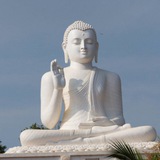
Forwarded from Words of the Buddha
When the Realized One understands the supreme perfect awakening. And then—in this world with its gods, Māras, and divinities, this population with its ascetics and brahmins, gods and humans—an immeasurable, magnificent light appears, surpassing the glory of the gods. Even in the boundless void of interstellar space—so utterly dark that even the light of the moon and the sun, so mighty and powerful, makes no impression—an immeasurable, magnificent light appears, surpassing the glory of the gods. And the sentient beings reborn there recognize each other by that light: ‘So, it seems other sentient beings have been reborn here!’ This is the third incredible and amazing thing that appears with the appearance of a Realized One.
Partial excerpts from AN 4.127: Paṭhamatathāgataacchariyasutta
❤1⚡1🔥1
Forwarded from Buddha Dharma books
Free Buddha Dharma ebook
The Buddha and the Philosophy of Food
By Bhante Shravasti Dhammika
Free download available:
https://budblooms.org/the-buddha-and-the-philosophy-of-food/
===
🔥1👏1🏆1
Forwarded from Buddha Dharma books
Free Buddha Dharma ebook
The Buddha and the Philosophy of Food
By Bhante Shravasti Dhammika
Like other ancient Indian thinkers, the Buddha saw that existence could be related in one way or another to food. He underlined food’s fundamental importance when he said: “All that lives subsists on food” The quest for food is the basis of all human action as it provides the energy to sustain life. Thus the Pali word for food, ahara, is derived from the Sanskrit a-hṛ, to fetch, to bring near, or to convey to oneself. The Buddha spoke of four types of food or sustenance; material, mental impressions, volition and consciousness. The first of these maintains the body and can be either gross (olarika) or subtle (sukhuma), while the three others maintain the mind. The craving for is one of the factors which creates the momentum that leads to repeated rebirth.
Free download available:
https://budblooms.org/the-buddha-and-the-philosophy-of-food/
===
🥰1🤗1
Now, Venerable Bhaddiya, son of the Kaligodhas, used to go to the forest, to the roots of trees & to lonely spots, & while there, cry out: “Oh joy! Oh joy!” Some monks heard him & they thought: “Doubtless, Bhaddiya is discontented with the holy life, seeing as he enjoyed the happiness when he was a royalty.” So those monks went to the Lord & told him of this, & he asked that Bhaddiya come to see him. When he came, the Lord said: “Bhaddiya, is it true as they say that you go to the forest, to the roots of the trees & to lonely spots, & that while there you often utter the cry: ‘Oh joy! Oh joy!’ ”
“It is true, sir.”
“and why do you do this?”
“Formerly, when I enjoyed the happiness of royalty, guards were set inside the palace, outside & even in the area beyond. Yet, although I was well guarded, I lived in fear, I was anxious, trembling & afraid. But now that I lived in the forest, all alone, I am without fear, I am assured, confident & unafraid. That is why I utter the cry: ‘Oh joy! Oh joy!’ ”
Udana 2.10
❤1🕊1😇1🎄1
Forwarded from Words of the Buddha
The Hidden Fish Bones of Happiness
The late Thai monk and philosopher on the true nature of attainment and suffering
By Buddhadasa Bhikkhu
Is it worth being a happy person? Is it worth being an unhappy person? There will be a forest of raised hands here, all asking to be happy people. On the other hand, those who have been happy, who have fully experienced the happiness others are clamoring for, will shake their heads. They know that the happy person endures the dukkha of happiness. You may not understand this point, so let me repeat: people who are happy must experience the dukkha of happy people. You must notice that worldlings assume, establish, and attach to the conventions concerning the nature of happiness. One who has money, power, influence, wealth, all the sensual pleasures, and other such things is a happy person. But if we look closely, we will see that there is a kind of dukkha appropriate to happy people. These kinds of happiness have hidden “fish bones” in them.
Even with the more subtle forms of happiness that arise from concentration (samadhi), the meditative “attainments” (samapatti), and the meditative absorptions (jhanas), if the feeling that “I am happy” arises, then it too will form a “fish bone” in the flesh of that happiness and will stick in one’s throat. Those who grasp at and cling to the happiness of the jhanas and attainments suffer accordingly.
The happy person endures the dukkha of happiness.
Consequently, there is the teaching of renouncing lust for form (rupa-raga) and lust for the formless (arupa-raga), which are the first two of the higher fetters (samyojana) that prevent people from being Arahants. If there is clinging to the idea that we have happiness, even if it’s the happiness that arises from dhamma, there will still be a refined kind of “fish bone” sticking in the throat, and the true dhamma cannot be discerned.
Grasping at nibbana as being “my self ” or “my happiness” is impossible. One may say, if one wishes, that nibbana is the supreme happiness, and then attach to nibbana as being “I” or “mine.” One may say, “I have the happiness of nibbana” or “I have attained nibbana.” But these are mere verbalizations. In fact, one who still grasps and clings cannot possibly realize nibbana. If anyone takes himself to be the enjoyer of nibbana’s happiness, that can only be a counterfeit nibbana. True nibbana is not of a nature that can be grasped at in this way.
So we pursue many types of happiness—from that of children, through the happiness of youth, of adults, of the elderly, of the powerful and influential, on up through the happiness of being a deva, of having meditative absorptions and attainments—until we reach whatever we believe to be the highest happiness. If we ever delusively consider that “I am happy,” we must suffer accordingly. Those who have realized the truth see this fact. Those who have not are in turmoil, ambitiously and hungryly striving for wealth, power, and sense pleasures. Or, on a higher level, they are greedily striving for insight, meditative absorptions, and attainments. Some push so hard they end up in mental hospitals. That in itself demonstrates the danger of grasping and clinging to happiness. Young children will not understand this point, but those advanced in years should.
Ajahn Buddhadasa, Under the Bodhi Tree: Buddha’s Original Vision of Dependent Co-arising.
Buddhadasa Bhikkhu (1906–1993) was a famous and influential Thai Buddhist philosopher and the founder of Suan Mokkh, the first modern forest monastery in Thailand.
===
Words of the Buddha channel:
https://xn--r1a.website/wordsofbuddha
===
Telegram
Words of the Buddha
Daily teachings of Buddha Dharma
👍1🥰1👌1
Forwarded from Words of the Buddha
“Svakkhato bhagavata dhammo, sandittiko akaliko ehipassiko, opanayiko paccattam veditabbo vinnuhi’ti”
"Well-proclaimed by the Lord is the Dhamma, visible here and now, timeless, inviting one to come and see / inspection, leading onward, to be comprehended by the wise each one for himself."
DN 33 : Saṅgītisutta
🙏3👍1🔥1👌1🕊1
7. Poràuam etam atula
n'etam ajjatanàm iva
Nindanti tuuhim asinam
nindanti bahubhàuinam
Mitabhàuinam pi nindanti
natthi loke anindito. 227.
8. Na câhu na ca bhavissati
na c'etarahi vijjati
Ekantam nindito poso
ekantam và pasamsito. 228.
9. Yañ ce viññu pasamsanti
anuvicca suve suve
Acchiddavuttim medhàvim
paññàsãlasamàhitam 229.
10. Nekkham jambonadass' eva
ko tam ninditum arahati
Devà'pi nam pasamsanti
brahmunà'pi pasamsito. 230.
THERE IS NONE WHO IS BLAMELESS IN THIS WORLD
7. This, O Atula, 3 is an old saying; it is not one of today only: they blame those who sit silent, they blame those who speak too much. Those speaking little too they blame. There is no one who is not blamed in this world. 227.
THERE IS NONE WHO IS WHOLLY BLAMED OR PRAISED
8. There never was, there never will be, nor does there exist now, a person who is wholly blamed or wholly praised. 228.
THE BLAMELESS ARE PRAISED
9. Examining day by day, the wise praise him who is of flawless life, intelligent, endowed with knowledge and virtue. 229.
WHO DARE BLAME THE PURE?
10. Who deigns to blame him who is like a piece of refined gold? Even the gods praise him; by Brahma too he is praised. 230.
Story
A lay leader of a group named Atula wished to hear the Dhamma from the Venerable Revata. He remained silent as he was bent on solitude. Displeased, he went to the Venerable Sàriputta who discoursed at length on Abhidhamma. Displeased again he went to the Venerable Ananda, who delivered a brief discourse. Displeased with him too, he finally approached the Buddha, who thereupon uttered these verses and remarked that even a Buddha is not free from blame.
===
Buddha dharma teachings channel:
https://xn--r1a.website/lorddivinebuddha
===
Telegram
Buddha
Buddha dharma teachings from the suttas and commentaries
👏1🙏1👌1
Forwarded from Words of the Buddha
Theravadin monks on Thudong on foot from Indonesia at the border of India and Nepal.
🕊2🔥1🤗1🎄1
Anyone who wants to develop the fire kasina should apprehend the sign in fire. Herein, when someone with merit, having had previous practice, is apprehending the sign, it arises in him in any sort of fire, not made up, as he looks at the fiery combustion in a lamp’s flame or in a furnace or in a place for baking bowls or in a forest conflagration, as in the Elder Cittagutta’s case. The sign arose in that elder as he was looking at a lamp’s flame while he was in the Uposatha house on the day of preaching the Dhamma.
The counterpart sign appears motionless like a piece of red cloth set in space, like a gold fan, like a gold column. With its appearance he reaches access jhana and the jhana tetrad and pentad in the way already described.
Partial excerpts from the Visuddhimagga : chapter 5: the Fire Kasina
🔥1😇1
Forwarded from Words of the Buddha
Water blessings at Borobudur temple, Java island, Indonesia.
👍1🕊1😇1
Forwarded from Words of the Buddha
Free Buddha dharma ebook
Seeing with the Eye of Dhamma
BUDDHADASA BHIKKHU
Free download available:
https://www.opensanghafoundation.org/newsite/wp-content/uploads/2023/08/Seeing-with-the-Eye-of-Dhamma-The-Comprehensive-Teaching-of-Buddhadasa-Bhikkhu-translated-by-Santikaro-and-Dhammavidu-Bhikkhu.pdf
===
🔥1👌1😇1🤝1
Forwarded from Words of the Buddha
Free Buddha dharma ebook
Seeing with the Eye of Dhamma
BUDDHADASA BHIKKHU
Ajahn Buddhadāsa spent more than sixty years in the forest in southern Thailand engaged in meditations, reflections, study of the words of the Buddha, living close to the elements, and teaching. He revealed an exceptional range of realizations throughout his life.
Seeing with the Eye of Dhamma embraces the expanse of his teachings, rich with insights, suitable for daily life. Readers will find reflections on cultivation of the mind, inquiry into the self/ego, superstitious beliefs, and the importance of the observation of life, as well as explanations of the Buddha’s core teachings on mental suffering, conditionality, dependent arising, the elements, mental concoctions, voidness, the goal, and nibbāna. A profound book provides a mind-opening reading experience: Seeing with the Eye of Dhamma falls into this category.
Free download available:
https://www.opensanghafoundation.org/newsite/wp-content/uploads/2023/08/Seeing-with-the-Eye-of-Dhamma-The-Comprehensive-Teaching-of-Buddhadasa-Bhikkhu-translated-by-Santikaro-and-Dhammavidu-Bhikkhu.pdf
===
👍1👏1🙏1
11. Kàyappakopam rakkheyya
kàyena samvuto siyà
Kàyaduccaritam hitvà
kàyena sucaritam care. 231.
12. Vacãpakopam rakkheyya
vàcàya samvuto siyà
Vacãduccaritam hitvà
vàcàya sucaritam care. 232.
13. Manopakopam rakkheyya
manasà samvuto siyà
Manoduccaritam hitvà
manasà sucaritam care. 233.
14. Kàyena samvutà dhãrà
atho vàcàya samvutà
Manasà samvutà dhãrà
te ve suparisamvutà. 234.
BE PURE IN DEED, WORD AND THOUGHT
11. One should guard against misdeeds (caused by) the body, and one should be restrained in body. Giving up evil conduct in body, one should be of good bodily conduct. 231.
12. One should guard against misdeeds (caused by) speech, and one should be restrained in speech. Giving up evil conduct in speech, one should be of good conduct in speech. 232.
13. One should guard against misdeeds (caused by) the mind, and one should be restrained in mind. Giving up evil conduct in mind, one should be of good conduct in mind. 233.
14. The wise are restrained in deed; in speech, too, they are restrained. The wise, restrained in mind, are indeed those who are perfectly restrained. 234.
Story
Some monks moved about wearing wooden sandals, thus creating a great noise. Advising them to be controlled in thought, word and, deed, the Buddha uttered these verses.
===
Words of the Buddha channel:
https://xn--r1a.website/wordsofbuddha
===
Telegram
Words of the Buddha
Daily teachings of Buddha Dharma
✍1🙏1
Forwarded from Words of the Buddha
“Having ventured out from my day’s abiding
at Vulture’s Peak Mountain,
I saw an elephant going in and out
the river by the shore.
A man took a pole with a hook,
and said to him: ‘give me your foot.’
The elephant held out his foot,
and the man mounted him.
Once I saw the untamed tamed,
brought under human control,
from there I sought one-pointedness of mind—
This is why I went to the forest."
Thig 3.4 Dantikātherīgāthā: Verses of the Elder Dantikā
❤1🕊1🎄1
“When your harp’s strings were tuned too tight, was it resonant and playable?”
“No, sir.”
“When your harp’s strings were tuned too slack, was it resonant and playable?”
“No, sir.”
“But when your harp’s strings were tuned neither too tight nor too slack, but fixed at an even tension, was it resonant and playable?”
“Yes, sir.”
“In the same way, Soṇa, when energy is too forceful it leads to restlessness. When energy is too slack it leads to laziness. So, Soṇa, you should focus on energy and serenity, find a balance of the faculties, and learn the pattern of this situation.”
[...] Then Soṇa, living alone, withdrawn, diligent, keen, and resolute, soon realized the supreme culmination of the spiritual path in this very life.[...]
He understood: “Rebirth is ended; the spiritual journey has been completed; what had to be done has been done; there is nothing further for this place.” And Venerable Soṇa became one of the perfected.
Partial excerpts from AN 6.55 : Sonasutta
🙏2👌1😇1
Chapter 18
Mala Vagga
Impurities Or Taints
(Text and Translation by Ven. Nàrada)
1. Paudupalàso' va' dàni' si
yamapurisà'pi ca tam upaññhità
Uyyogamukhe ca tiññhasi
pàtheyyam pi ca te na vijjati. 235.
2. So karohi dãpam attano
khippam vàyama paudito bhava
Niddhantamalo anaïgauo
dibbam ariyabhumim ehisi. 236.
3. Upanãtavayo va'dàni'si
sampayàto'si yamassa santike
Vàso'pi ca te natthi antarà
pàtheyyam pi ca te na vijjati. 237.
4. So karohi dãpam attano
khippam vàyama paudito bhava
Niddhantamalo anaïgauo
na puna jàtijaram upehisi. 238.
DEATH IS NEAR TO YOU
1. Like a withered leaf are you now. The messengers of death wait on you. On the threshold of decay you stand. Provision too there is none for you. 235.
STRIVE HARD
2. Make an island unto yourself. Strive quickly; become wise. Purged of stain and passionless, you shall enter the heavenly stage of the Ariyas. 1 236.
LIFE COMES TO AN END
3. Your life has come to an end now. To the presence of death you are setting out. No halting place is there for you by the way. Provision too there is none for you. 237.
BE PASSIONLESS
4. Make an island unto yourself. Strive without delay; become wise. Purged of stain and passionless, you will not come again to birth and old age. 238.
Story
A father-in-law grew old without doing any good. His son-in-law invited the Buddha and the Sangha to the house and gave alms in his name. Thereupon the Buddha addressed these verses to the old man in admonition.
===
Dhammapada, beloved and favorite teachings of the Buddha channel:
https://xn--r1a.website/dhammapadas
===
Telegram
Dhammapada - Buddha Dharma Teachings
Daily teachings of the Dhammapada, beloved and favorite teachings of the Buddha
❤1👍1💯1
Forwarded from Words of the Buddha
Big Buddha Taiwan, Fu Guang Shan monastery, Kaohsiung, Taiwan.
🔥2❤1👏1🙏1👌1