Forwarded from Buddha
Loving Kindness in Plain English - The Practice of Metta by Bhante Henepola Gunaratana
❤1👏1🤗1
Forwarded from Buddha
11 Benefits of Loving-Friendliness Meditation
Theravadin Buddhist monk Bhante Gunaratana outlines the ways meditation can benefit our mind and our body—and even our complexion.
By Bhante Henepola Gunaratana
Part 1 of 2
We don’t need an ideal society or a perfect world to practice loving-friendliness. We aren’t practicing to save the world or make it perfect. We practice for ourselves, for our own peace and well-being. Any effects beyond that are byproducts. If the focus is outside ourselves, we will never succeed. But fortunately, our own well-being is intimately bound up with the well-being of others; so truly practicing metta (loving-friendliness) for our own benefit does benefit others.
In the Discourse on the Benefits of Loving-Friendliness (Metta Nisamsa Sutta), the Buddha lists 11 benefits derived from practicing metta—and I might add that many of these benefits are being confirmed by contemporary scientific research!
Here is the Buddha’s list:
1. You sleep well.
When you go to bed feeling loving-friendliness toward yourself and others, you will be relaxed and will sleep peacefully.
2. You wake up feeling well.
When you get a good night’s sleep, you wake up feeling rested and relaxed. With a relaxed mind and body, you are able to connect with family, friends, relatives, neighbors, and even strangers in a genuine and centered way. You feel fresh, uplifted, and joyful all day.
3. You’re not likely to have nightmares.
When you practice metta, you become solid enough to face whatever arises. And in fact, the Buddha said it’s unlikely you’ll have nightmares when you practice metta.
4. Your body relaxes and your face is joyful.
Your body reflects your mind. When you feel love for all beings, it shows on your face. Seeing your honest, relaxed face, others will gravitate toward you and enjoy being around you.
5. Even animals and celestial beings feel drawn to you.
When you practice metta, your mind generates a peaceful field around you. Children especially are tuned in to this energy—and non-humans feel it too!
One day I was walking my dog, Brown, and a couple came toward us. The woman kneeled down to Brown’s level and talked to him.
He wagged his tail and became affectionate with her. The man was frightened, and Brown growled at him.
6. Spirits protect you.
There are times we feel guided and protected by beings beyond our sight. Recognizing this as a kind of grace is a source of serenity. Whether it’s literally true or there is some other energy that gives us this sense of guidance and protection, the Buddha included this among the benefits of practicing metta.
7. Fire, poisons, and weapons will not harm you.
When we read stories of old, many of the elements are symbolic or mythic. The Buddha shared tales of adepts who practiced metta and were protected from fire, poisons, and weapons. He explained that greed, hatred, and delusion are the fires, the poisons, and the weapons against which metta protects us.
In the Fire Sermon (Aditta Pariyaya Sutta), the Buddha said that poison is of three kinds—greed, hatred, and delusion. These weapons, like daggers, he said, can cut your peace into pieces. In the Numerical Discourses of the Buddha, the Buddha described bodily, verbal, and mental weapons. In the Udana, he said, “They quarrel, squabble, and argue with each other, stabbing each other with verbal daggers: ‘This is dharma. That is not.’” In the Dhammapada, the Buddha said, “There is no fire like greed, no misfortune like hatred, no suffering like delusion, and no greater happiness than peace.”
In a well-known story about the power of metta, Uttara, a devoted follower of the Buddha, was bereft. She had been given in marriage to a man who did not have high regard for the Buddha, and so she hadn’t seen the Buddha or his disciples for two and a half months. She was feeling forlorn, and her father suggested she hire a courtesan to serve her husband while she joined the Buddha and his community for the final two weeks of their rainy-season retreat.
Telegram
Buddha
Buddha dharma teachings from the suttas and commentaries
😍1😘1
Forwarded from Buddha
Uttara agreed and was able to serve the Buddha and his disciples as a cook and attend his teachings.
One day as he was looking out the window of his mansion, Uttara’s husband saw her working in the retreat kitchen wearing a stained apron and thought it pathetic she was attending the retreat rather than indulging in the luxuries of life with him. Noticing his disdain for his wife, Sirima, the courtesan, began plotting to harm Uttara so she herself could become the man’s wife. Sirima boiled some ghee and left the house to splash it on Uttara.
When Uttara saw the courtesan coming to harm her, she meditated on loving-friendliness and remained completely at peace.
At the same time, Uttara’s maidservants also saw this foul deed unfolding and ran to stop Sirima. The maids tackled Sirima and began to pummel her but Uttara intervened to save her attacker.
After that, Uttara bathed Sirima in warm water and massaged her body with herbs and oil to soothe her wounds. Sirima fell to the ground and begged Uttara’s forgiveness. Uttara said she would forgive Sirima if the Buddha advised it.
The next day, Sirima asked the Buddha to forgive what she had tried to do. The Buddha asked Uttara how she felt as Sirima was pouring boiling ghee on her, and Uttara responded, “I was grateful to Sirima for serving my husband so I could spend two weeks with the noble community. I had no ill will toward her, only loving-friendliness.” The Buddha commended her, “Well done, Uttara. By not bearing ill will, you were able to conquer the one who abuses you. By being generous, you conquered the one who is stingy. By speaking the truth, you conquered one who lies.” Upon the advice of the Buddha, Uttara forgave Sirima, and Sirima took refuge in the Buddha.
In another story, the Buddha told of Culasiva Thera, who was not at all affected by poison because of his profound practice of metta. A Dhammapada commentary tells of four novice monks whose practice of loving-friendliness was so profound they were unaffected by a weapon. Not only were disciples of the Buddha protected by metta, but in one story a cow was spared being shot with an arrow because of her love and affection nursing her calf.
The Buddha taught that the six senses—seeing, hearing, smelling, tasting, touching, and cognizing—are on fire. Any one of them is sufficient to consume us. The antidote, he taught, is to know reality.
Be mindful and see how sensations and states affect you. Think of your own experience; see how much you burn with the fire of greed, hatred, and delusion, and how much you poison your mind with greed, hatred, and delusion. When you practice metta, your breathing becomes calm and you feel so much love and compassion that your mind naturally wishes all beings to live in peace and harmony.
===
Buddha dharma teachings channel:
https://xn--r1a.website/lorddivinebuddha
===
Telegram
Buddha
Buddha dharma teachings from the suttas and commentaries
❤1🥰1
7. Kàmato jàyati soko
kàmato jàyati bhayam
Kàmato vippamuttassa
natthi soko kuto bhayam. 215.
GRIEF SPRINGS FROM LUST
7. From lust springs grief, from lust springs fear; for him who is wholly free from lust there is no grief, much less fear. 215.
Story
A misogynistic prince later fell in love with his beautiful bride-elect, whom he had not yet seen. As she was being brought to be given in marriage to the prince, she died unexpectedly. The prince was overcome with grief. Consoling him, the Buddha uttered this verse.
===
Ajahn Chah, Buddhist teacher of Thai forest meditation of Theravada Buddhism channel:
https://xn--r1a.website/ajahnchah_buddhism
===
Telegram
Ajahn Chah - Theravada Thailand Buddhism
Collection of teachings of Venerable Ajahn Chah, a foremost meditation and Buddhist teacher from Thailand
👍1👏1🙏1👌1
Thirteen Ascetics Practices
The five kinds of motivations
For the practice of dhutangas, there do exist several kinds of motivations. A few can adopt one of them out of a bad purpose, in the aim of stirring up admiration around themselves, whereas others adopt one of these practices out of a genuine purpose, in order to cure themselves from kilesas, with the same state of mind into which one takes a medicine. Here are the five kinds of motivation that we can distinguish among those who adopt one or more dhutangas:
1) Out of complete ignorance, without even knowing their advantages: after having merely heard the practitioners of the dhutangas are of good renown, for being able to say " me, I practice the dhutangas", etc.
2) For benefitting with the advantages feeding up greed, such as: for receiving a lot of gifts, for being well considered by others, for causing a great veneration to arise from others, for attracting disciples to oneself, etc.
3) Out of madness, out of complete ignorance, without being in quest for anything whatsoever.
4) Because Buddha and ariyas praise such practices.
5) For benefiting with healthy advantages, such as: the capacity to be contented with very little, weakness inherent to greed, easiness to obtain what is needed, tranquillity, detachment, etc.
Buddha disapproved the first three motivations, he only approved the last two. An individual may then adopt one or several dhutangas only if he is motivated according to the fourth or fifth among these five kinds of motivations. However, a dhutanga is of much higher benefit if it is adopted according to the fifth motivation instead of the fourth.
The five factors that ought to be developed by a practitioner of the dhutangas
A practitioner of the dhutangas who is in the position of doing such practices (he undergoes a good state of health, etc.), who is honest and who has nibbana as goal, is worthy to be worshipped by the brahmas, devas and humans.
===
Buddha dharma teachings channel:
https://xn--r1a.website/lorddivinebuddha
===
Telegram
Buddha
Buddha dharma teachings from the suttas and commentaries
💯1😇1
At Sāvatthī.
“Mendicants, dragons grow and wax strong supported by the Himalayas, the king of mountains. When they’re strong they dive into the pools. Then they dive into the lakes, the streams, the rivers, and finally the ocean. There they acquire a great and abundant body.
In the same way, a mendicant develops and cultivates the seven awakening factors depending on and grounded on ethics, acquiring great and abundant good qualities. And how does a mendicant develop the seven awakening factors depending on and grounded on ethics, acquiring great and abundant good qualities?
It’s when a mendicant develops the awakening factor of mindfulness, which relies on seclusion, fading away, and cessation, and ripens as letting go.
They develop the awakening factor of investigation of principles, energy, rapture, tranquility, immersion, and equanimity, which relies on seclusion, fading away, and cessation, and ripens as letting go.
SN 46.1 : Himavantasutta
Photo: Candi Bentar, Lempuyang temple, Bali, Indonesia
🙏2👏1💯1
Forwarded from Buddha
Loving Kindness in Plain English - The Practice of Metta by Bhante Henepola Gunaratana
👏2👌1
Forwarded from Words of the Buddha
11 Benefits of Loving-Friendliness Meditation
Theravadin Buddhist monk Bhante Gunaratana outlines the ways meditation can benefit our mind and our body—and even our complexion.
By Bhante Henepola Gunaratana
Part 2 of 2
8. Your mind immediately becomes calm.
Metta stimulates a friendly feeling that makes us calm and happy. It truly is a wonderful way of life!
9. Your complexion brightens.
Metta shows in your face. As you practice metta, joy arises. At first it is barely noticeable, but as the joy increases, it begins to pervade your whole mind and body. Metta does not rely on any particular time, place, or condition. Once aroused, it can remain present in you the rest of your life. Your face cannot hide what is going on in your mind. When you are angry, it shows on your face. When you are peaceful, everyone notices. The energy of metta spreads through your bloodstream and nourishes your whole being. You look bright and clear, calm and peaceful.
10. You’ll die with a clear mind.
The thought of dying peacefully can be comforting. When we have unresolved conflicts, death can be difficult. Loving-friendliness can make dying easier for the one passing away and for those around her.
There is a difference between true peace and the appearance of peace. You may seem cheerful; you might even make people laugh. But when you are approaching death, if greed, hatred, and delusion are still lurking deep down in your psyche, that joviality will vanish. Practicing loving-friendliness sinks into the depths of your consciousness and makes your mind genuinely calm. With metta, you will die peacefully, without confusion.
In the Anguttara Nikaya, Samavati, the wife of the king the Buddha had declared chief among those who practiced metta, was burned alive while leading a loving-friendliness retreat for women. Magandiya was the culprit. So proud of her rare beauty, Magandiya rejected suitor after suitor. One day her father saw the Buddha sitting under a tree and asked him to marry his daughter. The Buddha explained his vow of celibacy and declined in a way that Magandiya found offensive, and she was determined to seek revenge. Magandiya knew that Samavati was one of the Buddha’s favorite laywomen, so she set fire to the house where Samavati was leading a metta retreat for 500 women. They all died in the fire.
As she lay dying, Samavati declared, “Over many lifetimes our bodies have been burned over and over again. As you pass from birth to death and back to birth, be heedful!” Her words were so powerful that the 500 women dying alongside her were inspired to practice metta meditation in their final moments. Although their bodies were burned by fire, their minds were free.
11. You’ll die in peace.
If at the time of death you do not yet comprehend the highest truth, you will still go to a realm of great peace.
If you have not completed the path of awakening before you die, the peaceful mental state generated by metta will still allow you to be reborn in a heavenly realm.
Regardless of whether we consider heaven a real or figurative place, this portends well and encourages us to practice loving-friendliness while we can.
From Loving-Kindness in Plain English: The Practice of Metta, by Bhante Gunaratana.
===
Bhante Henepola Gunaratana is a Buddhist monk from Sri Lanka and the author of Mindfulness in Plain English. He is president of the Bhavana Society in High View, West Virginia, an organization that promotes meditation and monastic life.
===
Part 1 of 2:
https://xn--r1a.website/lorddivinebuddha/4314
Part 2 of 2:
https://xn--r1a.website/wordsofbuddha/5359
===
Words of the Buddha channel:
https://xn--r1a.website/wordsofbuddha
===
Telegram
Words of the Buddha
Daily teachings of Buddha Dharma
🔥1🤝1🆒1
8. Tauhàya jàyati soko
tauhàya jàyati bhayam
Tauhàya vippamuttassa
natthi soko kuto bhayam. 216.
GRIEF SPRINGS FROM CRAVING
8. From craving springs grief, from craving springs fear; for him who is wholly free from craving there is no grief, much less fear. 216.
Story
A brahmin ploughed his field and told the Buddha who visited him daily, that he would share the harvest with the Buddha. Unfortunately an unexpected storm destroyed the crop and the brahmin was sorry that he could not keep his promise. The Buddha visited him and consoling him, spoke on the nature of craving.
===
Free Buddhism books, teachings, podcasts and videos from Theravada, Mahayana and Vajrayana traditions:
https://xn--r1a.website/buddha_ebooks
===
Telegram
Buddha Dharma books
Free Buddhism books, teachings, podcasts and videos from Theravada, Mahayana and Vajrayana traditions
👍1👏1🙏1
Forwarded from Words of the Buddha
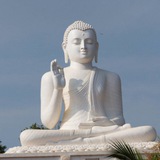
Big Buddhas of Wat Pha Sorn Kaew Buddhist temple, Phetchabun, Thailand
👏3🤩1😎1
Forwarded from Buddha Dharma books
Free Buddha Dharma ebook
A Naughty Jataka
By Bhante Shravasti Dhammika
Free download available:
https://budblooms.org/a-naughty-jataka/
===
🙈1🙉1🙊1
Forwarded from Buddha Dharma books
Free Buddha Dharma ebook
A Naughty Jataka
By Bhante Shravasti Dhammika
The Kacchapa Jataka is one of several rude stories in the Jataka and has, I think, never been translated into English before. Like several other risqué stories in the collection, Professor E. B. Cowell who edited the first complete English translation of the Jataka, thought it best to render it into Latin so that only scholars could read it. The purpose of the story is to highlight the Bodhisatta’s equanimity and non-retaliation. But the author or authors also uses the opportunity to poke fun at greedy brahmans who carry away more food than they can eat from various festivals and rituals, the tortoise’s shell looking something like a begging bowl. A ribald element is included to add to the fun and the tone of the story is generally light-hearted. In keeping with this ribald light-heartedness I have translated angajata as ‘dick’. The Kacchapa (Tortoise) and the Kondannas were the totems of two clans or tribes that usually did not intermarry. The monkey (makkata) in this story is a Rhesus Macaque, the most aggressive and mischievous of the several species of primates found in northern India. Interestingly, while the Bodhisatta is often depicted in Jataka stories as being reborn as one of these other types of monkeys, he is never reborn as a Macaque. One can well imagine village people roaring with laughter as a monk or learned lay person related this story to them at a religious festival or on a full-moon night. I would like to thank Anandajoti Bhikkhu for helping me with this translation.
Free download available:
https://budblooms.org/a-naughty-jataka/
===
👍1💯1🍾1