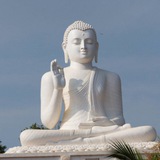
Forwarded from Buddha
And just as when a great rain cloud out of season pours down in heavy drops, covering the earth, so does delusion arise when ignorance prevails, covering beings, binding them, obstructing them.
Partial excerpts from Ud 5.5 : Uposathasutta
🙏2🕊1😍1
10. Sàdhu dassanam ariyànam
sannivàso sadà sukhà
Adassanena bàlànam
niccam eva sukhi siyà. 206.
11. Bàlasaïgatacàri hi
digham addhàna socati
Dukkho bàlehi samvàso
amitten' eva sabbadà.
Dhiro ca sukhasamvàso
ñàtinam' va samàgamo. 207.
12. Tasmà hi:-
Dhirañ ca paññañ ca bahussutañ ca
dhorayhasilam vatavantam àriyam
Tam tàdisam sappurisam sumedham
bhajetha nakkhattapatham' va candimà. 208.
BLESSED IS THE SIGHT OF THE NOBLE
SORROWFUL IS ASSOCIATION WITH THE FOOLISH
ASSOCIATE WITH THE WISE
10. Good is the sight of the Ariyas: their company is ever happy. Not seeing the foolish, one may ever be happy. 206.
11. Truly he who moves in company with fools grieves for a long time. Association with the foolish is ever painful as with a foe. Happy is association with the wise, even like meeting with kinsfolk. 207.
12. Therefore:-
With the intelligent, the wise, 8 the learned, 9 the enduring, 10 the dutiful, 11 and the Ariya 12 - with a man of such virtue and intellect should one associate, as the moon (follows) the starry path. 208.
Story
Once when the Buddha was unwell Sakka, King of the gods, assuming a human form, came to attend on the Buddha. The monks expressed surprise at the exemplary attitude of Sakka. Thereupon the Buddha uttered these verses.
===
Dhammapada, beloved and favorite teachings of the Buddha channel:
https://xn--r1a.website/dhammapadas
===
Telegram
Dhammapada - Buddha Dharma Teachings
Daily teachings of the Dhammapada, beloved and favorite teachings of the Buddha
👍1🙏1🏆1
Forwarded from Buddha
Ehipassiko
Please, Kālāmas, don’t go by oral transmission, don’t go by lineage, don’t go by testament, don’t go by canonical authority, don’t rely on logic, don’t rely on inference, don’t go by reasoned train of thought, don’t go by the acceptance of a view after deliberation, don’t go by the appearance of competence, and don’t think ‘The ascetic is our respected teacher.’ But when you know for yourselves: ‘These things are skillful, blameless, praised by sensible people, and when you undertake them, they lead to welfare and happiness’, then you should acquire them and keep them.
Partial excepts from AN 3.65 : Kesamutti or Kalama sutta
✍1❤1🔥1🙏1🤝1
Forwarded from Words of the Buddha
Free Buddha Dharma ebook
Nourishing the Roots
By Ajahn Pasanno
A collection of four talks given by Ajahn Pasanno in January 2021. This booklet was first offered as a gift commemorating Abhayagiri’s 25th Anniversary and Ajahn Pasanno’s 72nd birthday.
Free download available:
https://www.lotuslibrary.com/wp-content/uploads/2024/10/1951-Nourishin-Roots-_Pasanno.pdf
===
👌1😘1
Forwarded from Words of the Buddha
Free Buddha Dharma ebook
Nourishing the Roots
By Ajahn Pasanno
A collection of four talks given by Ajahn Pasanno in January 2021. This booklet was first offered as a gift commemorating Abhayagiri’s 25th Anniversary and Ajahn Pasanno’s 72nd birthday.
Free download available:
https://www.lotuslibrary.com/wp-content/uploads/2024/10/1951-Nourishin-Roots-_Pasanno.pdf
===
❤1🫡1🆒1
Forwarded from Buddha
Famous depiction of hell realms below the bridge to the main temple, Wat Rong Kun, the White Temple, Chiang Rai, Thailand.
❤1👏1😘1
Chapter 16
Piya Vagga
Affection
(Text and Translation by Ven. Nàrada)
1. Ayoge yuñjam attànam
yogasmiñ ca ayojayam
Attham hitvà piyaggàhã
pihet' attànuyoginam. 209.
2. Mà piyehi samàgañchi
appiyehi kudàcanam
Piyànam adassanam dukkham
appiyànañ ca dassanam. 210.
3. Tasmà piyam na kayiràtha
piympàyo hi pàpako
Ganthà tesam na vijjanti
yesam natthi piymppiyam. 211.
AVOID THAT WHICH SHOULD BE SHUNNED
1. Applying oneself 1 to that which should be avoided, not applying oneself to that which should be pursued, 2 and giving up the quest, 3 one who goes after pleasure envies them who exert themselves. 4 209.
GIVE UP BOTH WHAT IS DEAR AND NOT DEAR
2. Consort not with those that are dear, 5 never with those that are not dear; not seeing those that are dear and seeing those that are not dear, are both painful. 6 210.
HOLD NOTHING DEAR
3. Hence hold nothing dear, for separation from those that are dear is bad; bonds do not exist or those to whom naught is dear or not dear. 211.
Story
A youth, beloved by his parents, entered the Order without their approval. Later, the parents also entered the Order. Yet they could not live separated from one another, and could not give up their affection. Hearing their story, the Buddha uttered these verses.
===
Vajrayana Tantrayana Buddhism channel:
https://xn--r1a.website/tantrayanabuddhism
Tibetan Buddhism - Vajrayana, Tantrayana and esoteric Buddhism channel:
https://xn--r1a.website/tibetanbuddha
===
Telegram
Vajrayana Tantrayana Buddhism
Buddha teachings from the Vajrayana, esoteric, secret or Tantrayana vehicle
🔥1👏1🙏1🤝1
Forwarded from Buddha
Shwedagon Zedi Daw, The Shwedagon Golden Dagon Pagoda, Yangon, Myanmar. This 2,500-year-old Myanmar monument is heavily gilded with over 20 tons of gold, with the chatra is decorated with 5,448 diamonds, 2,317 rubies, and 4,000 gold bells..
👍2🥰1👏1😎1
And how does a mendicant meditate observing an aspect of feelings? Literally “a feeling among the feelings”; the practice shows that the meditator contemplates specific feelings as they occur.
It’s when a mendicant who feels a pleasant feeling knows: ‘I feel a pleasant feeling.’
When they feel a painful feeling, they know: ‘I feel a painful feeling.’
When they feel a neutral feeling, they know: ‘I feel a neutral feeling.’
And so they meditate observing an aspect of feelings internally, externally, and both internally and externally. They meditate observing feelings as liable to originate, as liable to fall, and as liable to both originate and vanish. Or mindfulness is established that feelings exist, to the extent necessary for knowledge and mindfulness. They meditate independent, not grasping at anything in the world.
That’s how a mendicant meditates by observing an aspect of feelings.
Partial excerpts from MN 10: Mahasatipatthanasutta
❤1🙏1😇1🫡1🆒1
Forwarded from Words of the Buddha
Pineapple shaped multi layered lotus petals pagoda of Avalokiteshvara, Baolin temple, Changzhou, Jiangsu, China.
👍2❤1👏1🤩1😍1
Forwarded from Buddha
Free Buddha Dharma ebook
A Map of the Journey
By Sayadaw U Jotika
A Map of the Journey by Sayādaw U Jotika is a nearly 400 pages long introduction to insight meditation. A Map of the Journey is an orginial, never previously published work. It is a transcript of a series of eleven preparatory talks given by Sayādaw U Jotika of Burma prior to a meditation retreat held in Australia. This book gives a thorough background to the Path with much detail about the various insight stages. The Sayādaw illustrates this with many stories from his own practice and from his many teachers.
Free download here:
https://www.lotuslibrary.com/wp-content/uploads/2024/10/1944-map-of-journey_Jotika.pdf
===
👍2👌1🕊1
Forwarded from Buddha
Free Buddha Dharma ebook
A Map of the Journey
By Sayadaw U Jotika
A Map of the Journey by Sayādaw U Jotika is a nearly 400 pages long introduction to insight meditation. A Map of the Journey is an orginial, never previously published work. It is a transcript of a series of eleven preparatory talks given by Sayādaw U Jotika of Burma prior to a meditation retreat held in Australia. This book gives a thorough background to the Path with much detail about the various insight stages. The Sayādaw illustrates this with many stories from his own practice and from his many teachers.
Free download here:
https://www.lotuslibrary.com/wp-content/uploads/2024/10/1944-map-of-journey_Jotika.pdf
===
🙏1😇1🫡1
Forwarded from Buddha
The Perfection of Wisdom in First Bloom
Relating Early Astasahasrika Prajnaparamita to Agama Literature
By Bhikkhu Anālayo
Part 1 of 2
Har Dayal (1932/1970, 43) explains that “Gautama Buddha speaks of himself as a bodhisatta, when he refers to the time before the attainment of Enlightenment. This seems to be the earliest signification of the word. It was applied to Gautama Buddha as he was in his last earthly life.”
When employed in this usage, the term “bodhisattva” mainly conveys the idea of Śākyamuni having gone forth in quest of awakening, without any explicit relationship to the compassionate wish to benefit others. At least in Āgama thought, his compassion does not feature as the motivational force leading to his awakening but much rather comes to the fore with his teaching activities once he had become a Buddha. The perspective that emerges in this way aligns with the stage of the bodhisattva ideal evident in the Perfection of Wisdom, where compassion has not yet reached the eminent position that it eventually was to acquire.
A Pāli discourse and its Chinese parallel explicitly depict the nature of Śākyamuni’s motivation. This can best be illustrated with the following two excerpts taken from the Chinese version, the first of which concerns his aspiration to set out on the path to awakening and the second his report of having successfully reached awakening:
Formerly, when I had not yet awakened to supreme, complete awakening, I thought also like this: “I am actually subject to disease myself, and I naively seek for what is subject to disease; I am actually subject to aging, subject to death, subject to worry and sadness, subject to defilement myself, and I naively seek for what is subject to defilement. What if I now rather seek for the supreme peace of Nirvana, which is free from disease, seek for the supreme peace of Nirvana, which is free from aging, free from death, free from worry and sadness, and free from defilement?”
Seeking for the supreme peace of Nirvana, which is free from disease, I in turn attained the supreme peace of Nirvana, which is free from disease. Seeking for the supreme peace of Nirvana, which is free from aging, free from death, free from worry and sadness, and free from defilement, I in turn attained the supreme peace of Nirvana, which is free from aging, free from death, free from worry and sadness, and free from defilement.
Arousing knowledge, arousing vision, I was concentrated on the qualities pertinent to awakening. I knew as it really is that birth has been extinguished, the holy life has been established, what had to be done has been done, and there will be no experiencing of a further existence.
""Śākyamuni’s motivation to set out in quest of awakening was to liberate himself.""
The Pāli version proceeds similarly, differing insofar as it does not refer to the qualities “pertinent to awakening” (bodhipākṣika). It additionally mentions the condition of being subject to birth alongside the predicaments of disease, aging, death, etc. Apart from such minor variations, however, the two parallels concord that Śākyamuni’s motivation to set out in quest of awakening was to liberate himself.
The term “bodhisattva” in this usage would be applicable to Śākyamuni mainly for the narrative period between the first and the second of the two excerpts translated above, that is, from his going forth to his actual awakening. Yet, already in Āgama literature a broadening in the scope of meaning of the term can be discerned. Relevant to this broadening is the circumstance that, in order to refer to him before he went forth, the alternative possibility of using the name Gautama was clearly not considered appropriate. Āgama literature shows the employment of this name to be characteristic of non- Buddhists, in contrast to his disciples, who prefer to refer to him by an honorific epithet like “Blessed One” (bhagavat).
Telegram
Buddha
Buddha dharma teachings from the suttas and commentaries
🕊1🆒1
Forwarded from Buddha
In fact, a Pāli discourse and parallels in Sanskrit and Chinese report that the recently awakened Buddha explicitly told those who were to become his first disciples that they should not address him by his name, Gautama. This procedure concords with an apparent general reluctance in the ancient setting to refer to a respected person by their name.
Since at this stage in the evolution of Buddhist thought there was only a single bodhisattva—the Buddha Śākyamuni during the time of his quest for awakening—it would in a way be natural to extend the usage of the expression “the bodhisattva” to the time of his life preceding his going forth. An example in case can be seen in the Buddha’s report that his mother passed away soon after his birth. In a Pāli discourse depicting various marvels related to the Buddha, this takes the following form: “Seven days after the bodhisattva has been born, Ānanda, the mother of the bodhisattva passes away and arises in the Tuṣita Heaven.” In this way, the Buddha here refers to himself as “the bodhisattva.”
===
Buddha dharma teachings channel:
https://xn--r1a.website/lorddivinebuddha
===
Telegram
Buddha
Buddha dharma teachings from the suttas and commentaries
💯1🤝1
Free Buddha Dharma ebook
Wings to Awakening: An Anthology from the Pali Canon
By Thanissaro Bhikkhu
The Wings to Awakening constitute the Buddha’s own list of his most important teachings. Toward the end of his life he stated several times that as long as the teachings in this list were remembered and put into practice, his message would endure. Thus the Wings cover, in the Buddha’s eyes, the words and skills most worth mastering and passing along to others.
Free download available:
https://www.accesstoinsight.org/lib/authors/thanissaro/wings.pdf
===
👏1🙏1🕊1
Free Buddha Dharma ebook
Wings to Awakening: An Anthology from the Pali Canon
By Thanissaro Bhikkhu
The Wings to Awakening constitute the Buddha’s own list of his most important teachings. Toward the end of his life he stated several times that as long as the teachings in this list were remembered and put into practice, his message would endure. Thus the Wings cover, in the Buddha’s eyes, the words and skills most worth mastering and passing along to others.
Free download available:
https://www.accesstoinsight.org/lib/authors/thanissaro/wings.pdf
===
💯1😇1🤝1
Forwarded from Words of the Buddha
Poy Sang Long, a Shan ceremony, a rite of passage for boys between 7 and 14 years old in Myanmar and northern Thailand. It involves the ordination of boys as novice monks, a symbolic representation of the Buddha's renunciation of worldly life. The ceremony includes a parade where the boys, dressed in elaborate costumes, are carried on the shoulders of their relatives.
❤1👏1🎉1