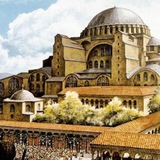
The Greek Church of Saint George in Tunis (city. Yes, the capital of Tunisia is called Tunis.) - the main Orthodox church in the country, built during the French rule in the characteristic French neo-Byzantine style, which makes it perhaps the only (or at least one of the few) Orthodox churches of this architectural school.
❤21👍1
Although there were two palaces belonging to the notorius Beldiman family in Iași, Romania, only the smaller of the two has survived to this day (I have already written about the larger palace here).
It is currently undergoing restoration, but even in its current state, details such as this neo-Gothic portico look quite picturesque.
It is currently undergoing restoration, but even in its current state, details such as this neo-Gothic portico look quite picturesque.
❤17🎉1
The main post office building in Kruševac, Serbia, built in the late Serbian-Byzantine Revival style, was erected shortly before World War II and skilfully used architectural trends popular at the time to convey a medieval spirit.
Unfortunately, this same adherence to trends later played a cruel joke on it - the building was too easy to convert into a modernist structure, and parts in this style were later added to it.
Unfortunately, this same adherence to trends later played a cruel joke on it - the building was too easy to convert into a modernist structure, and parts in this style were later added to it.
❤11
Neo-Manneristic or, to be exact, the neo-Cretan apse window of the All Saints church at Anatoli, Greece.
In the XIX century, on the wave of national revival, various schools of contemporary architecture emerged in different regions of Greece, which, in addition to the ubiquitous neo-Byzantine and neo-Greek recreated more local architectural traditions, and almost nowhere were such schools represented as vividly as in Crete and Cyprus.
The Cretan churches were particularly interesting, given that they were based on the local architecture of the Venetian period, which was combining post-Byzantine, Renaissance and Gothic details.
In the XIX century, on the wave of national revival, various schools of contemporary architecture emerged in different regions of Greece, which, in addition to the ubiquitous neo-Byzantine and neo-Greek recreated more local architectural traditions, and almost nowhere were such schools represented as vividly as in Crete and Cyprus.
The Cretan churches were particularly interesting, given that they were based on the local architecture of the Venetian period, which was combining post-Byzantine, Renaissance and Gothic details.
❤17
Beautiful Byzantine brickwork in the catholicon of the Kato Panagia monastery in Arta, Greece.
Particularly notable here are, of course, the inscription, which can be roughly translated as "From your depths, Panagia, we establish this building," and the monogram - not uncommon details, but definitely worthy of special attention.
Particularly notable here are, of course, the inscription, which can be roughly translated as "From your depths, Panagia, we establish this building," and the monogram - not uncommon details, but definitely worthy of special attention.
❤20🔥4
Unusual church of the former Inătești skete, which nowadays serves as a chapel of the Râmnicu Vâlcea theologic seminary.
Built in the XVIII century, apart from its small and somewhat unusual dimensions, at first glance it seems to be rather traditional or even archaic for the time of its construction.
However, upon closer inspection, one can see that the building is in the Brâncovenesc style, while its unusual layout demonstrates an understanding of the principles of Mannerist or Baroque traditions, rather than simply their decoration - the exonarthex has been remodelled while retaining its usual proportions to match the smaller size of the building, and most notably , the prosthesis and diaconicon are in the form of small chapels, whose decor further points to the architect's Baroque rather than Mannerist ideas.
Built in the XVIII century, apart from its small and somewhat unusual dimensions, at first glance it seems to be rather traditional or even archaic for the time of its construction.
However, upon closer inspection, one can see that the building is in the Brâncovenesc style, while its unusual layout demonstrates an understanding of the principles of Mannerist or Baroque traditions, rather than simply their decoration - the exonarthex has been remodelled while retaining its usual proportions to match the smaller size of the building, and most notably , the prosthesis and diaconicon are in the form of small chapels, whose decor further points to the architect's Baroque rather than Mannerist ideas.
❤15
As I have already mentioned, the early-Moscow, or rather Central Russian, architectural school, which later developed into the Uzorochye style, had its origins in Russian Romanesque architecture, specifically in its Vladimir-Suzdal variant.
Nevertheless, almost all known buildings of this school are distinguished by modest decor, especially in terms of the absence of carvings, while the last temples erected before the Mongol invasion, on the contrary, were distinguished by their abundance.
Of course, all this craftsmanship did not disappear overnight, although the invasion did significantly undermine Russian architecture. Still, almost no temples that still preserved the old traditions of decoration have survived to this day, and those that have survived have, in one way or another, lost their former adornments. In this sense, these recently discovered fragments of the first cathedral of the late XIII century in Tver provide a unique opportunity to see how the tradition developed after the devastation.
Nevertheless, almost all known buildings of this school are distinguished by modest decor, especially in terms of the absence of carvings, while the last temples erected before the Mongol invasion, on the contrary, were distinguished by their abundance.
Of course, all this craftsmanship did not disappear overnight, although the invasion did significantly undermine Russian architecture. Still, almost no temples that still preserved the old traditions of decoration have survived to this day, and those that have survived have, in one way or another, lost their former adornments. In this sense, these recently discovered fragments of the first cathedral of the late XIII century in Tver provide a unique opportunity to see how the tradition developed after the devastation.
❤7
What could be more Russian in the XIX century than wooden classicism? However, despite its once widespread popularity, fewer of these monuments have survived to this day than their stone counterparts, and even this estate in the center of Nizhny Novgorod, which belonged to the Shchelokov family, was on the verge of disappearing 10 years ago, despite its current exemplary appearance.
❤22👍3