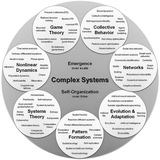
🔆 "Complex Systems Studies" is a graduate-level channel aiming to discuss all kinds of stuff related to the field of Complex Systems.
✔️ Our purpose is to be up-to-date, precise and international.
➡️ https://xn--r1a.website/ComplexSys
✔️ Our purpose is to be up-to-date, precise and international.
➡️ https://xn--r1a.website/ComplexSys
Telegram
Complex Systems Studies
What's up in Complexity Science?!
Check out here:
@ComplexSys
#complexity #complex_systems #networks #network_science
📨 Contact us: @carimi
Check out here:
@ComplexSys
#complexity #complex_systems #networks #network_science
📨 Contact us: @carimi
Forwarded from Deleted Account [SCAM]
This media is not supported in your browser
VIEW IN TELEGRAM
Dynamic scaling in natural swarms
🗞 Inferring Structural Characteristics of Networks with Strong and Weak Ties from Fixed-Choice Surveys
Naghmeh Momeni, Michael Rabbat
🔗 https://arxiv.org/pdf/1706.07828
📌 ABSTRACT
Knowing the structure of an offline social network facilitates a variety of analyses, including studying the rate at which infectious diseases may spread and identifying a subset of actors to immunize in order to reduce, as much as possible, the rate of spread. Offline social network topologies are typically estimated by surveying actors and asking them to list their neighbours. While identifying close friends and family (i.e., strong ties) can typically be done reliably, listing all of one's acquaintances (i.e., weak ties) is subject to error due to respondent fatigue. This issue is commonly circumvented through the use of so-called "fixed choice" surveys where respondents are asked to name a fixed, small number of their weak ties (e.g., two or ten). Of course, the resulting crude observed network will omit many ties, and using this crude network to infer properties of the network, such as its degree distribution or clustering coefficient, will lead to biased estimates. This paper develops estimators, based on the method of moments, for a number of network characteristics including those related to the first and second moments of the degree distribution as well as the network size, using fixed-choice survey data. Experiments with simulated data illustrate that the proposed estimators perform well across a variety of network topologies and measurement scenarios, and the resulting estimates are significantly more accurate than those obtained directly using the crude observed network, which are commonly used in the literature. We also describe a variation of the Jackknife procedure that can be used to obtain an estimate of the estimator variance.
Naghmeh Momeni, Michael Rabbat
🔗 https://arxiv.org/pdf/1706.07828
📌 ABSTRACT
Knowing the structure of an offline social network facilitates a variety of analyses, including studying the rate at which infectious diseases may spread and identifying a subset of actors to immunize in order to reduce, as much as possible, the rate of spread. Offline social network topologies are typically estimated by surveying actors and asking them to list their neighbours. While identifying close friends and family (i.e., strong ties) can typically be done reliably, listing all of one's acquaintances (i.e., weak ties) is subject to error due to respondent fatigue. This issue is commonly circumvented through the use of so-called "fixed choice" surveys where respondents are asked to name a fixed, small number of their weak ties (e.g., two or ten). Of course, the resulting crude observed network will omit many ties, and using this crude network to infer properties of the network, such as its degree distribution or clustering coefficient, will lead to biased estimates. This paper develops estimators, based on the method of moments, for a number of network characteristics including those related to the first and second moments of the degree distribution as well as the network size, using fixed-choice survey data. Experiments with simulated data illustrate that the proposed estimators perform well across a variety of network topologies and measurement scenarios, and the resulting estimates are significantly more accurate than those obtained directly using the crude observed network, which are commonly used in the literature. We also describe a variation of the Jackknife procedure that can be used to obtain an estimate of the estimator variance.
Complex Systems Studies
🎊 Hierarchal social systems continue to fail in the face of ever-increasing complexity. As NECSI research demonstrates, distributed organizational structures are needed.
🎊 Hierarchal social systems continue to fail in the face of ever-increasing complexity. As NECSI research demonstrates, distributed organizational structures are needed.
http://www.necsi.edu/research/overview/socialcomplexity.html?platform=hootsuite
http://www.necsi.edu/research/overview/socialcomplexity.html?platform=hootsuite
🗞 Temporal patterns behind the strength of persistent ties
Henry Navarro, Giovanna Miritello, Arturo Canales, Esteban Moro
🔗 https://arxiv.org/pdf/1706.06188
📌 ABSTRACT
Social networks are made out of strong and weak ties having very different structural and dynamical properties. But, what features of human interaction build a strong tie? Here we approach this question from an practical way by finding what are the properties of social interactions that make ties more persistent and thus stronger to maintain social interactions in the future. Using a large longitudinal mobile phone database we build a predictive model of tie persistence based on intensity, intimacy, structural and temporal patterns of social interaction. While our results confirm that structural (embeddedness) and intensity (number of calls) are correlated with tie persistence, we find that temporal features of communication events are better and more efficient predictors for tie persistence. Specifically, although communication within ties is always bursty we find that ties that are more bursty than the average are more likely to decay, signaling that tie strength is not only reflected in the intensity or topology of the network, but also on how individuals distribute time or attention across their relationships. We also found that stable relationships have and require a constant rhythm and if communication is halted for more than 8 times the previous communication frequency, most likely the tie will decay. Our results not only are important to understand the strength of social relationships but also to unveil the entanglement between the different temporal scales in networks, from microscopic tie burstiness and rhythm to macroscopic network evolution.
Henry Navarro, Giovanna Miritello, Arturo Canales, Esteban Moro
🔗 https://arxiv.org/pdf/1706.06188
📌 ABSTRACT
Social networks are made out of strong and weak ties having very different structural and dynamical properties. But, what features of human interaction build a strong tie? Here we approach this question from an practical way by finding what are the properties of social interactions that make ties more persistent and thus stronger to maintain social interactions in the future. Using a large longitudinal mobile phone database we build a predictive model of tie persistence based on intensity, intimacy, structural and temporal patterns of social interaction. While our results confirm that structural (embeddedness) and intensity (number of calls) are correlated with tie persistence, we find that temporal features of communication events are better and more efficient predictors for tie persistence. Specifically, although communication within ties is always bursty we find that ties that are more bursty than the average are more likely to decay, signaling that tie strength is not only reflected in the intensity or topology of the network, but also on how individuals distribute time or attention across their relationships. We also found that stable relationships have and require a constant rhythm and if communication is halted for more than 8 times the previous communication frequency, most likely the tie will decay. Our results not only are important to understand the strength of social relationships but also to unveil the entanglement between the different temporal scales in networks, from microscopic tie burstiness and rhythm to macroscopic network evolution.
🔅 “Complexity is the science of the 21st century. The catch is that we may have to wait decades to see it applied. Bar-Yam offers a convincing case, however, that the applications have arrived: many complex problems occurring in business and society can be successfully solved using the insights and tools of the emerging field.”
-- Albert-László Barabási, Author of Linked: The New Science of Networks
(from the foreword of Making Things Work)
-- Albert-László Barabási, Author of Linked: The New Science of Networks
(from the foreword of Making Things Work)
#Second_law_of_thermodynamics
🎯 " The law that entropy always increases holds, I think, the supreme position among the laws of Nature. If someone points out to you that your pet theory of the universe is in disagreement with Maxwell's equations — then so much the worse for Maxwell's equations. If it is found to be contradicted by observation — well, these experimentalists do bungle things sometimes. But if your theory is found to be against the second law of thermodynamics I can give you no hope; there is nothing for it but to collapse in deepest humiliation."
— Sir Arthur Stanley Eddington, The Nature of the Physical World (1927)
🎯 " The law that entropy always increases holds, I think, the supreme position among the laws of Nature. If someone points out to you that your pet theory of the universe is in disagreement with Maxwell's equations — then so much the worse for Maxwell's equations. If it is found to be contradicted by observation — well, these experimentalists do bungle things sometimes. But if your theory is found to be against the second law of thermodynamics I can give you no hope; there is nothing for it but to collapse in deepest humiliation."
— Sir Arthur Stanley Eddington, The Nature of the Physical World (1927)
🔹 Markov Chains
A visual explanation by Victor Powell
http://setosa.io/blog/2014/07/26/markov-chains/index.html
A visual explanation by Victor Powell
http://setosa.io/blog/2014/07/26/markov-chains/index.html