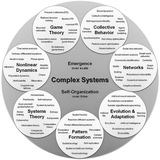
🌀 A Nature Communications collection highlighting their papers in complexity research:
🔗 https://www.nature.com/collections/ycjylwzvmz
🔗 https://www.nature.com/collections/ycjylwzvmz
🗞 The scaling structure of the global road network
Emanuele Strano, Andrea Giometto, Saray Shai, Enrico Bertuzzo, Peter J. Mucha, Andrea Rinaldo
🔗 https://arxiv.org/pdf/1706.01401
📌 ABSTRACT
Because of increasing global urbanization and its immediate consequences, including changes in patterns of food demand/circulation and land-use, the next century will witness a major increase in the extent of paved roads built worldwide. It is crucial then to understand whether possible self-organized patterns are inherent in the global road network structure. Here, we use the largest updated database comprising all major roads on Earth, together with global urban and cropland inventories, to suggest that road length distributions within croplands are indistinguishable from urban ones, once rescaled to account for the difference in mean road length. Such similarity extends to road length distributions within urban or agricultural domains of given area. We find two distinct regimes for the scaling of the mean road length with the associated area, holding in general at small and at large values of the latter. In suitably large urban and cropland domains, we find that mean and total road lengths increase linearly with their domain area, differently from earlier suggestions. Scaling regimes suggest that simple and universal mechanisms regulate urban and cropland road expansion at the global scale. Our findings bear implications on global road infrastructure growth based on land-use change and on planning policies sustaining urban expansions.
Emanuele Strano, Andrea Giometto, Saray Shai, Enrico Bertuzzo, Peter J. Mucha, Andrea Rinaldo
🔗 https://arxiv.org/pdf/1706.01401
📌 ABSTRACT
Because of increasing global urbanization and its immediate consequences, including changes in patterns of food demand/circulation and land-use, the next century will witness a major increase in the extent of paved roads built worldwide. It is crucial then to understand whether possible self-organized patterns are inherent in the global road network structure. Here, we use the largest updated database comprising all major roads on Earth, together with global urban and cropland inventories, to suggest that road length distributions within croplands are indistinguishable from urban ones, once rescaled to account for the difference in mean road length. Such similarity extends to road length distributions within urban or agricultural domains of given area. We find two distinct regimes for the scaling of the mean road length with the associated area, holding in general at small and at large values of the latter. In suitably large urban and cropland domains, we find that mean and total road lengths increase linearly with their domain area, differently from earlier suggestions. Scaling regimes suggest that simple and universal mechanisms regulate urban and cropland road expansion at the global scale. Our findings bear implications on global road infrastructure growth based on land-use change and on planning policies sustaining urban expansions.
💻
Self-Paced Training: Machine Learning with MATLAB
https://www.mathworks.com/training-schedule/machine-learning-with-matlab.html?s_tid=trg_mlml_mlacad_bod&class_format=Public%2BSelf%2BPaced
Self-Paced Training: Machine Learning with MATLAB
https://www.mathworks.com/training-schedule/machine-learning-with-matlab.html?s_tid=trg_mlml_mlacad_bod&class_format=Public%2BSelf%2BPaced
🗞 Geometric structure and information change in phase transitions
Eun-jin Kim and Rainer Hollerbach
Phys. Rev. E 95, 062107 – Published 6 June 2017
🔗 https://journals.aps.org/pre/abstract/10.1103/PhysRevE.95.062107
📌 ABSTRACT
We propose a toy model for a cyclic order-disorder transition and introduce a geometric methodology to understand stochastic processes involved in transitions. Specifically, our model consists of a pair of forward and backward processes (FPs and BPs) for the emergence and disappearance of a structure in a stochastic environment. We calculate time-dependent probability density functions (PDFs) and the information length L, which is the total number of different states that a system undergoes during the transition. Time-dependent PDFs during transient relaxation exhibit strikingly different behavior in FPs and BPs. In particular, FPs driven by instability undergo the broadening of the PDF with a large increase in fluctuations before the transition to the ordered state accompanied by narrowing the PDF width. During this stage, we identify an interesting geodesic solution accompanied by the self-regulation between the growth and nonlinear damping where the time scale τof information change is constant in time, independent of the strength of the stochastic noise. In comparison, BPs are mainly driven by the macroscopic motion due to the movement of the PDF peak. The total information length L between initial and final states is much larger in BPs than in FPs, increasing linearly with the deviation γ of a control parameter from the critical state in BPs while increasing logarithmically with γ in FPs. L scales as |lnD| and D−1/2 in FPs and BPs, respectively, where D measures the strength of the stochastic forcing. These differing scalings with γ and D suggest a great utility of L in capturing different underlying processes, specifically, diffusion vs advection in phase transition by geometry. We discuss physical origins of these scalings and comment on implications of our results for bistable systems undergoing repeated order-disorder transitions (e.g., fitness).
https://journals.aps.org/pre/abstract/10.1103/PhysRevE.95.062107
Eun-jin Kim and Rainer Hollerbach
Phys. Rev. E 95, 062107 – Published 6 June 2017
🔗 https://journals.aps.org/pre/abstract/10.1103/PhysRevE.95.062107
📌 ABSTRACT
We propose a toy model for a cyclic order-disorder transition and introduce a geometric methodology to understand stochastic processes involved in transitions. Specifically, our model consists of a pair of forward and backward processes (FPs and BPs) for the emergence and disappearance of a structure in a stochastic environment. We calculate time-dependent probability density functions (PDFs) and the information length L, which is the total number of different states that a system undergoes during the transition. Time-dependent PDFs during transient relaxation exhibit strikingly different behavior in FPs and BPs. In particular, FPs driven by instability undergo the broadening of the PDF with a large increase in fluctuations before the transition to the ordered state accompanied by narrowing the PDF width. During this stage, we identify an interesting geodesic solution accompanied by the self-regulation between the growth and nonlinear damping where the time scale τof information change is constant in time, independent of the strength of the stochastic noise. In comparison, BPs are mainly driven by the macroscopic motion due to the movement of the PDF peak. The total information length L between initial and final states is much larger in BPs than in FPs, increasing linearly with the deviation γ of a control parameter from the critical state in BPs while increasing logarithmically with γ in FPs. L scales as |lnD| and D−1/2 in FPs and BPs, respectively, where D measures the strength of the stochastic forcing. These differing scalings with γ and D suggest a great utility of L in capturing different underlying processes, specifically, diffusion vs advection in phase transition by geometry. We discuss physical origins of these scalings and comment on implications of our results for bistable systems undergoing repeated order-disorder transitions (e.g., fitness).
https://journals.aps.org/pre/abstract/10.1103/PhysRevE.95.062107
Physical Review E
Geometric structure and information change in phase transitions
We propose a toy model for a cyclic order-disorder transition and introduce a geometric methodology to understand stochastic processes involved in transitions. Specifically, our model consists of a pair of forward and backward processes (FPs and BPs) for…
🌀The 2017 SIAM Conference on Applications of Dynamical Systems (DS17) was held in Sandy, Utah on May 21st - May 25th, 2017. The SIAM DS conference seeks to enable in-depth technical discussions on a wide variety of major computational efforts on large-scale problems in science and engineering, foster the interdisciplinary culture required to meet these large-scale challenges, and promote the training of the next generation of computational scientists.
Use the search box in the upper right to search for a speaker, talk title, or topic. Select "Content" to see the list of other SIAM meetings with presentations available for viewing.
🔗 https://www.pathlms.com/siam/courses/4812
Use the search box in the upper right to search for a speaker, talk title, or topic. Select "Content" to see the list of other SIAM meetings with presentations available for viewing.
🔗 https://www.pathlms.com/siam/courses/4812
Friends and enemies in the Middle East. Who is connected to whom? - interactive | News | The Guardian
https://www.theguardian.com/news/datablog/ng-interactive/2014/sep/24/friends-and-enemies-in-the-middle-east-who-is-connected-to-who-interactive
https://www.theguardian.com/news/datablog/ng-interactive/2014/sep/24/friends-and-enemies-in-the-middle-east-who-is-connected-to-who-interactive
the Guardian
Friends and enemies in the Middle East. Who is connected to whom? - interactive
As the US and UK are set to again commit to military involvement in the Middle East, this interactive visualises the intricate, complex and sometimes hidden relationships and alliances across the region
🔥 Gall's Law: "A complex system that works is invariably found to have evolved from a simple system that worked."
– John Gall (1975)
– John Gall (1975)
Tutorials are short, self-paced “mini-courses” designed to introduce students to important techniques and to provide illustrations of their application in complex systems.
https://www.complexityexplorer.org/tutorials
https://www.complexityexplorer.org/tutorials