Forwarded from Sitpor.org سیتپـــــور
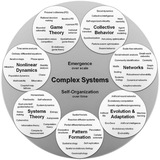
یک سیستم پیچیده چیست؟
http://www.sitpor.org/2017/01/complexsys1/
http://www.sitpor.org/2017/01/complexsys1/
Forwarded from Sitpor.org سیتپـــــور
🌀 سیستمهای پیچیده: «ماهیت و ویژگی»
http://www.sitpor.org/2017/01/complexsys1/
🎯 مقدمه:
حدود۳۳۰ سال پیش، نیوتون با انتشار شاهکار خود، اصول ریاضی فلسفه طبیعی، نگاهی جدید نسبت به بررسی طبیعت را معرفی کرد. نگاه نیوتون به علم به کمک نظریه الکترومغناطیس که توسط مکسول جمع بندی و در نهایت توسط آلبرت اینشتین کامل شد، شالوده فیزیککلاسیک را بنا نهاد. انقلاب بعدی علم، توسط مکانیک کوانتومی رخداد. آنچه که مکانیک کوانتومی در قرن ۲۰ میلادی نشانه گرفت، مسئله موضعیت در فیزیک کلاسیک و نگاه احتمالاتی به طبیعت بود. نگاهی که سرانجام منجر به پارادایمی جدید در علم، به عنوان فیزیک مدرن شد. با این وجود، علیرغم پیشرفتهای خارقالعاده در فیزیک و سایر علوم، کماکان در توجیه بسیاری از پدیدهها وا ماندهایم. پدیدههایی که همیشه اطرافمان حاضر بودهاند ولی هیچموقع قادر به توجیه رفتار آنها نبودهایم. بنابراین، میتوان به این فکر کرد که شاید در نگاه ما به طبیعت و مسائل علمی، نقصی وجود داشته باشد. به دیگر سخن، بعید نیست که مجددا نیاز به بازنگری در نگاهمان به طبیعت (تغییر پارادایم) داشته باشیم؛ عدهی زیادی معتقدند آنچه که در قرن ۲۱ام نیاز است، نگاهی جدید به مبانی علم است؛ نگاه پیچیدگی!
http://www.sitpor.org/2017/01/complexsys1/
🎯 مقدمه:
حدود۳۳۰ سال پیش، نیوتون با انتشار شاهکار خود، اصول ریاضی فلسفه طبیعی، نگاهی جدید نسبت به بررسی طبیعت را معرفی کرد. نگاه نیوتون به علم به کمک نظریه الکترومغناطیس که توسط مکسول جمع بندی و در نهایت توسط آلبرت اینشتین کامل شد، شالوده فیزیککلاسیک را بنا نهاد. انقلاب بعدی علم، توسط مکانیک کوانتومی رخداد. آنچه که مکانیک کوانتومی در قرن ۲۰ میلادی نشانه گرفت، مسئله موضعیت در فیزیک کلاسیک و نگاه احتمالاتی به طبیعت بود. نگاهی که سرانجام منجر به پارادایمی جدید در علم، به عنوان فیزیک مدرن شد. با این وجود، علیرغم پیشرفتهای خارقالعاده در فیزیک و سایر علوم، کماکان در توجیه بسیاری از پدیدهها وا ماندهایم. پدیدههایی که همیشه اطرافمان حاضر بودهاند ولی هیچموقع قادر به توجیه رفتار آنها نبودهایم. بنابراین، میتوان به این فکر کرد که شاید در نگاه ما به طبیعت و مسائل علمی، نقصی وجود داشته باشد. به دیگر سخن، بعید نیست که مجددا نیاز به بازنگری در نگاهمان به طبیعت (تغییر پارادایم) داشته باشیم؛ عدهی زیادی معتقدند آنچه که در قرن ۲۱ام نیاز است، نگاهی جدید به مبانی علم است؛ نگاه پیچیدگی!
🗞 Power-law distributions in empirical data
Aaron Clauset, Cosma Rohilla Shalizi, M. E. J. Newman
🔗 https://arxiv.org/pdf/0706.1062v2
📌 ABSTRACT
Power-law distributions occur in many situations of scientific interest and have significant consequences for our understanding of natural and man-made phenomena. Unfortunately, the detection and characterization of power laws is complicated by the large fluctuations that occur in the tail of the distribution -- the part of the distribution representing large but rare events -- and by the difficulty of identifying the range over which power-law behavior holds. Commonly used methods for analyzing power-law data, such as least-squares fitting, can produce substantially inaccurate estimates of parameters for power-law distributions, and even in cases where such methods return accurate answers they are still unsatisfactory because they give no indication of whether the data obey a power law at all. Here we present a principled statistical framework for discerning and quantifying power-law behavior in empirical data. Our approach combines maximum-likelihood fitting methods with goodness-of-fit tests based on the Kolmogorov-Smirnov statistic and likelihood ratios. We evaluate the effectiveness of the approach with tests on synthetic data and give critical comparisons to previous approaches. We also apply the proposed methods to twenty-four real-world data sets from a range of different disciplines, each of which has been conjectured to follow a power-law distribution. In some cases we find these conjectures to be consistent with the data while in others the power law is ruled out.
Aaron Clauset, Cosma Rohilla Shalizi, M. E. J. Newman
🔗 https://arxiv.org/pdf/0706.1062v2
📌 ABSTRACT
Power-law distributions occur in many situations of scientific interest and have significant consequences for our understanding of natural and man-made phenomena. Unfortunately, the detection and characterization of power laws is complicated by the large fluctuations that occur in the tail of the distribution -- the part of the distribution representing large but rare events -- and by the difficulty of identifying the range over which power-law behavior holds. Commonly used methods for analyzing power-law data, such as least-squares fitting, can produce substantially inaccurate estimates of parameters for power-law distributions, and even in cases where such methods return accurate answers they are still unsatisfactory because they give no indication of whether the data obey a power law at all. Here we present a principled statistical framework for discerning and quantifying power-law behavior in empirical data. Our approach combines maximum-likelihood fitting methods with goodness-of-fit tests based on the Kolmogorov-Smirnov statistic and likelihood ratios. We evaluate the effectiveness of the approach with tests on synthetic data and give critical comparisons to previous approaches. We also apply the proposed methods to twenty-four real-world data sets from a range of different disciplines, each of which has been conjectured to follow a power-law distribution. In some cases we find these conjectures to be consistent with the data while in others the power law is ruled out.
☄ Postdoc in physics at Northwestern (in Adilson Motter's group) on dynamical aspects of networks (deadline 1 March)
http://dyn.phys.northwestern.edu/positions.html
http://dyn.phys.northwestern.edu/positions.html
☄ Position in Complex Networked Production Systems at Graz University of Technology
👇
👇
⭕️ Enroll NOW:Fractals and Scaling MOOC starts February 13th. FREE and fantastic. Sign up and share!
🔗 https://www.complexityexplorer.org/courses/62-fractals-and-scaling-winter-2017
🔗 https://www.complexityexplorer.org/courses/62-fractals-and-scaling-winter-2017
☑️ 5th European Conference on Networks
Wednesday 25 and Thursday 26 May 2017
The Department of Economics at University College London (UCL) will host the 5th European Conference on Networks. This conference aims to bring together economic researchers on networks in economics and related topics. The conference will be held at UCL, 25-26 May 2017. The program committee invites applied, econometrics and theoretical work on the topic.
Confirmed speakers include:
Jennifer La’O (Columbia University)
Robin Lee (Harvard University)
Aureo de Paula (University College London)
Luigi Pistaferri (Stanford University)
Dominic Rohner (University of Lausanne)
Marzena Rostek (University of Wisconsin-Madison)
Elie Tamer (Harvard University).
Call for Papers
We primarily invite submissions of completed papers, but will also consider submissions of substantial abstracts (2 pages). Prospective contributors are invited to submit papers and abstracts by 17 March, 2017 to euronetconf@gmail.com
All submitted papers will be reviewed prior to acceptance for presentation. The scientific committee aim to complete the review process by early April, 2017 and will notify applicants by email. Following the review process, a final program will be compiled and posted here on the conference webpage.
Scientific Committee
Yann Bramoulle, Aix-Marseille University
Vasco Carvalho, Cambridge University
Andrea Galeotti, European University Institute and Essex University
Sanjeev Goyal, Cambridge University
Aureo de Paula, University College London
Adam Szeidl, Central European University
http://www.ucl.ac.uk/economics/non-seminar/upcoming/5ecn
Wednesday 25 and Thursday 26 May 2017
The Department of Economics at University College London (UCL) will host the 5th European Conference on Networks. This conference aims to bring together economic researchers on networks in economics and related topics. The conference will be held at UCL, 25-26 May 2017. The program committee invites applied, econometrics and theoretical work on the topic.
Confirmed speakers include:
Jennifer La’O (Columbia University)
Robin Lee (Harvard University)
Aureo de Paula (University College London)
Luigi Pistaferri (Stanford University)
Dominic Rohner (University of Lausanne)
Marzena Rostek (University of Wisconsin-Madison)
Elie Tamer (Harvard University).
Call for Papers
We primarily invite submissions of completed papers, but will also consider submissions of substantial abstracts (2 pages). Prospective contributors are invited to submit papers and abstracts by 17 March, 2017 to euronetconf@gmail.com
All submitted papers will be reviewed prior to acceptance for presentation. The scientific committee aim to complete the review process by early April, 2017 and will notify applicants by email. Following the review process, a final program will be compiled and posted here on the conference webpage.
Scientific Committee
Yann Bramoulle, Aix-Marseille University
Vasco Carvalho, Cambridge University
Andrea Galeotti, European University Institute and Essex University
Sanjeev Goyal, Cambridge University
Aureo de Paula, University College London
Adam Szeidl, Central European University
http://www.ucl.ac.uk/economics/non-seminar/upcoming/5ecn
🗞 Understanding cancer complexome using networks, spectral graph theory and multilayer framework
🔗 https://arxiv.org/pdf/1701.06349v1
Aparna Rai, Priodyuti Pradhan, Jyothi Nagraj, K. Lohitesh, Rajdeep Chowdhury, Sarika Jalan
📌 ABSTRACT
Cancer complexome comprises a heterogeneous and multifactorial milieu that varies in cytology, physiology, signaling mechanisms and response to therapy. The combined framework of network theory and spectral graph theory along with the multilayer anal- ysis provides a comprehensive approach to analyze the proteomic data of seven different cancers, namely, breast, oral, ovarian, cervical, lung, colon and prostate. Our analysis demonstrates that the protein-protein interaction networks of the normal and the cancerous tissues associated with the seven cancers have overall similar structural and spectral properties. However, few of these properties implicate unsystematic changes from the normal to the disease networks depicting difference in the interactions and highlighting changes in the complexity of different cancers. Importantly, analysis of common proteins of all the cancer networks reveals few proteins namely the sensors, which not only occupy significant position in all the layers but also have direct involvement in causing cancer. The prediction and analysis of miRNAs targeting these sensor proteins hint towards the possible role of these proteins in tumorigenesis. This novel approach helps in understanding cancer at the fundamental level and provides a clue to develop promising and nascent concept of single drug therapy for multiple diseases as well as personalized medicine.
🔗 https://arxiv.org/pdf/1701.06349v1
Aparna Rai, Priodyuti Pradhan, Jyothi Nagraj, K. Lohitesh, Rajdeep Chowdhury, Sarika Jalan
📌 ABSTRACT
Cancer complexome comprises a heterogeneous and multifactorial milieu that varies in cytology, physiology, signaling mechanisms and response to therapy. The combined framework of network theory and spectral graph theory along with the multilayer anal- ysis provides a comprehensive approach to analyze the proteomic data of seven different cancers, namely, breast, oral, ovarian, cervical, lung, colon and prostate. Our analysis demonstrates that the protein-protein interaction networks of the normal and the cancerous tissues associated with the seven cancers have overall similar structural and spectral properties. However, few of these properties implicate unsystematic changes from the normal to the disease networks depicting difference in the interactions and highlighting changes in the complexity of different cancers. Importantly, analysis of common proteins of all the cancer networks reveals few proteins namely the sensors, which not only occupy significant position in all the layers but also have direct involvement in causing cancer. The prediction and analysis of miRNAs targeting these sensor proteins hint towards the possible role of these proteins in tumorigenesis. This novel approach helps in understanding cancer at the fundamental level and provides a clue to develop promising and nascent concept of single drug therapy for multiple diseases as well as personalized medicine.
🔹 Could the apparent complexity of life just be a consequence of thermodynamics?
🔗 https://www.quantamagazine.org/20170126-information-theory-and-the-foundation-of-life/
🔗 https://www.quantamagazine.org/20170126-information-theory-and-the-foundation-of-life/
Quanta Magazine
How Life (and Death) Spring From Disorder
Life was long thought to obey its own set of rules. But as simple systems show signs of lifelike behavior, scientists are arguing about whether this apparent
Forwarded from Deleted Account [SCAM]
This media is not supported in your browser
VIEW IN TELEGRAM
Similarly, does anyone care to guess the dimension of this shape?