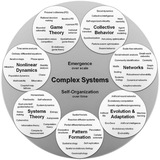
🔵 Complex systems Winter School 2017:
Early Registration Deadline on Nov. 2
http://necsi.edu/education/school.html
Early Registration Deadline on Nov. 2
http://necsi.edu/education/school.html
📝 Social Network Analysis Reveals Potential Fission-Fusion Behavior in a Shark
Danielle E. Haulsee, Dewayne A. Fox[…]Matthew J. Oliver
📌Abstract
Complex social networks and behaviors are difficult to observe for free-living marine species, especially those that move great distances. Using implanted acoustic transceivers to study the inter- and intraspecific interactions of sand tiger sharks Carcharias taurus, we observed group behavior that has historically been associated with higher order mammals. We found evidence strongly suggestive of fission-fusion behavior, or changes in group size and composition of sand tigers, related to five behavioral modes (summering, south migration, community bottleneck, dispersal, north migration). Our study shows sexually dimorphic behavior during migration, in addition to presenting evidence of a potential solitary phase for these typically gregarious sharks. Sand tigers spent up to 95 consecutive and 335 cumulative hours together, with the strongest relationships occurring between males. Species that exhibit fission-fusion group dynamics pose a particularly challenging issue for conservation and management because changes in group size and composition affect population estimates and amplify anthropogenic impacts.
http://www.nature.com/articles/srep34087
Danielle E. Haulsee, Dewayne A. Fox[…]Matthew J. Oliver
📌Abstract
Complex social networks and behaviors are difficult to observe for free-living marine species, especially those that move great distances. Using implanted acoustic transceivers to study the inter- and intraspecific interactions of sand tiger sharks Carcharias taurus, we observed group behavior that has historically been associated with higher order mammals. We found evidence strongly suggestive of fission-fusion behavior, or changes in group size and composition of sand tigers, related to five behavioral modes (summering, south migration, community bottleneck, dispersal, north migration). Our study shows sexually dimorphic behavior during migration, in addition to presenting evidence of a potential solitary phase for these typically gregarious sharks. Sand tigers spent up to 95 consecutive and 335 cumulative hours together, with the strongest relationships occurring between males. Species that exhibit fission-fusion group dynamics pose a particularly challenging issue for conservation and management because changes in group size and composition affect population estimates and amplify anthropogenic impacts.
http://www.nature.com/articles/srep34087
Scientific Reports
Social Network Analysis Reveals Potential Fission-Fusion Behavior in a Shark
Scientific Reports volume 6, Article number: 34087 (2016) Cite this article
Wanna do PhD on the Internet in "best university of the world"? Apply by Jan-20
http://www.ox.ac.uk/admissions/graduate/courses/dphil-information-communication-and-social-sciences
http://www.ox.ac.uk/admissions/graduate/courses/dphil-information-communication-and-social-sciences
www.ox.ac.uk
DPhil in Information, Communication and the Social Sciences |
About the courseThe DPhil in Information, Communication and the Social Sciences provides an opportunity for highly-qualified students to undertake innovative internet-related research.
📝 Encoding Temporal Markov Dynamics in Graph for Time Series Visualization
https://arxiv.org/abs/1610.07273
📌ABSTRACT:
Time series is attracting more attention across statistics, machine learning and pattern recognition as it appears widely in both industry and academia, but few advances has been achieved in effective time series visualization due to its temporal dimensionality and complex dynamics. Inspired by recent effort on using network metrics to characterize time series for classification, we present an approach to visualize time series as complex networks based on first order Markov process and temporal ordering. Different to classical bar charts, line plots and other statistics based graph, our approach delivers more intuitive visualization that better preserves both the temporal dependency and frequency structures. It provides a natural inverse operation to map the graph back to time series, making it possible to use graph statistics to characterize time series for better visual exploration and statistical analysis. Our experimental results suggest the effectiveness on various tasks such as system identification, classification and anomaly detection on both synthetic and the real time series data.
https://arxiv.org/abs/1610.07273
📌ABSTRACT:
Time series is attracting more attention across statistics, machine learning and pattern recognition as it appears widely in both industry and academia, but few advances has been achieved in effective time series visualization due to its temporal dimensionality and complex dynamics. Inspired by recent effort on using network metrics to characterize time series for classification, we present an approach to visualize time series as complex networks based on first order Markov process and temporal ordering. Different to classical bar charts, line plots and other statistics based graph, our approach delivers more intuitive visualization that better preserves both the temporal dependency and frequency structures. It provides a natural inverse operation to map the graph back to time series, making it possible to use graph statistics to characterize time series for better visual exploration and statistical analysis. Our experimental results suggest the effectiveness on various tasks such as system identification, classification and anomaly detection on both synthetic and the real time series data.
What is your field of study?
Physics, MS – 21
👍👍👍👍👍👍👍 53%
Physics, BS – 7
👍👍 18%
Other – 6
👍👍 15%
Physics, PhD – 2
👍 5%
Biology – 2
👍 5%
I am a professor of Physics. – 1
▫️ 3%
Not a professor or a student! – 1
▫️ 3%
Mathematics
▫️ 0%
Economy
▫️ 0%
👥 40 people voted so far. Poll closed.
Physics, MS – 21
👍👍👍👍👍👍👍 53%
Physics, BS – 7
👍👍 18%
Other – 6
👍👍 15%
Physics, PhD – 2
👍 5%
Biology – 2
👍 5%
I am a professor of Physics. – 1
▫️ 3%
Not a professor or a student! – 1
▫️ 3%
Mathematics
▫️ 0%
Economy
▫️ 0%
👥 40 people voted so far. Poll closed.
📝 Estimating the Size of a Large Network and its Communities from a Random Sample
Lin Chen, Amin Karbasi, Forrest W. Crawford
https://arxiv.org/pdf/1610.08473v1
📌 ABSTRACT:
Most real-world networks are too large to be measured or studied directly and there is substantial interest in estimating global network properties from smaller sub-samples. One of the most important global properties is the number of vertices/nodes in the network. Estimating the number of vertices in a large network is a major challenge in computer science, epidemiology, demography, and intelligence analysis. In this paper we consider a population random graph G = (V;E) from the stochastic block model (SBM) with K communities/blocks. A sample is obtained by randomly choosing a subset W and letting G(W) be the induced subgraph in G of the vertices in W. In addition to G(W), we observe the total degree of each sampled vertex and its block membership. Given this partial information, we propose an efficient PopULation Size Estimation algorithm, called PULSE, that correctly estimates the size of the whole population as well as the size of each community. To support our theoretical analysis, we perform an exhaustive set of experiments to study the effects of sample size, K, and SBM model parameters on the accuracy of the estimates. The experimental results also demonstrate that PULSE significantly outperforms a widely-used method called the network scale-up estimator in a wide variety of scenarios. We conclude with extensions and directions for future work.
Lin Chen, Amin Karbasi, Forrest W. Crawford
https://arxiv.org/pdf/1610.08473v1
📌 ABSTRACT:
Most real-world networks are too large to be measured or studied directly and there is substantial interest in estimating global network properties from smaller sub-samples. One of the most important global properties is the number of vertices/nodes in the network. Estimating the number of vertices in a large network is a major challenge in computer science, epidemiology, demography, and intelligence analysis. In this paper we consider a population random graph G = (V;E) from the stochastic block model (SBM) with K communities/blocks. A sample is obtained by randomly choosing a subset W and letting G(W) be the induced subgraph in G of the vertices in W. In addition to G(W), we observe the total degree of each sampled vertex and its block membership. Given this partial information, we propose an efficient PopULation Size Estimation algorithm, called PULSE, that correctly estimates the size of the whole population as well as the size of each community. To support our theoretical analysis, we perform an exhaustive set of experiments to study the effects of sample size, K, and SBM model parameters on the accuracy of the estimates. The experimental results also demonstrate that PULSE significantly outperforms a widely-used method called the network scale-up estimator in a wide variety of scenarios. We conclude with extensions and directions for future work.
🔴 علم بارپرستگونه:
ملاحظاتی در علم، شبهعلم و یادگیری اینکه چگونه خود را فریب ندهیم.
سخنرانی ریچارد #فاینمن به مناسبت جشن فارغالتحصیلی - #کلتک ۱۹۷۴
http://www.sitpor.org/2016/04/cargo-cult-science/
#Cargo_Cult_Science , #sitpor
ملاحظاتی در علم، شبهعلم و یادگیری اینکه چگونه خود را فریب ندهیم.
سخنرانی ریچارد #فاینمن به مناسبت جشن فارغالتحصیلی - #کلتک ۱۹۷۴
http://www.sitpor.org/2016/04/cargo-cult-science/
#Cargo_Cult_Science , #sitpor
📝 Percolation in real multiplex networks
Ginestra Bianconi, Filippo Radicchi
https://arxiv.org/pdf/1610.08708v1
(Submitted on 27 Oct 2016)
📌 ABSTRACT
We present an exact mathematical framework able to describe site-percolation transitions in real multiplex networks. Specifically, we consider the average percolation diagram valid over an infinite number of random configurations where nodes are present in the system with given probability. The approach relies on the locally treelike ansatz, so that it is expected to accurately reproduce the true percolation diagram of sparse multiplex networks with negligible number of short loops. The performance of our theory is tested in social, biological, and transportation multiplex graphs. When compared against previously introduced methods, we observe improvements in the prediction of the percolation diagrams in all networks analyzed. Results from our method confirm previous claims about the robustness of real multiplex networks, in the sense that the average connectedness of the system does not exhibit any significant abrupt change as its individual components are randomly destroyed.
Ginestra Bianconi, Filippo Radicchi
https://arxiv.org/pdf/1610.08708v1
(Submitted on 27 Oct 2016)
📌 ABSTRACT
We present an exact mathematical framework able to describe site-percolation transitions in real multiplex networks. Specifically, we consider the average percolation diagram valid over an infinite number of random configurations where nodes are present in the system with given probability. The approach relies on the locally treelike ansatz, so that it is expected to accurately reproduce the true percolation diagram of sparse multiplex networks with negligible number of short loops. The performance of our theory is tested in social, biological, and transportation multiplex graphs. When compared against previously introduced methods, we observe improvements in the prediction of the percolation diagrams in all networks analyzed. Results from our method confirm previous claims about the robustness of real multiplex networks, in the sense that the average connectedness of the system does not exhibit any significant abrupt change as its individual components are randomly destroyed.
#سلسله_سمینارهای_هفتگی گروه سیستم های پیچیده شهید بهشتی
علاقه مندان می توانند برای ارائه موضوعات خود به ادمین پیام داده یا به صورت حضوری در جلسه مطرح نمایند.
@onmjnl
علاقه مندان می توانند برای ارائه موضوعات خود به ادمین پیام داده یا به صورت حضوری در جلسه مطرح نمایند.
@onmjnl
📝 Network science on belief system dynamics under logic constraints
http://science.sciencemag.org/content/354/6310/321
📌 ABSTRACT
Breakthroughs have been made in algorithmic approaches to understanding how individuals in a group influence each other to reach a consensus. However, what happens to the group consensus if it depends on several statements, one of which is proven false? Here, we show how the existence of logical constraints on beliefs affect the collective convergence to a shared belief system and, in contrast, how an idiosyncratic set of arbitrarily linked beliefs held by a few may become held by many.
http://science.sciencemag.org/content/354/6310/321
📌 ABSTRACT
Breakthroughs have been made in algorithmic approaches to understanding how individuals in a group influence each other to reach a consensus. However, what happens to the group consensus if it depends on several statements, one of which is proven false? Here, we show how the existence of logical constraints on beliefs affect the collective convergence to a shared belief system and, in contrast, how an idiosyncratic set of arbitrarily linked beliefs held by a few may become held by many.
Science
Network science on belief system dynamics under logic constraints
An algorithmic approach shows how our belief systems change when facts and beliefs are in conflict.
🔵 Are you a student eager to work on Complex Networks and Systems? Apply to our PhD program at Indiana University!
http://cnets.indiana.edu/phd/
http://cnets.indiana.edu/phd/
Forwarded from انجمن علمی فیزیک بهشتی (SBU)
سمینار عمومی هفتگی، سه شنبه 11آبان، تالار ابن هیثم، دانشکده فیزیک، کانال انجمن علمی دانشجویی فیزیک را به دوستان خود معرفی کنید @sbu_physics