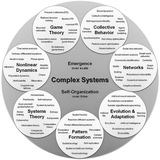
The difference between #reversible and #irreversible events has particular explanatory value in #complex_systems (such as living organisms, or ecosystems). According to the biologists Humberto Maturana and Francisco Varela, living organisms are characterized by autopoiesis, which enables their continued existence. More primitive forms of self-organizing systems have been described by the physicist and chemist Ilya Prigogine. In the context of complex systems, events which lead to the end of certain #self-organising processes, like death, extinction of a species or the collapse of a meteorological system can be considered as irreversible. Even if a clone with the same organizational principle (e.g. identical DNA-structure) could be developed, this would not mean that the former distinct system comes back into being. Events to which the self-organizing capacities of organisms, species or other complex systems can adapt, like minor injuries or changes in the physical environment are reversible. However, #adaptation depends on import of negentropy into the organism, thereby increasing irreversible processes in its environment. Ecological principles, like those of sustainability and the precautionary principle can be defined with reference to the concept of reversibility.
https://en.wikipedia.org/wiki/Irreversible_process#Complex_systems
https://en.wikipedia.org/wiki/Irreversible_process#Complex_systems
Wikipedia
Irreversible process
thermodynamic process that is not reversible
📝 Taxi shareability
P Santi, G Resta, M Szell, S Sobolevsky, SH #Strogatz, C Ratti
📌 If people shared taxis with strangers, how much money could be saved? And how much could pollution and traffic be reduced? A dataset of 150 million taxi trips and a new type of mathematical analysis enabled the untapped potential of New York City’s fleet of more than 13,000 taxis to be quantified.
Press: goo.gl/r1RgW5
If Two New Yorkers Shared a Cab...
– The New York Times
Articles: goo.gl/lQvkAc
Quantifying the Benefits of Vehicle Pooling With Shareability Networks (PDF)
P Santi, G Resta, M Szell, S Sobolevsky, SH #Strogatz, C Ratti
📌 If people shared taxis with strangers, how much money could be saved? And how much could pollution and traffic be reduced? A dataset of 150 million taxi trips and a new type of mathematical analysis enabled the untapped potential of New York City’s fleet of more than 13,000 taxis to be quantified.
Press: goo.gl/r1RgW5
If Two New Yorkers Shared a Cab...
– The New York Times
Articles: goo.gl/lQvkAc
Quantifying the Benefits of Vehicle Pooling With Shareability Networks (PDF)
NY Times
If 2 New Yorkers Shared a Cab ... (Published 2014)
A team of mathematicians and engineers has calculated that if taxi riders were willing to share a cab, New York City could reduce the current fleet of 13,500 taxis up to 40 percent.
📝 Nonlinear dynamics of the rock-paper-scissors game with mutations
Danielle F. P. Toupo and Steven H. #Strogatz
goo.gl/wuaYmk
📌 Abstract
We analyze the replicator-mutator equations for the rock-paper-scissors game. Various graph-theoretic patterns of mutation are considered, ranging from a single unidirectional mutation pathway between two of the species, to global bidirectional mutation among all the species. Our main result is that the coexistence state, in which all three species exist in equilibrium, can be destabilized by arbitrarily small mutation rates. After it loses stability, the coexistence state gives birth to a stable limit cycle solution created in a supercritical Hopf bifurcation. This attracting periodic solution exists for all the mutation patterns considered, and persists arbitrarily close to the limit of zero mutation rate and a zero-sum game.
Danielle F. P. Toupo and Steven H. #Strogatz
goo.gl/wuaYmk
📌 Abstract
We analyze the replicator-mutator equations for the rock-paper-scissors game. Various graph-theoretic patterns of mutation are considered, ranging from a single unidirectional mutation pathway between two of the species, to global bidirectional mutation among all the species. Our main result is that the coexistence state, in which all three species exist in equilibrium, can be destabilized by arbitrarily small mutation rates. After it loses stability, the coexistence state gives birth to a stable limit cycle solution created in a supercritical Hopf bifurcation. This attracting periodic solution exists for all the mutation patterns considered, and persists arbitrarily close to the limit of zero mutation rate and a zero-sum game.
📝 Taxi pooling in New York City:
a #network-based approach to social sharing problems
Paolo Santi, Giovanni Resta, Michael Szell, Stanislav Sobolevsky, Steven #Strogatz, Carlo Ratti
goo.gl/mdS8Is
📌 Taxi services are a vital part of urban transportation, and a major contributor to traffic
congestion and air pollution causing substantial adverse effects on human health1, 2.
Sharing taxi trips is a possible way of reducing the negative impact of taxi services on
cities3, but this comes at the expense of passenger discomfort in terms of a longer travel
time. Due to computational challenges, taxi sharing has traditionally been approached on
small scales4, 5, such as within airport perimeters6, 7, or with dynamical ad-hoc ...
a #network-based approach to social sharing problems
Paolo Santi, Giovanni Resta, Michael Szell, Stanislav Sobolevsky, Steven #Strogatz, Carlo Ratti
goo.gl/mdS8Is
📌 Taxi services are a vital part of urban transportation, and a major contributor to traffic
congestion and air pollution causing substantial adverse effects on human health1, 2.
Sharing taxi trips is a possible way of reducing the negative impact of taxi services on
cities3, but this comes at the expense of passenger discomfort in terms of a longer travel
time. Due to computational challenges, taxi sharing has traditionally been approached on
small scales4, 5, such as within airport perimeters6, 7, or with dynamical ad-hoc ...
📽 SFI 2010 Ulam Lecture
Mark #Newman
1⃣ The Connected World: goo.gl/qb9Yw4
2⃣ What Networks Can Tell Us about the World: goo.gl/dFoTt7
3⃣ Using Networks to Make Predictions: https://goo.gl/RrJitF
Mark #Newman
1⃣ The Connected World: goo.gl/qb9Yw4
2⃣ What Networks Can Tell Us about the World: goo.gl/dFoTt7
3⃣ Using Networks to Make Predictions: https://goo.gl/RrJitF
www.santafe.edu
2010 Ulam Lecture - The Connected World
Our Small World: How Networks of People and Information Shape Our World
Networks appear in every part of our lives. Some ...
Networks appear in every part of our lives. Some ...
📽 BBC Documentary - Order And Disorder
1⃣ goo.gl/tb5SHc
2⃣ goo.gl/Xmvr2z
3⃣ goo.gl/UuF0bc
4⃣ goo.gl/WU2nfD
🔊 You can use @SaveVideoBot to simply download the videos form youtube by just sending the link(s) to the bot!
1⃣ goo.gl/tb5SHc
2⃣ goo.gl/Xmvr2z
3⃣ goo.gl/UuF0bc
4⃣ goo.gl/WU2nfD
🔊 You can use @SaveVideoBot to simply download the videos form youtube by just sending the link(s) to the bot!
YouTube
Documentary - Order And Disorder 1of2 Energy
Professor Jim Al-Khalili investigates the important concepts of energy and information.
#سلسله_سمینارهای_هفتگی گروه سیستم های پیچیده شهید بهشتی
علاقه مندان می توانند برای ارائه موضوعات خود به ادمین پیام داده یا به صورت حضوری در جلسه مطرح نمایند.
@onmjnl
علاقه مندان می توانند برای ارائه موضوعات خود به ادمین پیام داده یا به صورت حضوری در جلسه مطرح نمایند.
@onmjnl