⚡️ Inverse Problems course, spring 2017
🔗 http://wiki.helsinki.fi/display/mathstatKurssit/Inverse+problems%2C+spring+2017
🎞 https://www.youtube.com/playlist?list=PLyIjfdC_fHWYSVIcrNtV9Hr7zAGE3GF-6
Teacher: Samuli Siltanen
Topics: Inverse problems are about measuring something indirectly and trying to recover that something from the data. For example, a doctor may take several X-ray images of a patient from different directions and wish to understand the three-dimensional structure of the patient's inner organs. But each of the 2D images only shows a projection of the inner organs; one has to actually calculate the 3D structure using a reconstruction algorithm. This course teaches how to
🔹 model a (linear) measurement process as a matrix equation m = Ax + noise,
🔹 detect if the matrix A leads to an ill-posed inverse problem,
🔹 design and implement a regularized reconstruction method for recovering x from m. We study truncated singular value decomposition, Tikhonov regularization, total variation regularization and wavelet-based sparsity,
🔹 measure tomographic data in X-ray laboratory,
🔹 report your findings in the form of a scientific poster.
Prerequisites: Linear algebra, basic Matlab programming skills, interest in practical applications, and a curious mind. The course is suitable (and very useful) for students of mathematics, statistics, physics or computer science.
🔗 http://wiki.helsinki.fi/display/mathstatKurssit/Inverse+problems%2C+spring+2017
🎞 https://www.youtube.com/playlist?list=PLyIjfdC_fHWYSVIcrNtV9Hr7zAGE3GF-6
Teacher: Samuli Siltanen
Topics: Inverse problems are about measuring something indirectly and trying to recover that something from the data. For example, a doctor may take several X-ray images of a patient from different directions and wish to understand the three-dimensional structure of the patient's inner organs. But each of the 2D images only shows a projection of the inner organs; one has to actually calculate the 3D structure using a reconstruction algorithm. This course teaches how to
🔹 model a (linear) measurement process as a matrix equation m = Ax + noise,
🔹 detect if the matrix A leads to an ill-posed inverse problem,
🔹 design and implement a regularized reconstruction method for recovering x from m. We study truncated singular value decomposition, Tikhonov regularization, total variation regularization and wavelet-based sparsity,
🔹 measure tomographic data in X-ray laboratory,
🔹 report your findings in the form of a scientific poster.
Prerequisites: Linear algebra, basic Matlab programming skills, interest in practical applications, and a curious mind. The course is suitable (and very useful) for students of mathematics, statistics, physics or computer science.
⚡️ 3 lectures: #Nonequilibrium_Statistical_Mechanics
Chris Jarzynski, University of Maryland
1️⃣ Fundamental Problems and Applications Nonequilibrium work relations
🎞 http://www.aparat.com/v/ehcsf
2️⃣ Microscopic systems driven away from equilibrium
🎞 http://www.aparat.com/v/EapnM
3️⃣ Dissipation and the Arrow of Time
🎞 http://www.aparat.com/v/0BJAY
Chris Jarzynski, University of Maryland
1️⃣ Fundamental Problems and Applications Nonequilibrium work relations
🎞 http://www.aparat.com/v/ehcsf
2️⃣ Microscopic systems driven away from equilibrium
🎞 http://www.aparat.com/v/EapnM
3️⃣ Dissipation and the Arrow of Time
🎞 http://www.aparat.com/v/0BJAY
آپارات - سرویس اشتراک ویدیو
Nonequilibrium Statistical Mechanics I - Chris Jarzynski
Lecture 1 of 3 in SeriesFundamental Problems and Applications Nonequilibrium work relations - Chris Jarzynski, University of MarylandHits from scivee.tv prior to youtube upload : 2113
☑️ Round table on open problems in #Nonequilibrium_Statistical_Mechanics
🎞 Michael Aizenmann, Princeton University
🔗 http://www.aparat.com/v/a4FqV
🎞 Juerg Froehlich Institute for Advanced Study
🔗 http://www.aparat.com/v/V3dzE
🎞 Michael Aizenmann, Princeton University
🔗 http://www.aparat.com/v/a4FqV
🎞 Juerg Froehlich Institute for Advanced Study
🔗 http://www.aparat.com/v/V3dzE
آپارات - سرویس اشتراک ویدیو
Round table on open problems in non-equilibrium statistical physics... - Michael
Michael AizenmannPrinceton UniversityMarch 28, 2014For more videos, visit http://video.ias.edu
Hiroki_Sayama_Introduction_to_the.pdf
15.7 MB
Introduction to the Modeling and Analysis of
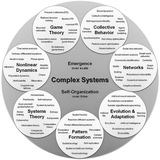
Complex Systems
Hiroki Sayama
This work is licensed under a Creative Commons Attribution-NonCommercial-ShareAlike
3.0 Unported License.
Complex Systems
Hiroki Sayama
This work is licensed under a Creative Commons Attribution-NonCommercial-ShareAlike
3.0 Unported License.
🌀 https://medium.com/complex-systems-channel/1-4-universality-1e51ec144390#.qhgfoy49g
🔗 http://www.necsi.edu/research/multiscale/universalitytext.pdf
🔗 http://www.necsi.edu/research/multiscale/universalitytext.pdf
Medium
1.4 Universality
When we observe the largest scale behaviors of a system, we simplify the mathematical description of the system because there are fewer…
Forwarded from انجمن علمی فیزیک بهشتی (SBU)
#مدرسه سه روزه #علم_داده (Data science)
🗓 مرداد و شهريور 96
📍دانشگاه شهید بهشتی
درصورت نیاز،خوابگاه به شرکت کنندگان تعلق میگیرد!
منتظر اطلاعیه های بعدی باشید...
انجمن علمی فیزیک بهشتی
@sbu_physics
🗓 مرداد و شهريور 96
📍دانشگاه شهید بهشتی
درصورت نیاز،خوابگاه به شرکت کنندگان تعلق میگیرد!
منتظر اطلاعیه های بعدی باشید...
انجمن علمی فیزیک بهشتی
@sbu_physics
🗞 Community Discovery in Dynamic Networks: a Survey
Giulio Rossetti, Rémy Cazabet
🔗 https://arxiv.org/pdf/1707.03186
📌 ABSTRACT
Networks built to model real world phenomena are characeterised by some properties that have attracted the attention of the scientific community: (i) they are organised according to community structure and (ii) their structure evolves with time. Many researchers have worked on methods that can efficiently unveil substructures in complex networks, giving birth to the field of community discovery. A novel and challenging problem started capturing researcher interest recently: the identification of evolving communities. To model the evolution of a system, dynamic networks can be used: nodes and edges are mutable and their presence, or absence, deeply impacts the community structure that composes them. The aim of this survey is to present the distinctive features and challenges of dynamic community discovery, and propose a classification of published approaches. As a "user manual", this work organizes state of art methodologies into a taxonomy, based on their rationale, and their specific instanciation. Given a desired definition of network dynamics, community characteristics and analytical needs, this survey will support researchers to identify the set of approaches that best fit their needs. The proposed classification could also help researchers to choose in which direction should future research be oriented
Giulio Rossetti, Rémy Cazabet
🔗 https://arxiv.org/pdf/1707.03186
📌 ABSTRACT
Networks built to model real world phenomena are characeterised by some properties that have attracted the attention of the scientific community: (i) they are organised according to community structure and (ii) their structure evolves with time. Many researchers have worked on methods that can efficiently unveil substructures in complex networks, giving birth to the field of community discovery. A novel and challenging problem started capturing researcher interest recently: the identification of evolving communities. To model the evolution of a system, dynamic networks can be used: nodes and edges are mutable and their presence, or absence, deeply impacts the community structure that composes them. The aim of this survey is to present the distinctive features and challenges of dynamic community discovery, and propose a classification of published approaches. As a "user manual", this work organizes state of art methodologies into a taxonomy, based on their rationale, and their specific instanciation. Given a desired definition of network dynamics, community characteristics and analytical needs, this survey will support researchers to identify the set of approaches that best fit their needs. The proposed classification could also help researchers to choose in which direction should future research be oriented
Forwarded from Deleted Account [SCAM]
This media is not supported in your browser
VIEW IN TELEGRAM
Ant architecture: The simple rules of ant construction
Summer School on Complex Socio-Technical Systems, 4-8/09
#IFISC10years #SocioComplex17
https://sociocomplex2017.ifisc.uib-csic.es/
#IFISC10years #SocioComplex17
https://sociocomplex2017.ifisc.uib-csic.es/
Green Chile Science Ep. 1
SFI Education
Dr. Paul Hooper challenges Dr. Eleanor Power to discuss how religion and suffering bring people together while eating mouth scalding New Mexico green chile!
🔅 http://www.cidid.org/publications-1/2017/7/14/monte-carlo-profile-confidence-intervals-for-dynamic-systems
🔗 https://static1.squarespace.com/static/53d8f599e4b0ba978ec978d1/t/5969291bc534a5cc075a1e3f/1500064029155/20170126.full.pdf
🔗 https://static1.squarespace.com/static/53d8f599e4b0ba978ec978d1/t/5969291bc534a5cc075a1e3f/1500064029155/20170126.full.pdf
Center for Inference and Dynamics of Infectious Diseases
Monte Carlo profile confidence intervals for dynamic systems
E. L. Ionides, C. Breto, J. Park, R. A. Smith, A. A. KingRoyal Society
Interface
July 5, 2017
View PDF ABSTRACT
Monte Carlo methods to evaluate and maximize the likelihood function enable
the construction of confidence intervals and hypothesis…
Interface
July 5, 2017
View PDF ABSTRACT
Monte Carlo methods to evaluate and maximize the likelihood function enable
the construction of confidence intervals and hypothesis…
Forwarded from Deleted Account [SCAM]
This media is not supported in your browser
VIEW IN TELEGRAM
Thomas House explains the maths behind memes