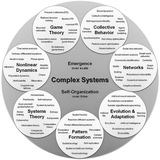
Complex Systems Studies
Photo
Complexity Economics:.pdf
789.3 KB
Complexity Economics:
A Different Framework for Economic Thought
W. Brian Arthur
A Different Framework for Economic Thought
W. Brian Arthur
#Review_article , 45 pages
🗞 Inverse statistical problems:
from the inverse Ising problem to data science
H. Chau Nguyen, Riccardo Zecchina, Johannes Berg
🔗 https://arxiv.org/pdf/1702.01522
📌 ABSTRACT
Inverse problems in statistical physics are motivated by the challenges of `big data' in different fields, in particular high-throughput experiments in biology. In inverse problems, the usual procedure of statistical physics needs to be reversed: Instead of calculating observables on the basis of model parameters, we seek to infer parameters of a model based on observations. In this review, we focus on the inverse Ising problem and closely related problems, namely how to infer the coupling strengths between spins given observed spin correlations, magnetisations, or other data. We review applications of the inverse Ising problem, including the reconstruction of neural connections, protein structure determination, and the inference of gene regulatory networks. For the inverse Ising problem in equilibrium, a number of controlled and uncontrolled approximate solutions have been developed in the statistical mechanics community. A particularly strong method, pseudolikelihood, stems from statistics. We also review the inverse Ising problem in the non-equilibrium case, where the model parameters must be reconstructed based on non-equilibrium statistics.
🗞 Inverse statistical problems:
from the inverse Ising problem to data science
H. Chau Nguyen, Riccardo Zecchina, Johannes Berg
🔗 https://arxiv.org/pdf/1702.01522
📌 ABSTRACT
Inverse problems in statistical physics are motivated by the challenges of `big data' in different fields, in particular high-throughput experiments in biology. In inverse problems, the usual procedure of statistical physics needs to be reversed: Instead of calculating observables on the basis of model parameters, we seek to infer parameters of a model based on observations. In this review, we focus on the inverse Ising problem and closely related problems, namely how to infer the coupling strengths between spins given observed spin correlations, magnetisations, or other data. We review applications of the inverse Ising problem, including the reconstruction of neural connections, protein structure determination, and the inference of gene regulatory networks. For the inverse Ising problem in equilibrium, a number of controlled and uncontrolled approximate solutions have been developed in the statistical mechanics community. A particularly strong method, pseudolikelihood, stems from statistics. We also review the inverse Ising problem in the non-equilibrium case, where the model parameters must be reconstructed based on non-equilibrium statistics.
🌀 3 Lectures by Simon DeDeo (simon@santafe.edu) during the Santa Fe Institute 2012 Complex Systems Summer School, an interdisciplinary course for graduate and postdoctoral students in the mathematical, biological, cognitive and social sciences.
🎞 Lecture 1: Coarse-Graining, Renormalization
🔗 http://www.aparat.com/v/v7QNe
🎞 Lecture 2: Effective Theories for Computational Systems
🔗 http://www.aparat.com/v/hH6me
🎞 Lecture 3: Symmetry Breaking and Non-Equilibrium Phenomena
🔗 http://www.aparat.com/v/IlENS
🎞 Lecture 1: Coarse-Graining, Renormalization
🔗 http://www.aparat.com/v/v7QNe
🎞 Lecture 2: Effective Theories for Computational Systems
🔗 http://www.aparat.com/v/hH6me
🎞 Lecture 3: Symmetry Breaking and Non-Equilibrium Phenomena
🔗 http://www.aparat.com/v/IlENS
آپارات - سرویس اشتراک ویدیو
Lecture 1: Coarse-Graining, Renormalization
Lectures by Simon DeDeo (simon@santafe.edu) during the Santa Fe Institute 2012 Complex Systems Summer School, an interdisciplinary course for graduate and postdoctoral students in the mathematical, biological, cognitive and social sciences. Full bibliography…
🌀 What Are Inverse Problems?
http://www.siltanen-research.net/IPexamples/inverse_problems
http://www.siltanen-research.net/IPexamples/inverse_problems
⚡️ Inverse Problems course, spring 2017
🔗 http://wiki.helsinki.fi/display/mathstatKurssit/Inverse+problems%2C+spring+2017
🎞 https://www.youtube.com/playlist?list=PLyIjfdC_fHWYSVIcrNtV9Hr7zAGE3GF-6
Teacher: Samuli Siltanen
Topics: Inverse problems are about measuring something indirectly and trying to recover that something from the data. For example, a doctor may take several X-ray images of a patient from different directions and wish to understand the three-dimensional structure of the patient's inner organs. But each of the 2D images only shows a projection of the inner organs; one has to actually calculate the 3D structure using a reconstruction algorithm. This course teaches how to
🔹 model a (linear) measurement process as a matrix equation m = Ax + noise,
🔹 detect if the matrix A leads to an ill-posed inverse problem,
🔹 design and implement a regularized reconstruction method for recovering x from m. We study truncated singular value decomposition, Tikhonov regularization, total variation regularization and wavelet-based sparsity,
🔹 measure tomographic data in X-ray laboratory,
🔹 report your findings in the form of a scientific poster.
Prerequisites: Linear algebra, basic Matlab programming skills, interest in practical applications, and a curious mind. The course is suitable (and very useful) for students of mathematics, statistics, physics or computer science.
🔗 http://wiki.helsinki.fi/display/mathstatKurssit/Inverse+problems%2C+spring+2017
🎞 https://www.youtube.com/playlist?list=PLyIjfdC_fHWYSVIcrNtV9Hr7zAGE3GF-6
Teacher: Samuli Siltanen
Topics: Inverse problems are about measuring something indirectly and trying to recover that something from the data. For example, a doctor may take several X-ray images of a patient from different directions and wish to understand the three-dimensional structure of the patient's inner organs. But each of the 2D images only shows a projection of the inner organs; one has to actually calculate the 3D structure using a reconstruction algorithm. This course teaches how to
🔹 model a (linear) measurement process as a matrix equation m = Ax + noise,
🔹 detect if the matrix A leads to an ill-posed inverse problem,
🔹 design and implement a regularized reconstruction method for recovering x from m. We study truncated singular value decomposition, Tikhonov regularization, total variation regularization and wavelet-based sparsity,
🔹 measure tomographic data in X-ray laboratory,
🔹 report your findings in the form of a scientific poster.
Prerequisites: Linear algebra, basic Matlab programming skills, interest in practical applications, and a curious mind. The course is suitable (and very useful) for students of mathematics, statistics, physics or computer science.
⚡️ 3 lectures: #Nonequilibrium_Statistical_Mechanics
Chris Jarzynski, University of Maryland
1️⃣ Fundamental Problems and Applications Nonequilibrium work relations
🎞 http://www.aparat.com/v/ehcsf
2️⃣ Microscopic systems driven away from equilibrium
🎞 http://www.aparat.com/v/EapnM
3️⃣ Dissipation and the Arrow of Time
🎞 http://www.aparat.com/v/0BJAY
Chris Jarzynski, University of Maryland
1️⃣ Fundamental Problems and Applications Nonequilibrium work relations
🎞 http://www.aparat.com/v/ehcsf
2️⃣ Microscopic systems driven away from equilibrium
🎞 http://www.aparat.com/v/EapnM
3️⃣ Dissipation and the Arrow of Time
🎞 http://www.aparat.com/v/0BJAY
آپارات - سرویس اشتراک ویدیو
Nonequilibrium Statistical Mechanics I - Chris Jarzynski
Lecture 1 of 3 in SeriesFundamental Problems and Applications Nonequilibrium work relations - Chris Jarzynski, University of MarylandHits from scivee.tv prior to youtube upload : 2113
☑️ Round table on open problems in #Nonequilibrium_Statistical_Mechanics
🎞 Michael Aizenmann, Princeton University
🔗 http://www.aparat.com/v/a4FqV
🎞 Juerg Froehlich Institute for Advanced Study
🔗 http://www.aparat.com/v/V3dzE
🎞 Michael Aizenmann, Princeton University
🔗 http://www.aparat.com/v/a4FqV
🎞 Juerg Froehlich Institute for Advanced Study
🔗 http://www.aparat.com/v/V3dzE
آپارات - سرویس اشتراک ویدیو
Round table on open problems in non-equilibrium statistical physics... - Michael
Michael AizenmannPrinceton UniversityMarch 28, 2014For more videos, visit http://video.ias.edu
Hiroki_Sayama_Introduction_to_the.pdf
15.7 MB
Introduction to the Modeling and Analysis of
Complex Systems
Hiroki Sayama
This work is licensed under a Creative Commons Attribution-NonCommercial-ShareAlike
3.0 Unported License.
Complex Systems
Hiroki Sayama
This work is licensed under a Creative Commons Attribution-NonCommercial-ShareAlike
3.0 Unported License.
🌀 https://medium.com/complex-systems-channel/1-4-universality-1e51ec144390#.qhgfoy49g
🔗 http://www.necsi.edu/research/multiscale/universalitytext.pdf
🔗 http://www.necsi.edu/research/multiscale/universalitytext.pdf
Medium
1.4 Universality
When we observe the largest scale behaviors of a system, we simplify the mathematical description of the system because there are fewer…