🌀 First detailed version of #CCS17 program is out!App will be available next week.
http://easychair.org/smart-program/CCS'17/index.html
http://easychair.org/smart-program/CCS'17/index.html
A Physics-Inspired Mechanistic Model of Migratory Movement Patterns in Birds | Scientific Reports
https://www.nature.com/articles/s41598-017-09270-6
https://www.nature.com/articles/s41598-017-09270-6
Nature
A Physics-Inspired Mechanistic Model of Migratory Movement Patterns in Birds
Scientific Reports - A Physics-Inspired Mechanistic Model of Migratory Movement Patterns in Birds
👇2018 Spring College on the Physics of Complex Systems - ICTP, Trieste, Italy👇
📌Computational and Systems Neuroscience (Cosyne) 2018 http://www.cosyne.org/c/index.php?title=Cosyne_18
🎞 THE MATHEMATICAL BIOSCIENCE INSTITUTE NATIONAL MATHEMATICAL BIOLOGY COLLOQUIUM
https://mbi.osu.edu/programs/mbi_programs/?type=online-colloquium&pk_campaign=go-COLLOQUIUM&pk_kwd=Email%20Newsletter
https://mbi.osu.edu/programs/mbi_programs/?type=online-colloquium&pk_campaign=go-COLLOQUIUM&pk_kwd=Email%20Newsletter
🌀 Why is there such a gap between economic theory and the reality of our lived experience? Join us Tuesday evening in Santa Fe for a panel discussion on the complexity of economics:
https://www.santafe.edu/news-center/news/sfi-community-lecture-complexity-economics
https://www.santafe.edu/news-center/news/sfi-community-lecture-complexity-economics
www.santafe.edu
Video: SFI Community Lecture — The Complexity of Economics
On September 12, 2017, SFI and Thornburg Investment Management co-hosted a panel discussion to explore the possibilities for advancing our understanding of economics through the ideas and tools of complexity science. Watch the talk <a href="https://www.y…
🔖 Machine Learning Spatial Geometry from Entanglement Features
Yi-Zhuang You, Zhao Yang, Xiao-Liang Qi
🔗 https://arxiv.org/pdf/1709.01223
📌 ABSTRACT
Motivated by the close relations of the renormalization group with both the holography duality and the deep learning, we propose that the holographic geometry can emerge from deep learning the entanglement feature of a quantum many-body state. We develop a concrete algorithm, call the entanglement feature learning (EFL), based on the random tensor network (RTN) model for the tensor network holography. We show that each RTN can be mapped to a Boltzmann machine, trained by the entanglement entropies over all subregions of a given quantum many-body state. The goal is to construct the optimal RTN that best reproduce the entanglement feature. The RTN geometry can then be interpreted as the emergent holographic geometry. We demonstrate the EFL algorithm on 1D free fermion system and observe the emergence of the hyperbolic geometry (AdS3 spatial geometry) as we tune the fermion system towards the gapless critical point (CFT2 point).
Yi-Zhuang You, Zhao Yang, Xiao-Liang Qi
🔗 https://arxiv.org/pdf/1709.01223
📌 ABSTRACT
Motivated by the close relations of the renormalization group with both the holography duality and the deep learning, we propose that the holographic geometry can emerge from deep learning the entanglement feature of a quantum many-body state. We develop a concrete algorithm, call the entanglement feature learning (EFL), based on the random tensor network (RTN) model for the tensor network holography. We show that each RTN can be mapped to a Boltzmann machine, trained by the entanglement entropies over all subregions of a given quantum many-body state. The goal is to construct the optimal RTN that best reproduce the entanglement feature. The RTN geometry can then be interpreted as the emergent holographic geometry. We demonstrate the EFL algorithm on 1D free fermion system and observe the emergence of the hyperbolic geometry (AdS3 spatial geometry) as we tune the fermion system towards the gapless critical point (CFT2 point).
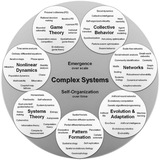
Complex Systems Studies
https://www.quantamagazine.org/ants-build-complex-structures-with-a-few-simple-rules-20140409/?utm_content=buffer48dbe&utm_medium=social&utm_source=twitter.com&utm_campaign=buffer
ICYMI: Understanding the self-organizing mechanisms in ant colonies may lead to improvements in swarm robotics.
https://www.quantamagazine.org/ants-build-complex-structures-with-a-few-simple-rules-20140409/?utm_content=buffer48dbe&utm_medium=social&utm_source=twitter.com&utm_campaign=buffer
https://www.quantamagazine.org/ants-build-complex-structures-with-a-few-simple-rules-20140409/?utm_content=buffer48dbe&utm_medium=social&utm_source=twitter.com&utm_campaign=buffer
Quanta Magazine
The Remarkable Self-Organization of Ants
Knowing the rules behind ant-made structures could help scientists understand how other complex systems emerge in nature.
🌀 To Solve the Biggest Mystery in Physics, Join Two Kinds of Law | Quanta Magazine
https://www.quantamagazine.org/to-solve-the-biggest-mystery-in-physics-join-two-kinds-of-law-20170907/
https://www.quantamagazine.org/to-solve-the-biggest-mystery-in-physics-join-two-kinds-of-law-20170907/
Quanta Magazine
To Solve the Biggest Mystery in Physics, Join Two Kinds of Law
Reductionism breaks the world into elementary building blocks. Emergence finds the simple laws that arise out of complexity. These two complementary ways of
Emotion shapes the diffusion of moralized content in social networks
https://www.researchgate.net/publication/317947723_Emotion_shapes_the_diffusion_of_moralized_content_in_social_networks
https://www.researchgate.net/publication/317947723_Emotion_shapes_the_diffusion_of_moralized_content_in_social_networks
🔹 Models of Behavior and Neuroimaging Data
Christoph Mathys
🎞 https://www.pathlms.com/ohbm/courses/1492/sections/1828/video_presentations/17170
🔗 Slides: https://www.filepicker.io/api/file/Vp5WxNtwQXOnEtChSe1K
Christoph Mathys
🎞 https://www.pathlms.com/ohbm/courses/1492/sections/1828/video_presentations/17170
🔗 Slides: https://www.filepicker.io/api/file/Vp5WxNtwQXOnEtChSe1K
⚡️ Modern physics provides a precise language to capture the way things #scale: the so-called #renormalization_group. This mathematical formalism allows us to go systematically from the small to the large. The essential step is taking averages. For example, instead of looking at the behavior of individual atoms that make up matter, we can take little cubes, say 10 atoms wide on each side, and take these cubes as our new building blocks. One can then repeat this averaging procedure.
#Renormalization theory describes in detail how the properties of a physical system change if one increases the length scale on which the observations are made. A famous example is the electric charge of particles that can increase or decrease depending on quantum interactions. A sociological example is understanding the behavior of groups of various sizes starting from individual behavior. Is there wisdom in crowds, or do the masses behave less responsibly?
Most interesting are the two endpoints of the renormalization process: the infinite large and infinite small. Here things will typically simplify because either all details are washed away, or the environment disappears. Both the largest and the smallest structures of the universe are astonishingly #simple. It is here that we find the two “standard models,” of #particle_physics and #cosmology.
🔗 https://www.quantamagazine.org/to-solve-the-biggest-mystery-in-physics-join-two-kinds-of-law-20170907/
#Renormalization theory describes in detail how the properties of a physical system change if one increases the length scale on which the observations are made. A famous example is the electric charge of particles that can increase or decrease depending on quantum interactions. A sociological example is understanding the behavior of groups of various sizes starting from individual behavior. Is there wisdom in crowds, or do the masses behave less responsibly?
Most interesting are the two endpoints of the renormalization process: the infinite large and infinite small. Here things will typically simplify because either all details are washed away, or the environment disappears. Both the largest and the smallest structures of the universe are astonishingly #simple. It is here that we find the two “standard models,” of #particle_physics and #cosmology.
🔗 https://www.quantamagazine.org/to-solve-the-biggest-mystery-in-physics-join-two-kinds-of-law-20170907/
Quanta Magazine
To Solve the Biggest Mystery in Physics, Join Two Kinds of Law
Reductionism breaks the world into elementary building blocks. Emergence finds the simple laws that arise out of complexity. These two complementary ways of
Geoffrey West on Computational Biology, Complexity, and a Unified…
Demetri Kofinas
🔊 Geoffrey West on Computational Biology, Complexity, and a Unified Theory of Sustainability
🔗 goo.gl/Whi7J8
🔗 goo.gl/Whi7J8