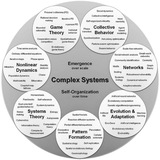
Complex Systems Studies
🎊 Hierarchal social systems continue to fail in the face of ever-increasing complexity. As NECSI research demonstrates, distributed organizational structures are needed.
🎊 Hierarchal social systems continue to fail in the face of ever-increasing complexity. As NECSI research demonstrates, distributed organizational structures are needed.
http://www.necsi.edu/research/overview/socialcomplexity.html?platform=hootsuite
http://www.necsi.edu/research/overview/socialcomplexity.html?platform=hootsuite
🗞 Temporal patterns behind the strength of persistent ties
Henry Navarro, Giovanna Miritello, Arturo Canales, Esteban Moro
🔗 https://arxiv.org/pdf/1706.06188
📌 ABSTRACT
Social networks are made out of strong and weak ties having very different structural and dynamical properties. But, what features of human interaction build a strong tie? Here we approach this question from an practical way by finding what are the properties of social interactions that make ties more persistent and thus stronger to maintain social interactions in the future. Using a large longitudinal mobile phone database we build a predictive model of tie persistence based on intensity, intimacy, structural and temporal patterns of social interaction. While our results confirm that structural (embeddedness) and intensity (number of calls) are correlated with tie persistence, we find that temporal features of communication events are better and more efficient predictors for tie persistence. Specifically, although communication within ties is always bursty we find that ties that are more bursty than the average are more likely to decay, signaling that tie strength is not only reflected in the intensity or topology of the network, but also on how individuals distribute time or attention across their relationships. We also found that stable relationships have and require a constant rhythm and if communication is halted for more than 8 times the previous communication frequency, most likely the tie will decay. Our results not only are important to understand the strength of social relationships but also to unveil the entanglement between the different temporal scales in networks, from microscopic tie burstiness and rhythm to macroscopic network evolution.
Henry Navarro, Giovanna Miritello, Arturo Canales, Esteban Moro
🔗 https://arxiv.org/pdf/1706.06188
📌 ABSTRACT
Social networks are made out of strong and weak ties having very different structural and dynamical properties. But, what features of human interaction build a strong tie? Here we approach this question from an practical way by finding what are the properties of social interactions that make ties more persistent and thus stronger to maintain social interactions in the future. Using a large longitudinal mobile phone database we build a predictive model of tie persistence based on intensity, intimacy, structural and temporal patterns of social interaction. While our results confirm that structural (embeddedness) and intensity (number of calls) are correlated with tie persistence, we find that temporal features of communication events are better and more efficient predictors for tie persistence. Specifically, although communication within ties is always bursty we find that ties that are more bursty than the average are more likely to decay, signaling that tie strength is not only reflected in the intensity or topology of the network, but also on how individuals distribute time or attention across their relationships. We also found that stable relationships have and require a constant rhythm and if communication is halted for more than 8 times the previous communication frequency, most likely the tie will decay. Our results not only are important to understand the strength of social relationships but also to unveil the entanglement between the different temporal scales in networks, from microscopic tie burstiness and rhythm to macroscopic network evolution.
🔅 “Complexity is the science of the 21st century. The catch is that we may have to wait decades to see it applied. Bar-Yam offers a convincing case, however, that the applications have arrived: many complex problems occurring in business and society can be successfully solved using the insights and tools of the emerging field.”
-- Albert-László Barabási, Author of Linked: The New Science of Networks
(from the foreword of Making Things Work)
-- Albert-László Barabási, Author of Linked: The New Science of Networks
(from the foreword of Making Things Work)
#Second_law_of_thermodynamics
🎯 " The law that entropy always increases holds, I think, the supreme position among the laws of Nature. If someone points out to you that your pet theory of the universe is in disagreement with Maxwell's equations — then so much the worse for Maxwell's equations. If it is found to be contradicted by observation — well, these experimentalists do bungle things sometimes. But if your theory is found to be against the second law of thermodynamics I can give you no hope; there is nothing for it but to collapse in deepest humiliation."
— Sir Arthur Stanley Eddington, The Nature of the Physical World (1927)
🎯 " The law that entropy always increases holds, I think, the supreme position among the laws of Nature. If someone points out to you that your pet theory of the universe is in disagreement with Maxwell's equations — then so much the worse for Maxwell's equations. If it is found to be contradicted by observation — well, these experimentalists do bungle things sometimes. But if your theory is found to be against the second law of thermodynamics I can give you no hope; there is nothing for it but to collapse in deepest humiliation."
— Sir Arthur Stanley Eddington, The Nature of the Physical World (1927)
🔹 Markov Chains
A visual explanation by Victor Powell
http://setosa.io/blog/2014/07/26/markov-chains/index.html
A visual explanation by Victor Powell
http://setosa.io/blog/2014/07/26/markov-chains/index.html
🔸 Here you can explore the dynamics of a famous two-dimensional, time discrete map, known as the standard or Chirikov–Taylor map.
http://rocs.hu-berlin.de/D3/kr/
http://rocs.hu-berlin.de/D3/kr/
Laplacian growth, sandpiles, and scaling limits = deep, beautiful math by two masters, Lionel Levine and Yuval Peres 👇👇👇👇
Complex Systems Studies
S0273-0979-2017-01573-X.pdf
Laplacian growth, sandpiles, and scaling limits = deep, beautiful math by two masters, Lionel Levine and Yuval Peres
🗞 New Models and Methods for Formation and Analysis of Social Networks
Swapnil Dhamal
🔗 https://arxiv.org/pdf/1706.09310
📌 ABSTRACT
This doctoral work focuses on three main problems related to social networks: (1) Orchestrating Network Formation: We consider the problem of orchestrating formation of a social network having a certain given topology that may be desirable for the intended usecases. Assuming the social network nodes to be strategic in forming relationships, we derive conditions under which a given topology can be uniquely obtained. We also study the efficiency and robustness of the derived conditions. (2) Multi-phase Influence Maximization: We propose that information diffusion be carried out in multiple phases rather than in a single instalment. With the objective of achieving better diffusion, we discover optimal ways of splitting the available budget among the phases, determining the time delay between consecutive phases, and also finding the individuals to be targeted for initiating the diffusion process. (3) Scalable Preference Aggregation: It is extremely useful to determine a small number of representatives of a social network such that the individual preferences of these nodes, when aggregated, reflect the aggregate preference of the entire network. Using real-world data collected from Facebook with human subjects, we discover a model that faithfully captures the spread of preferences in a social network. We hence propose fast and reliable ways of computing a truly representative aggregate preference of the entire network. In particular, we develop models and methods for solving the above problems, which primarily deal with formation and analysis of social networks.
Swapnil Dhamal
🔗 https://arxiv.org/pdf/1706.09310
📌 ABSTRACT
This doctoral work focuses on three main problems related to social networks: (1) Orchestrating Network Formation: We consider the problem of orchestrating formation of a social network having a certain given topology that may be desirable for the intended usecases. Assuming the social network nodes to be strategic in forming relationships, we derive conditions under which a given topology can be uniquely obtained. We also study the efficiency and robustness of the derived conditions. (2) Multi-phase Influence Maximization: We propose that information diffusion be carried out in multiple phases rather than in a single instalment. With the objective of achieving better diffusion, we discover optimal ways of splitting the available budget among the phases, determining the time delay between consecutive phases, and also finding the individuals to be targeted for initiating the diffusion process. (3) Scalable Preference Aggregation: It is extremely useful to determine a small number of representatives of a social network such that the individual preferences of these nodes, when aggregated, reflect the aggregate preference of the entire network. Using real-world data collected from Facebook with human subjects, we discover a model that faithfully captures the spread of preferences in a social network. We hence propose fast and reliable ways of computing a truly representative aggregate preference of the entire network. In particular, we develop models and methods for solving the above problems, which primarily deal with formation and analysis of social networks.
🔹 Reka Albert gave a wonderful talk at CEU about boolean models in gene regulatory networks. Watch it here :
🎞 http://www.aparat.com/v/YLItE
🎞 http://www.aparat.com/v/YLItE
آپارات
Reka Albert - Network Structure and Logic Determines the Dynamic Repertoire of B
Reka Albert’s group at Penn State is collaborating with wet-bench biologists to develop and validate predictive models of various biological systems, from the molecular to the ecological level. They recently developed an efficient method to determine the…
Forwarded from Deleted Account [SCAM]
Media is too big
VIEW IN TELEGRAM
Network Mathematics and Rival Factions | Infinite Series