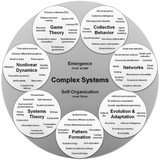
🔖 Complex Systems: A Survey
M. E. J. Newman
*Publication date: 2011/12/6
🔗 https://arxiv.org/pdf/1112.1440.pdf
📌 ABSTRACT
A complex system is a system composed of many interacting parts, often called agents, which displays collective behavior that does not follow trivially from the behaviors of the individual parts. Examples include condensed matter systems, ecosystems, stock markets and economies, biological evolution, and indeed the whole of human society. Substantial progress has been made in the quantitative understanding of complex systems, particularly since the 1980s, using a combination of basic theory, much of it derived from physics, and computer simulation.
The subject is a broad one, drawing on techniques and ideas from a wide range of areas. Here I give a survey of the main themes and methods of complex systems science and an annotated bibliography of resources, ranging from classic papers to recent books and reviews.
M. E. J. Newman
*Publication date: 2011/12/6
🔗 https://arxiv.org/pdf/1112.1440.pdf
📌 ABSTRACT
A complex system is a system composed of many interacting parts, often called agents, which displays collective behavior that does not follow trivially from the behaviors of the individual parts. Examples include condensed matter systems, ecosystems, stock markets and economies, biological evolution, and indeed the whole of human society. Substantial progress has been made in the quantitative understanding of complex systems, particularly since the 1980s, using a combination of basic theory, much of it derived from physics, and computer simulation.
The subject is a broad one, drawing on techniques and ideas from a wide range of areas. Here I give a survey of the main themes and methods of complex systems science and an annotated bibliography of resources, ranging from classic papers to recent books and reviews.
June 5-23, 2017
⭕️ Expanded Complexity and Data Analytics Summer Courses
Scholarship Application Deadline April 21
We have funding for a limited number of partial scholarships for the NECSI Summer School. The deadline to apply is April 21, and awards will be announced on April 28. Apply online.
The NECSI Summer School offers three intensive week-long courses on complexity science, modeling and networks, and data analytics. The new expanded format is modular with second and third weeks building on material covered in previous weeks, but none are a prerequisite for the others. You may register for any of the weeks. If desired, arrangements for credit at a home institution may be made in advance.
The new third week on data analytics will cover how to handle large datasets using academy- and industry-standard toolboxes, how to integrate data into the construction of models and analysis relevant to research and industry applications, and a variety of visualization techniques.
The courses are intended for faculty, graduate students, post-doctoral fellows, professionals and others who would like to gain an understanding of complexity science and data analytics for their respective fields, new research directions, or industry applications.
The schedule for the summer school is as follows:
• Week 1: June 5-9 CX201: Complex Physical, Biological and Social Systems
• Lab 1: June 11 CX102: Computer Programming for Complex Systems
• Week 2: June 12-16 CX202: Building Models and Mapping Networks
• Lab 2: June 18 CX103: Setting up for Data Analytics
• Week 3: June 19-23 CX203: From Data to Insight Using Data Analytics
Register before April 1 for an early registration discount. For more information, go to:
http://necsi.edu/education/school.html
New England Complex Systems Institute
⭕️ Expanded Complexity and Data Analytics Summer Courses
Scholarship Application Deadline April 21
We have funding for a limited number of partial scholarships for the NECSI Summer School. The deadline to apply is April 21, and awards will be announced on April 28. Apply online.
The NECSI Summer School offers three intensive week-long courses on complexity science, modeling and networks, and data analytics. The new expanded format is modular with second and third weeks building on material covered in previous weeks, but none are a prerequisite for the others. You may register for any of the weeks. If desired, arrangements for credit at a home institution may be made in advance.
The new third week on data analytics will cover how to handle large datasets using academy- and industry-standard toolboxes, how to integrate data into the construction of models and analysis relevant to research and industry applications, and a variety of visualization techniques.
The courses are intended for faculty, graduate students, post-doctoral fellows, professionals and others who would like to gain an understanding of complexity science and data analytics for their respective fields, new research directions, or industry applications.
The schedule for the summer school is as follows:
• Week 1: June 5-9 CX201: Complex Physical, Biological and Social Systems
• Lab 1: June 11 CX102: Computer Programming for Complex Systems
• Week 2: June 12-16 CX202: Building Models and Mapping Networks
• Lab 2: June 18 CX103: Setting up for Data Analytics
• Week 3: June 19-23 CX203: From Data to Insight Using Data Analytics
Register before April 1 for an early registration discount. For more information, go to:
http://necsi.edu/education/school.html
New England Complex Systems Institute
Forwarded from Deleted Account [SCAM]
Media is too big
VIEW IN TELEGRAM
The Challenge of Visualizing the Artificial Intelligence | Mauro Martino | TEDxRiga
🔹 Postdoctoral Positions in the SNAP Group
Machine Learning and Bioinformatics
http://snap.stanford.edu/apply/index.php
Machine Learning and Bioinformatics
http://snap.stanford.edu/apply/index.php
🗞 Network susceptibilities: Theory and applications
Debsankha Manik, Martin Rohden, Henrik Ronellenfitsch, Xiaozhu Zhang, Sarah Hallerberg, Dirk Witthaut, and Marc Timme (2017)
Phys. Rev. E 95(1):012319.
Projects involved: Dynamics of Modern Power Grids
🔗 https://www.researchgate.net/publication/308107316_Network_susceptibilities_Theory_and_applications
📌 ABSTRACT
We introduce the concept of network susceptibilities quantifying the response of the collective dynamics of a network to small parameter changes. We distinguish two types of susceptibilities: vertex susceptibilities and edge susceptibilities, measuring the responses due to changes in the properties of units and their interactions, respectively. We derive explicit forms of network susceptibilities for oscillator networks close to steady states and offer example applications for Kuramoto-type phase-oscillator models, power grid models, and generic flow models. Focusing on the role of the network topology implies that these ideas can be easily generalized to other types of networks, in particular those characterizing flow, transport, or spreading phenomena. The concept of network susceptibilities is broadly applicable and may straightforwardly be transferred to all settings where networks responses of the collective dynamics to topological changes are essential.
Debsankha Manik, Martin Rohden, Henrik Ronellenfitsch, Xiaozhu Zhang, Sarah Hallerberg, Dirk Witthaut, and Marc Timme (2017)
Phys. Rev. E 95(1):012319.
Projects involved: Dynamics of Modern Power Grids
🔗 https://www.researchgate.net/publication/308107316_Network_susceptibilities_Theory_and_applications
📌 ABSTRACT
We introduce the concept of network susceptibilities quantifying the response of the collective dynamics of a network to small parameter changes. We distinguish two types of susceptibilities: vertex susceptibilities and edge susceptibilities, measuring the responses due to changes in the properties of units and their interactions, respectively. We derive explicit forms of network susceptibilities for oscillator networks close to steady states and offer example applications for Kuramoto-type phase-oscillator models, power grid models, and generic flow models. Focusing on the role of the network topology implies that these ideas can be easily generalized to other types of networks, in particular those characterizing flow, transport, or spreading phenomena. The concept of network susceptibilities is broadly applicable and may straightforwardly be transferred to all settings where networks responses of the collective dynamics to topological changes are essential.
ResearchGate
(PDF) Network susceptibilities: Theory and applications
PDF | We introduce the concept of network susceptibilities quantifying the response of the collective dy- namics of a network to small parameter... | Find, read and cite all the research you need on ResearchGate
🌀 Multilayer Networks Library for Python (Pymnet)
http://www.mkivela.com/pymnet/
The libarary is based on the general definition of multilayer networks presented in a review article. Multilayer networks can be used to represent various types network generalizations found in the literature. For example, multiplex networks, temporal networks, networks of networks, and interdependent networks are all types of multilayer networks. The library supports even more general types of networks with multiple aspects such that the networks can for example have both temporal and multiplex aspect at the same time.
The visualization on the left is produced with the library. See the Visualizing networks tutorial (http://www.mkivela.com/pymnet/visualizing.html#visualization-tutorial) for instructions how to your own network data with the library!
http://www.mkivela.com/pymnet/
The libarary is based on the general definition of multilayer networks presented in a review article. Multilayer networks can be used to represent various types network generalizations found in the literature. For example, multiplex networks, temporal networks, networks of networks, and interdependent networks are all types of multilayer networks. The library supports even more general types of networks with multiple aspects such that the networks can for example have both temporal and multiplex aspect at the same time.
The visualization on the left is produced with the library. See the Visualizing networks tutorial (http://www.mkivela.com/pymnet/visualizing.html#visualization-tutorial) for instructions how to your own network data with the library!
🎞 https://www.cs.ox.ac.uk/people/nando.defreitas/machinelearning/
This course is taught by Nando de Freitas. (Slides + Video)
This course is taught by Nando de Freitas. (Slides + Video)
www.cs.ox.ac.uk
Machine Learning
⚡️ Introduction to Renormalization
Lead instructor: Simon DeDeo
https://www.complexityexplorer.org/tutorials/67-introduction-to-renormalization
🌀 About the Tutorial:
What does a JPEG have to do with economics and quantum gravity? All of them are about when happens when you simplify world-descriptions. A JPEG compresses an image by throwing out fine structure in ways a casual glance won't detect. Economists produce theories of human behavior that gloss over the details of individual psychology. Meanwhile, even our most sophisticated physics experiments can't show us the most fundamental building-blocks of matter, and so our theories have to make do with descriptions that blur out the smallest scales. The study of how theories change as we move to more or less detailed descriptions is known as renormalization.
This tutorial provides a modern introduction to renormalization from a complex systems point of view. Simon DeDeo will take students from basic concepts in information theory and image processing to some of the most important concepts in complexity, including emergence, coarse-graining, and effective theories. Only basic comfort with the use of probabilities is required for the majority of the material; some more advanced modules rely on more sophisticated algebra and basic calculus, but can be skipped.
We'll introduce, in an elementary fashion, explicit examples of model-building including Markov Chains and Cellular Automata. We'll cover some new ideas for the description of complex systems including the Krohn-Rhodes theorem and State-Space Compression. And we'll show the connections between classic problems in physics, including the Ising model and plasma physics, and cutting-edge questions in machine learning and artificial intelligence.
https://www.complexityexplorer.org/tutorials/67-introduction-to-renormalization
Lead instructor: Simon DeDeo
https://www.complexityexplorer.org/tutorials/67-introduction-to-renormalization
🌀 About the Tutorial:
What does a JPEG have to do with economics and quantum gravity? All of them are about when happens when you simplify world-descriptions. A JPEG compresses an image by throwing out fine structure in ways a casual glance won't detect. Economists produce theories of human behavior that gloss over the details of individual psychology. Meanwhile, even our most sophisticated physics experiments can't show us the most fundamental building-blocks of matter, and so our theories have to make do with descriptions that blur out the smallest scales. The study of how theories change as we move to more or less detailed descriptions is known as renormalization.
This tutorial provides a modern introduction to renormalization from a complex systems point of view. Simon DeDeo will take students from basic concepts in information theory and image processing to some of the most important concepts in complexity, including emergence, coarse-graining, and effective theories. Only basic comfort with the use of probabilities is required for the majority of the material; some more advanced modules rely on more sophisticated algebra and basic calculus, but can be skipped.
We'll introduce, in an elementary fashion, explicit examples of model-building including Markov Chains and Cellular Automata. We'll cover some new ideas for the description of complex systems including the Krohn-Rhodes theorem and State-Space Compression. And we'll show the connections between classic problems in physics, including the Ising model and plasma physics, and cutting-edge questions in machine learning and artificial intelligence.
https://www.complexityexplorer.org/tutorials/67-introduction-to-renormalization
#سمینارهای_هفتگی گروه سیستمهای پیچیده و علم شبکه دانشگاه شهید بهشتی
🔹دوشنبه، ۲۸ فروردینماه، ساعت ۴/۵ - کلاس ۴ دانشکده فیزیک دانشگاه شهید بهشتی
@carimi
🔹دوشنبه، ۲۸ فروردینماه، ساعت ۴/۵ - کلاس ۴ دانشکده فیزیک دانشگاه شهید بهشتی
@carimi