Forwarded from رسانه بهشتی
#SBU #انجمن_علمی
✳️ کارگاه Deep Learning
🗓 یکشنبه ۲۰ فروردین ۹۶
🕰 ساعت ۱۳:۳۰ تا ۱۷
🌀 ثبتنام در : soce.ir
🔸 کانال : @sce_sbu
@SBU_SBMU | Channel
Instagram.com/SBU_SBMU
✳️ کارگاه Deep Learning
🗓 یکشنبه ۲۰ فروردین ۹۶
🕰 ساعت ۱۳:۳۰ تا ۱۷
🌀 ثبتنام در : soce.ir
🔸 کانال : @sce_sbu
@SBU_SBMU | Channel
Instagram.com/SBU_SBMU
🌀 Is Matter Conscious?
Why the central problem in neuroscience is mirrored in physics.
http://nautil.us/issue/47/consciousness/is-matter-conscious
Why the central problem in neuroscience is mirrored in physics.
http://nautil.us/issue/47/consciousness/is-matter-conscious
Nautilus
Is Matter Conscious?
The nature of consciousness seems to be unique among scientific puzzles. Not only do neuroscientists have no fundamental explanation…
🔹Causal Effects in Social Networks
Marcel Fafchamps
This paper reviews the current literature on the estimation of causal peer effects. After a discussion of causality in general, I introduce the standard peer effect model in networks and illustrate the reflection problem. I then present
approaches to causal inference with observational data before introducing experimental approaches. I review estimation issues arising from measurement and sampling errors, and discuss how they affect causal inference in network and peer effect experiments. The last section of the paper broadens the discussion to encompass dynamic peer effects and link formation and illustrates the different meanings that causality can take in the estimation of peer effects.
Marcel Fafchamps
This paper reviews the current literature on the estimation of causal peer effects. After a discussion of causality in general, I introduce the standard peer effect model in networks and illustrate the reflection problem. I then present
approaches to causal inference with observational data before introducing experimental approaches. I review estimation issues arising from measurement and sampling errors, and discuss how they affect causal inference in network and peer effect experiments. The last section of the paper broadens the discussion to encompass dynamic peer effects and link formation and illustrates the different meanings that causality can take in the estimation of peer effects.
causal.pdf
476.5 KB
Causal Effects in Social Networks
Marcel Fafchamps
Marcel Fafchamps
🔹 Introduction to network analysis in #Python notebook using #igraph.
#homophily #weakties #contagion #clustering
https://github.com/vtraag/4TU-CSS/blob/master/presentations/traag/notebook/Network.ipynb
#homophily #weakties #contagion #clustering
https://github.com/vtraag/4TU-CSS/blob/master/presentations/traag/notebook/Network.ipynb
GitHub
vtraag/4TU-CSS
Material for a Computational Social Science (CSS) Workshop hosted by the four Dutch technical universities. - vtraag/4TU-CSS
🔹 Nice introduction to neural nets, starting from scratch.
https://medium.com/@k3no/making-a-simple-neural-network-2ea1de81ec20
https://medium.com/@k3no/making-a-simple-neural-network-2ea1de81ec20
Medium
Making a Simple Neural Network
What are we making ? We’ll try making a simple & minimal Neural Network which we will explain and train to identify something, there will…
Network Representations of Complex Engineering Systems | Engineering Systems Division | MIT OpenCourseWare
https://ocw.mit.edu/courses/engineering-systems-division/esd-342-network-representations-of-complex-engineering-systems-spring-2010/
https://ocw.mit.edu/courses/engineering-systems-division/esd-342-network-representations-of-complex-engineering-systems-spring-2010/
MIT OpenCourseWare
Network Representations of Complex Engineering Systems
This course provides a deep understanding of engineering systems at a level intended for research on complex engineering systems. It provides a review and extension of what is known about system architecture and complexity from a theoretical point of view…
🔖 Complex Systems: A Survey
M. E. J. Newman
*Publication date: 2011/12/6
🔗 https://arxiv.org/pdf/1112.1440.pdf
📌 ABSTRACT
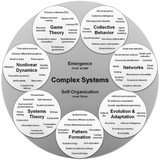
A complex system is a system composed of many interacting parts, often called agents, which displays collective behavior that does not follow trivially from the behaviors of the individual parts. Examples include condensed matter systems, ecosystems, stock markets and economies, biological evolution, and indeed the whole of human society. Substantial progress has been made in the quantitative understanding of complex systems, particularly since the 1980s, using a combination of basic theory, much of it derived from physics, and computer simulation.
The subject is a broad one, drawing on techniques and ideas from a wide range of areas. Here I give a survey of the main themes and methods of complex systems science and an annotated bibliography of resources, ranging from classic papers to recent books and reviews.
M. E. J. Newman
*Publication date: 2011/12/6
🔗 https://arxiv.org/pdf/1112.1440.pdf
📌 ABSTRACT
A complex system is a system composed of many interacting parts, often called agents, which displays collective behavior that does not follow trivially from the behaviors of the individual parts. Examples include condensed matter systems, ecosystems, stock markets and economies, biological evolution, and indeed the whole of human society. Substantial progress has been made in the quantitative understanding of complex systems, particularly since the 1980s, using a combination of basic theory, much of it derived from physics, and computer simulation.
The subject is a broad one, drawing on techniques and ideas from a wide range of areas. Here I give a survey of the main themes and methods of complex systems science and an annotated bibliography of resources, ranging from classic papers to recent books and reviews.
June 5-23, 2017
⭕️ Expanded Complexity and Data Analytics Summer Courses
Scholarship Application Deadline April 21
We have funding for a limited number of partial scholarships for the NECSI Summer School. The deadline to apply is April 21, and awards will be announced on April 28. Apply online.
The NECSI Summer School offers three intensive week-long courses on complexity science, modeling and networks, and data analytics. The new expanded format is modular with second and third weeks building on material covered in previous weeks, but none are a prerequisite for the others. You may register for any of the weeks. If desired, arrangements for credit at a home institution may be made in advance.
The new third week on data analytics will cover how to handle large datasets using academy- and industry-standard toolboxes, how to integrate data into the construction of models and analysis relevant to research and industry applications, and a variety of visualization techniques.
The courses are intended for faculty, graduate students, post-doctoral fellows, professionals and others who would like to gain an understanding of complexity science and data analytics for their respective fields, new research directions, or industry applications.
The schedule for the summer school is as follows:
• Week 1: June 5-9 CX201: Complex Physical, Biological and Social Systems
• Lab 1: June 11 CX102: Computer Programming for Complex Systems
• Week 2: June 12-16 CX202: Building Models and Mapping Networks
• Lab 2: June 18 CX103: Setting up for Data Analytics
• Week 3: June 19-23 CX203: From Data to Insight Using Data Analytics
Register before April 1 for an early registration discount. For more information, go to:
http://necsi.edu/education/school.html
New England Complex Systems Institute
⭕️ Expanded Complexity and Data Analytics Summer Courses
Scholarship Application Deadline April 21
We have funding for a limited number of partial scholarships for the NECSI Summer School. The deadline to apply is April 21, and awards will be announced on April 28. Apply online.
The NECSI Summer School offers three intensive week-long courses on complexity science, modeling and networks, and data analytics. The new expanded format is modular with second and third weeks building on material covered in previous weeks, but none are a prerequisite for the others. You may register for any of the weeks. If desired, arrangements for credit at a home institution may be made in advance.
The new third week on data analytics will cover how to handle large datasets using academy- and industry-standard toolboxes, how to integrate data into the construction of models and analysis relevant to research and industry applications, and a variety of visualization techniques.
The courses are intended for faculty, graduate students, post-doctoral fellows, professionals and others who would like to gain an understanding of complexity science and data analytics for their respective fields, new research directions, or industry applications.
The schedule for the summer school is as follows:
• Week 1: June 5-9 CX201: Complex Physical, Biological and Social Systems
• Lab 1: June 11 CX102: Computer Programming for Complex Systems
• Week 2: June 12-16 CX202: Building Models and Mapping Networks
• Lab 2: June 18 CX103: Setting up for Data Analytics
• Week 3: June 19-23 CX203: From Data to Insight Using Data Analytics
Register before April 1 for an early registration discount. For more information, go to:
http://necsi.edu/education/school.html
New England Complex Systems Institute