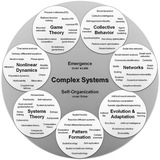
🔑 GENERAL FEATURES OF COMPLEX SYSTEMS
Y. Bar-Yam
New England Complex Systems Institute, Cambridge, MA, USA
🗒 Contents
1. Overview
2. Self-Organizing Patterns
3. Complexity, Scale and the Space of Possibilities
4. Evolution (Simple to Complex Patterns)
🎯 Keywords:
adaptive, altruism, clique, coherent, competition, complexity, cooperation, creativity, description, development, emergence, environment, evolution, fad, feedback, hierarchy, human civilization, information, interdependence, memory, network, observer, panic, pattern, possibilities, random, reductionism, relationship, scale, selfishness, self- organization, state, system 👇
Y. Bar-Yam
New England Complex Systems Institute, Cambridge, MA, USA
🗒 Contents
1. Overview
2. Self-Organizing Patterns
3. Complexity, Scale and the Space of Possibilities
4. Evolution (Simple to Complex Patterns)
🎯 Keywords:
adaptive, altruism, clique, coherent, competition, complexity, cooperation, creativity, description, development, emergence, environment, evolution, fad, feedback, hierarchy, human civilization, information, interdependence, memory, network, observer, panic, pattern, possibilities, random, reductionism, relationship, scale, selfishness, self- organization, state, system 👇
📋 Greedy Routing and the Algorithmic Small-World Phenomenom
Karl Bringmann, Ralph Keusch, Johannes Lengler, Yannic Maus, Anisur Molla
🔗 https://arxiv.org/pdf/1612.05539v1
📌ABSTRACT
The algorithmic small-world phenomenon, empirically established by Milgram's letter forwarding experiments from the 60s, was theoretically explained by Kleinberg in 2000. However, from today's perspective his model has several severe shortcomings that limit the applicability to real-world networks. In order to give a more convincing explanation of the algorithmic small-world phenomenon, we study greedy routing in a more realistic random graph model (geometric inhomogeneous random graphs), which overcomes the previous shortcomings. Apart from exhibiting good properties in theory, it has also been extensively experimentally validated that this model reasonably captures real-world networks.
In this model, we show that greedy routing succeeds with constant probability, and in case of success almost surely finds a path that is an almost shortest path. Our results are robust to changes in the model parameters and the routing objective. Moreover, since constant success probability is too low for technical applications, we study natural local patching methods augmenting greedy routing by backtracking and we show that such methods can ensure success probability 1 in a number of steps that is close to the shortest path length.
These results also address the question of Krioukov et al. whether there are efficient local routing protocols for the internet graph. There were promising experimental studies, but the question remained unsolved theoretically. Our results give for the first time a rigorous and analytical answer, assuming our random graph model.
Karl Bringmann, Ralph Keusch, Johannes Lengler, Yannic Maus, Anisur Molla
🔗 https://arxiv.org/pdf/1612.05539v1
📌ABSTRACT
The algorithmic small-world phenomenon, empirically established by Milgram's letter forwarding experiments from the 60s, was theoretically explained by Kleinberg in 2000. However, from today's perspective his model has several severe shortcomings that limit the applicability to real-world networks. In order to give a more convincing explanation of the algorithmic small-world phenomenon, we study greedy routing in a more realistic random graph model (geometric inhomogeneous random graphs), which overcomes the previous shortcomings. Apart from exhibiting good properties in theory, it has also been extensively experimentally validated that this model reasonably captures real-world networks.
In this model, we show that greedy routing succeeds with constant probability, and in case of success almost surely finds a path that is an almost shortest path. Our results are robust to changes in the model parameters and the routing objective. Moreover, since constant success probability is too low for technical applications, we study natural local patching methods augmenting greedy routing by backtracking and we show that such methods can ensure success probability 1 in a number of steps that is close to the shortest path length.
These results also address the question of Krioukov et al. whether there are efficient local routing protocols for the internet graph. There were promising experimental studies, but the question remained unsolved theoretically. Our results give for the first time a rigorous and analytical answer, assuming our random graph model.
Complex Systems Studies
My Recording – 161130_001
فایل صوتی سخنرانی دکتر سید ریحانی ک با عنوان "میکرودستکاری اجزای زیستی با لیزر" در مرکز تحقیقات بیوشیمی و بیوفیزیک دانشگاه تهران برگزار شد.
🌀 Statistical Thinking in Python (Part 1)
🚩 Course Description
After all of the hard work of acquiring data and getting them into a form you can work with, you ultimately want to make clear, succinct conclusions from them. This crucial last step of a data analysis pipeline hinges on the principles of statistical inference. In this course, you will start building the foundation you need to think statistically, to speak the language of your data, to understand what they are telling you. The foundations of statistical thinking took decades upon decades to build, but they can be grasped much faster today with the help of computers. With the power of Python-based tools, you will rapidly get up to speed and begin thinking statistically by the end of this course.
https://www.datacamp.com/courses/statistical-thinking-in-python-part-1
🌀 Statistical Thinking in Python (Part 2)
🚩 Course Description
After completing Statistical Thinking in Python (Part 1), you have the probabilistic mindset and foundational hacker stats skills to dive into data sets and extract useful information from them. In this course, you will do just that, expanding and honing your hacker stats toolbox to perform the two key tasks in statistical inference, parameter estimation and hypothesis testing. You will work with real data sets as you learn, culminating with analysis of measurements of the beaks of the Darwin's famous finches. You will emerge this course with new knowledge and lots of practice under your belt, ready to attack your own inference problems out in the world.
https://www.datacamp.com/courses/statistical-thinking-in-python-part-2
🚩 Course Description
After all of the hard work of acquiring data and getting them into a form you can work with, you ultimately want to make clear, succinct conclusions from them. This crucial last step of a data analysis pipeline hinges on the principles of statistical inference. In this course, you will start building the foundation you need to think statistically, to speak the language of your data, to understand what they are telling you. The foundations of statistical thinking took decades upon decades to build, but they can be grasped much faster today with the help of computers. With the power of Python-based tools, you will rapidly get up to speed and begin thinking statistically by the end of this course.
https://www.datacamp.com/courses/statistical-thinking-in-python-part-1
🌀 Statistical Thinking in Python (Part 2)
🚩 Course Description
After completing Statistical Thinking in Python (Part 1), you have the probabilistic mindset and foundational hacker stats skills to dive into data sets and extract useful information from them. In this course, you will do just that, expanding and honing your hacker stats toolbox to perform the two key tasks in statistical inference, parameter estimation and hypothesis testing. You will work with real data sets as you learn, culminating with analysis of measurements of the beaks of the Darwin's famous finches. You will emerge this course with new knowledge and lots of practice under your belt, ready to attack your own inference problems out in the world.
https://www.datacamp.com/courses/statistical-thinking-in-python-part-2
📄 Four lectures on probabilistic methods for data science
Roman Vershynin
🔗 https://arxiv.org/pdf/1612.06661v1
📌 ABSTRACT
Methods of high-dimensional probability play a central role in applications for statistics, signal processing theoretical computer science and related fields. These lectures present a sample of particularly useful tools of high-dimensional probability, focusing on the classical and matrix Bernstein's inequality and the uniform matrix deviation inequality. We illustrate these tools with applications for dimension reduction, network analysis, covariance estimation, matrix completion and sparse signal recovery. The lectures are geared towards beginning graduate students who have taken a rigorous course in probability but may not have any experience in data science applications.
Roman Vershynin
🔗 https://arxiv.org/pdf/1612.06661v1
📌 ABSTRACT
Methods of high-dimensional probability play a central role in applications for statistics, signal processing theoretical computer science and related fields. These lectures present a sample of particularly useful tools of high-dimensional probability, focusing on the classical and matrix Bernstein's inequality and the uniform matrix deviation inequality. We illustrate these tools with applications for dimension reduction, network analysis, covariance estimation, matrix completion and sparse signal recovery. The lectures are geared towards beginning graduate students who have taken a rigorous course in probability but may not have any experience in data science applications.
📄 Temporal profiles of avalanches on networks
James P Gleeson, Rick Durrett
🔗 https://arxiv.org/pdf/1612.06477v1
📌 ABSTRACT
An avalanche or cascade occurs when one event causes one or more subsequent events, which in turn may cause further events in a chain reaction. Avalanching dynamics are studied in many disciplines, with a recent focus on average avalanche shapes, i.e., the temporal profiles that characterize the growth and decay of avalanches of fixed duration. At the critical point of the dynamics the average avalanche shapes for different durations can be rescaled so that they collapse onto a single universal curve. We apply Markov branching process theory to derive a simple equation governing the average avalanche shape for cascade dynamics on networks. Analysis of the equation at criticality demonstrates that nonsymmetric average avalanche shapes (as observed in some experiments) occur for certain combinations of dynamics and network topology; specifically, on networks with heavy-tailed degree distributions. We give examples using numerical simulations of models of information spreading, neural dynamics, and threshold models of behaviour adoption.
James P Gleeson, Rick Durrett
🔗 https://arxiv.org/pdf/1612.06477v1
📌 ABSTRACT
An avalanche or cascade occurs when one event causes one or more subsequent events, which in turn may cause further events in a chain reaction. Avalanching dynamics are studied in many disciplines, with a recent focus on average avalanche shapes, i.e., the temporal profiles that characterize the growth and decay of avalanches of fixed duration. At the critical point of the dynamics the average avalanche shapes for different durations can be rescaled so that they collapse onto a single universal curve. We apply Markov branching process theory to derive a simple equation governing the average avalanche shape for cascade dynamics on networks. Analysis of the equation at criticality demonstrates that nonsymmetric average avalanche shapes (as observed in some experiments) occur for certain combinations of dynamics and network topology; specifically, on networks with heavy-tailed degree distributions. We give examples using numerical simulations of models of information spreading, neural dynamics, and threshold models of behaviour adoption.
🍻 Apply now: SFI's Complex Systems Summer School, a 4-week intro to complex behavior in physical & social systems:
🔗 https://www.santafe.edu/engage/learn/schools/sfi-complex-systems-summer-school
🔗 https://www.santafe.edu/engage/learn/schools/sfi-complex-systems-summer-school
www.santafe.edu
Complex Systems Summer School
<p>2021 CSSS will not be held due to the global pandemic.</p>
<p>Please visit this page in mid Oct 2021 to get information and apply for 2022 CSSS.</p>
<p>Please visit this page in mid Oct 2021 to get information and apply for 2022 CSSS.</p>
📄 Scale-free networks emerging from multifractal time series
Marcello A. Budroni, Andrea Baronchelli, Romualdo Pastor-Satorras
🔗 https://arxiv.org/pdf/1612.07070v1
📌 ABSTRACT
Methods connecting dynamical systems and graph theory have attracted increasing interest in the past few years, with applications ranging from a detailed comparison of different kinds of dynamics to the characterisation of empirical data. Here we investigate the effects of the (multi)fractal properties of a time signal, common in sequences arising from chaotic or strange attractors, on the topology of a suitably projected network. Relying on the box counting formalism, we map boxes into the nodes of a network and establish analytic expressions connecting the natural measure of a box with its degree in the graph representation. We single out the conditions yielding to the emergence of a scale-free topology, and validate our findings with extensive numerical simulations.
Marcello A. Budroni, Andrea Baronchelli, Romualdo Pastor-Satorras
🔗 https://arxiv.org/pdf/1612.07070v1
📌 ABSTRACT
Methods connecting dynamical systems and graph theory have attracted increasing interest in the past few years, with applications ranging from a detailed comparison of different kinds of dynamics to the characterisation of empirical data. Here we investigate the effects of the (multi)fractal properties of a time signal, common in sequences arising from chaotic or strange attractors, on the topology of a suitably projected network. Relying on the box counting formalism, we map boxes into the nodes of a network and establish analytic expressions connecting the natural measure of a box with its degree in the graph representation. We single out the conditions yielding to the emergence of a scale-free topology, and validate our findings with extensive numerical simulations.
📄Finding network communities using modularity density
Federico Botta, Charo I. del Genio
🔗 https://arxiv.org/pdf/1612.07297v1
📌 ABSTRACT
Many real-world complex networks exhibit a community structure, in which the modules correspond to actual functional units. Identifying these communities is a key challenge for scientists. A common approach is to search for the network partition that maximizes a quality function. Here, we present a detailed analysis of a recently proposed function, namely modularity density. We show that it does not incur in the drawbacks suffered by traditional modularity, and that it can identify networks without ground-truth community structure, deriving its analytical dependence on link density in generic random graphs. In addition, we show that modularity density allows an easy comparison between networks of different sizes, and we also present some limitations that methods based on modularity density may suffer from. Finally, we introduce an efficient, quadratic community detection algorithm based on modularity density maximization, validating its accuracy against theoretical predictions and on a set of benchmark networks.
Federico Botta, Charo I. del Genio
🔗 https://arxiv.org/pdf/1612.07297v1
📌 ABSTRACT
Many real-world complex networks exhibit a community structure, in which the modules correspond to actual functional units. Identifying these communities is a key challenge for scientists. A common approach is to search for the network partition that maximizes a quality function. Here, we present a detailed analysis of a recently proposed function, namely modularity density. We show that it does not incur in the drawbacks suffered by traditional modularity, and that it can identify networks without ground-truth community structure, deriving its analytical dependence on link density in generic random graphs. In addition, we show that modularity density allows an easy comparison between networks of different sizes, and we also present some limitations that methods based on modularity density may suffer from. Finally, we introduce an efficient, quadratic community detection algorithm based on modularity density maximization, validating its accuracy against theoretical predictions and on a set of benchmark networks.
📄 A Guide to Teaching Data Science
Stephanie C. Hicks, Rafael A. Irizarry
🔗 https://arxiv.org/pdf/1612.07140v1
📌 ABSTRACT:
Demand for data science education is surging and traditional courses offered by statistics departments are not meeting the needs of those seeking this training. This has led to a number of opinion pieces advocating for an update to the Statistics curriculum. The unifying recommendation is that computing should play a more prominent role. We strongly agree with this recommendation, but advocate that the main priority is to bring applications to the forefront as proposed by Nolan and Speed (1999). We also argue that the individuals tasked with developing data science courses should not only have statistical training, but also have experience analyzing data with the main objective of solving real-world problems. Here, we share a set of general principles and offer a detailed guide derived from our successful experience developing and teaching data science courses centered entirely on case studies. We argue for the importance of statistical thinking, as defined by Wild and Pfannkuck (1999) and describe how our approach teaches students three key skills needed to succeed in data science, which we refer to as creating, connecting, and computing. This guide can also be used for statisticians wanting to gain more practical knowledge about data science before embarking on teaching a course.
Stephanie C. Hicks, Rafael A. Irizarry
🔗 https://arxiv.org/pdf/1612.07140v1
📌 ABSTRACT:
Demand for data science education is surging and traditional courses offered by statistics departments are not meeting the needs of those seeking this training. This has led to a number of opinion pieces advocating for an update to the Statistics curriculum. The unifying recommendation is that computing should play a more prominent role. We strongly agree with this recommendation, but advocate that the main priority is to bring applications to the forefront as proposed by Nolan and Speed (1999). We also argue that the individuals tasked with developing data science courses should not only have statistical training, but also have experience analyzing data with the main objective of solving real-world problems. Here, we share a set of general principles and offer a detailed guide derived from our successful experience developing and teaching data science courses centered entirely on case studies. We argue for the importance of statistical thinking, as defined by Wild and Pfannkuck (1999) and describe how our approach teaches students three key skills needed to succeed in data science, which we refer to as creating, connecting, and computing. This guide can also be used for statisticians wanting to gain more practical knowledge about data science before embarking on teaching a course.