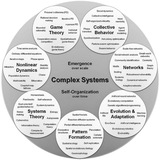
🎯 Interested in #complexity and cellular automata?
Then some of Stephen Wolfram´s collected papers might be
of interest to you!
https://www.complexityexplorer.org/explore/resources/461-cellular-automata-and-complexity-collected-papers
Then some of Stephen Wolfram´s collected papers might be
of interest to you!
https://www.complexityexplorer.org/explore/resources/461-cellular-automata-and-complexity-collected-papers
📄 A biology journal that can teach physicists a lesson in peer review
Raymond E. Goldstein
https://arxiv.org/pdf/1612.00241v1
🔻This is a Commentary in Physics Today on the novel review process developed by the biology journal eLife, with the suggestion that it be adopted by physics journals.
Raymond E. Goldstein
https://arxiv.org/pdf/1612.00241v1
🔻This is a Commentary in Physics Today on the novel review process developed by the biology journal eLife, with the suggestion that it be adopted by physics journals.
📖 Phenomenological theory of collective decision-making
Anna Zafeiris, Zsombor Koman, Enys Mones, Tamás Vicsek
https://arxiv.org/pdf/1612.00071v1
🔗 ABSTRACT
An essential task of groups is to provide efficient solutions for the complex problems they face. Indeed, considerable efforts have been devoted to the question of collective decision-making related to problems involving a single dominant feature. Here we introduce a quantitative formalism for finding the optimal distribution of the group members' competences in the more typical case when the underlying problem is complex, i.e., multidimensional. Thus, we consider teams that are aiming at obtaining the best possible answer to a problem having a number of independent sub-problems. Our approach is based on a generic scheme for the process of evaluating the proposed solutions (i.e., negotiation). We demonstrate that the best performing groups have at least one specialist for each sub-problem -- but a far less intuitive result is that finding the optimal solution by the interacting group members requires that the specialists also have some insight into the sub-problems beyond their unique field(s). We present empirical results obtained by using a large-scale database of citations being in good agreement with the above theory. The framework we have developed can easily be adapted to a variety of realistic situations since taking into account the weights of the sub-problems, the opinions or the relations of the group is straightforward. Consequently, our method can be used in several contexts, especially when the optimal composition of a group of decision-makers is designed.
Subjects: #Physics and #Society (physics.soc-ph); Social and #Information #Networks
Anna Zafeiris, Zsombor Koman, Enys Mones, Tamás Vicsek
https://arxiv.org/pdf/1612.00071v1
🔗 ABSTRACT
An essential task of groups is to provide efficient solutions for the complex problems they face. Indeed, considerable efforts have been devoted to the question of collective decision-making related to problems involving a single dominant feature. Here we introduce a quantitative formalism for finding the optimal distribution of the group members' competences in the more typical case when the underlying problem is complex, i.e., multidimensional. Thus, we consider teams that are aiming at obtaining the best possible answer to a problem having a number of independent sub-problems. Our approach is based on a generic scheme for the process of evaluating the proposed solutions (i.e., negotiation). We demonstrate that the best performing groups have at least one specialist for each sub-problem -- but a far less intuitive result is that finding the optimal solution by the interacting group members requires that the specialists also have some insight into the sub-problems beyond their unique field(s). We present empirical results obtained by using a large-scale database of citations being in good agreement with the above theory. The framework we have developed can easily be adapted to a variety of realistic situations since taking into account the weights of the sub-problems, the opinions or the relations of the group is straightforward. Consequently, our method can be used in several contexts, especially when the optimal composition of a group of decision-makers is designed.
Subjects: #Physics and #Society (physics.soc-ph); Social and #Information #Networks
📽 Algorithms for Big Data (COMPSCI 229r)
Harvard University
https://www.youtube.com/playlist?list=PL2SOU6wwxB0v1kQTpqpuu5kEJo2i-iUyf
Harvard University
https://www.youtube.com/playlist?list=PL2SOU6wwxB0v1kQTpqpuu5kEJo2i-iUyf
🎯 Eye-catching visualization of chaotic flow on the Lorenz attractor, using the power of #GPU.
http://rickyreusser.com/demos/lorenz/
http://rickyreusser.com/demos/lorenz/
Rickyreusser
lorenz
Computing the lorenz attractor on the GPU
🎯 Samuel Arbesman on #Complex_Adaptive_Systems and the Difference between #Biological and #Physics Based Thinking
https://www.farnamstreetblog.com/2016/11/samuel-arbesman-biological-physics-thinking/?utm_source=twitter.com&utm_medium=social&utm_campaign=buffer&utm_content=bufferb2052
https://www.farnamstreetblog.com/2016/11/samuel-arbesman-biological-physics-thinking/?utm_source=twitter.com&utm_medium=social&utm_campaign=buffer&utm_content=bufferb2052
Farnam Street
Samuel Arbesman on Complex Adaptive Systems and the Difference between Biological and Physics Based Thinking
Knowledge Project and Shane Parrish. Samuel Arbesman (@arbesman) is a complexity scientist focusing on the nature of scientific and technological change.
👆 Live streaming video of the whole workshop here:
https://t.co/alDffhTQRW
Right now: Prakash Panagaden on "semantics for physicists".
https://t.co/alDffhTQRW
Right now: Prakash Panagaden on "semantics for physicists".
YouTube
Simons Institute - Live Stream
The Simons Institute for the Theory of Computing aims to promote fundamental research on the foundations of computer science, as well as to expand the horizo...
🎯 Winter school @UniofGreenwich in London 16-20 Jan. Courses on networks and big-data:
https://showtime.gre.ac.uk/index.php/business/CBNAAS17/schedConf/program
https://showtime.gre.ac.uk/index.php/business/CBNAAS17/schedConf/program
showtime.gre.ac.uk
Programme
Business School conferences
🎯 Stealing Reality: When Criminals Become Data Scientists (or Vice Versa)
http://web.media.mit.edu/~yanival/IEEE_Intelligent_Systems.pdf
http://web.media.mit.edu/~yanival/IEEE_Intelligent_Systems.pdf
📄 #Complexity and #Philosophy
Francis Heylighen, Paul Cilliers, Carlos Gershenson
(Submitted on 19 Apr 2006)
https://arxiv.org/pdf/cs/0604072v1
📌 ABSTRACT
The science of complexity is based on a new way of thinking that stands in sharp contrast to the philosophy underlying Newtonian science, which is based on reductionism, determinism, and objective knowledge. This paper reviews the historical development of this new world view, focusing on its philosophical foundations. Determinism was challenged by quantum mechanics and chaos theory. Systems theory replaced reductionism by a scientifically based holism. Cybernetics and postmodern social science showed that knowledge is intrinsically subjective. These developments are being integrated under the header of "complexity science". Its central paradigm is the multi-agent system. Agents are intrinsically subjective and uncertain about their environment and future, but out of their local interactions, a global organization emerges. Although different philosophers, and in particular the postmodernists, have voiced similar ideas, the paradigm of complexity still needs to be fully assimilated by philosophy. This will throw a new light on old philosophical issues such as relativism, ethics and the role of the subject.
Francis Heylighen, Paul Cilliers, Carlos Gershenson
(Submitted on 19 Apr 2006)
https://arxiv.org/pdf/cs/0604072v1
📌 ABSTRACT
The science of complexity is based on a new way of thinking that stands in sharp contrast to the philosophy underlying Newtonian science, which is based on reductionism, determinism, and objective knowledge. This paper reviews the historical development of this new world view, focusing on its philosophical foundations. Determinism was challenged by quantum mechanics and chaos theory. Systems theory replaced reductionism by a scientifically based holism. Cybernetics and postmodern social science showed that knowledge is intrinsically subjective. These developments are being integrated under the header of "complexity science". Its central paradigm is the multi-agent system. Agents are intrinsically subjective and uncertain about their environment and future, but out of their local interactions, a global organization emerges. Although different philosophers, and in particular the postmodernists, have voiced similar ideas, the paradigm of complexity still needs to be fully assimilated by philosophy. This will throw a new light on old philosophical issues such as relativism, ethics and the role of the subject.