Forwarded from Hyperborean Radio (Uncensored)
Yuletide & The Good Women
In German Folklore and across Europe there is tell especially at Yuletide of Female Spirits coming house to house in a procession of the dead. These spirits were often ancestors though they would appear in the form of Weisse Frauen or through Christian Eyes devils. This is especially noted in the example of the Good Women who would go door to door receiving feasts as offerings to the dead and consuming the spirit of the food before the living would eat the physical side. The Good Women were also said to weave fate for new borns and spinning tools were left out for the Good Women to spin fate for the newborn. While similar to the Norns these spirits are specifically mentioned as ancestors, though the Church via a tale of St. Germanicus is said to have "Exposed" them as demons. In a Hagiography intended to vilify this widespread pagan custom. A similar honoring of Feminine Ancestors can be seen in the Norse Disir Blot.-TLK
In German Folklore and across Europe there is tell especially at Yuletide of Female Spirits coming house to house in a procession of the dead. These spirits were often ancestors though they would appear in the form of Weisse Frauen or through Christian Eyes devils. This is especially noted in the example of the Good Women who would go door to door receiving feasts as offerings to the dead and consuming the spirit of the food before the living would eat the physical side. The Good Women were also said to weave fate for new borns and spinning tools were left out for the Good Women to spin fate for the newborn. While similar to the Norns these spirits are specifically mentioned as ancestors, though the Church via a tale of St. Germanicus is said to have "Exposed" them as demons. In a Hagiography intended to vilify this widespread pagan custom. A similar honoring of Feminine Ancestors can be seen in the Norse Disir Blot.-TLK
Forwarded from Æhtemen
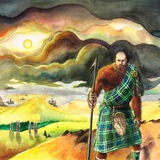
Winter is often personified as an old man. In Icelandic and Nordic myth – this was the giant Þorri (Thorri) who was the son of the Snær (English 'Snow') – himself the son of Frosti (Frost). They all descended from the Eoten Fornjót, whom the English called Fornete. Þorri is still remembered in the Icelandic winter festival of Þorrablót.
(Artwork 'Winter' by Malcolm Brown)
(Artwork 'Winter' by Malcolm Brown)
Olentzero, the Basque Father Christmas
With ties to pre-christian Basque Yule culture, and dressed like a farmer, or fieldhand, Olentzero visits households during the Yule season in the same capacity of Father Christmas.
The first written tale of Olentzero comes from Lope de Isasi in the 16th century. In his account, he is called "Onentzaro," and tells of an era thousands of years ago with a tribe of jentilak (giants in Basque mythology) to which Olentzero belonged.
His name originates from the merging of two words that are used in the Basque language. The first word 'Olesen' is comes from folk songs and means to 'call' or 'ask' and the term 'aroa' translates as ‘clear’, 'time' or 'season'.
With ties to pre-christian Basque Yule culture, and dressed like a farmer, or fieldhand, Olentzero visits households during the Yule season in the same capacity of Father Christmas.
The first written tale of Olentzero comes from Lope de Isasi in the 16th century. In his account, he is called "Onentzaro," and tells of an era thousands of years ago with a tribe of jentilak (giants in Basque mythology) to which Olentzero belonged.
His name originates from the merging of two words that are used in the Basque language. The first word 'Olesen' is comes from folk songs and means to 'call' or 'ask' and the term 'aroa' translates as ‘clear’, 'time' or 'season'.
Usually with blue pants and a bruxa, txapela and sometimes a sheepskin cape, Olentzero is often depicted as smoking a pipe with a dirty face because he is a charcoal maker.
Today we know the Olentzero as a legendary winter figure that fills a similar role to Santa Claus, mostly due to the christianization of pagan custom but he takes his name from an elder custom.
For Basques of old, this was the season of visitations from house to house, imitating the generous Olentzero during the Yuletide season.
This custom is still celebrated in some Basque villages as the youth go from house to house, dancing and singing, collecting food or money to prepare a special meal. In some areas of Spain, Olentzero effigies are burned as per the local traditions, which is a very heathen custom indeed.
Today we know the Olentzero as a legendary winter figure that fills a similar role to Santa Claus, mostly due to the christianization of pagan custom but he takes his name from an elder custom.
For Basques of old, this was the season of visitations from house to house, imitating the generous Olentzero during the Yuletide season.
This custom is still celebrated in some Basque villages as the youth go from house to house, dancing and singing, collecting food or money to prepare a special meal. In some areas of Spain, Olentzero effigies are burned as per the local traditions, which is a very heathen custom indeed.
Forwarded from Hyperborean Radio (Uncensored)
The Mari Lwyd Part 1
The Mari Lwyd is a ghastly Christmas Horse, a continuation of Hobby Horse and Wassailing traditions of the Welsh, likely since pre-christian times. The Mari Lwyd likely translates to “Grey mare” and while the origins of the tradition similar to that of Krampus are shrouded in mystery, and the Mari Lwyd tradition almost died out in the early 1900's especially after the world wars. The tradition has seen a revival in recent years. Becoming so popular that is has spread out from the Twelfths and the Welsh New Year “Hen Galan” into other celebrations such as Midsummer and Samhain. The latter of which it is theorized is where the tradition may have originated. The Mari Lwyd is the skull of a horse typically buried and allowed to rot before the skull is retrieved.
The Mari Lwyd is a ghastly Christmas Horse, a continuation of Hobby Horse and Wassailing traditions of the Welsh, likely since pre-christian times. The Mari Lwyd likely translates to “Grey mare” and while the origins of the tradition similar to that of Krampus are shrouded in mystery, and the Mari Lwyd tradition almost died out in the early 1900's especially after the world wars. The tradition has seen a revival in recent years. Becoming so popular that is has spread out from the Twelfths and the Welsh New Year “Hen Galan” into other celebrations such as Midsummer and Samhain. The latter of which it is theorized is where the tradition may have originated. The Mari Lwyd is the skull of a horse typically buried and allowed to rot before the skull is retrieved.
A Wassail bowl from 1910 in the Museum of Wales.
Wassail the drink was based on hot ale with often lambswool (fluffy inside of baked apple) filled with sugar, fruit, spices and beer and carried from door to door on New Year’s Day or Twelfth Night.
The ancient New Year practice of wassailing was practiced in Glamorgan Wales, when parties would progress from house to house with traditional greetings for the health and prosperity of the inhabitants, which were acknowledged with spiced ale, dispensed in a wassail bowl carried round by the party.
Wassail the drink was based on hot ale with often lambswool (fluffy inside of baked apple) filled with sugar, fruit, spices and beer and carried from door to door on New Year’s Day or Twelfth Night.
The ancient New Year practice of wassailing was practiced in Glamorgan Wales, when parties would progress from house to house with traditional greetings for the health and prosperity of the inhabitants, which were acknowledged with spiced ale, dispensed in a wassail bowl carried round by the party.
Gruß vom Krampus (Greetings from the Krampus) on this Krampusnacht!